A man in a plaid shirt poses for a photo.

Warren Johnson, Class of '26: Mathematics major balances parenthood and academic success

By Hannah Ashton

When Warren Johnson goes home after a long day on campus studying the beauty of mathematics, his routine looks unlike most college seniors.

Instead of roommates and late nights, his days end with giggles and family time. Johnson is married to his wife Elizabeth, and together they have a 2-year-old daughter, Naomi, with a son on the way this summer. He is also a transfer student from Linn-Benton Community College, already working on his accelerated master’s degree and a top scorer in the William Lowell Putnam Mathematical Competition, one of the most difficult undergraduate math exams in North America.

For Johnson, mathematics is not only a passion. It’s a tool to build a meaningful life and provide for his family.

“If you want it hard enough, it’s possible. Being in college, you’re not always confident it’s going to work out, but I’ve been able to push and God’s helped me, Elizabeth’s helped me,” he said. “It’s been awesome. I’ve been able to skip courses to help fit a better timeline for my family.”

A winding path

Born in Utah and raised in Lebanon, Oregon, Johnson was homeschooled for much of his early education before attending Lebanon High School. He initially believed he struggled with math until realizing his mom was giving him more advanced content than typical for his age.

“I realized I could handle it,” he said. “And I actually enjoyed it.”

That enjoyment deepened when Johnson dove into calculus, and math began to feel less like repetition and more like exploration and connecting to the real world.

“That’s when I could first say math became beautiful,” Johnson said. “You realize there are many ways to solve a problem, and some of them are just elegant.”

Through Linn-Benton Community College (LBCC), he began college coursework while still in high school and eventually completed his associate degree there before transferring to Oregon State.


A man and woman pose for a photo with a young child.

Johnson and his wife and daughter stand outside a temple for their church, just before his sister comes out of the doors with her (newly married) husband.

Starting at a community college was a practical decision shaped by cost, proximity and family ties in the area. “It was a great local option,” he said. “Cost-effective, and I like the instructors.”

That path also meant he arrived at Oregon State already accustomed to college-level work and with easily transferable course credits.

“The curriculum at LBCC is built to transfer to OSU,” he said. “That made the process really smooth.”

Family & faith at the center

Being married and having kids was always part of Johnson’s plan. He grew up in a very family-oriented home and having children while going to college was normal. He married his wife, Elizabeth, in 2023 during his time at LBCC and they had their daughter in 2024.

“Making sure you are home in time for dinner and having time for kids is extra time on your day, but it’s more fulfilling,” he said. “I don’t feel like I’ve lost anything, and it keeps me grounded.”

To stay on top of everything, Johnson recommends planning ahead and also personally relies on his faith. As a member of The Church of Jesus Christ of Latter-day Saints, he served a two-year mission in Texas that shaped how he understands people, communication and purpose.

Faith is not separate from his academic life, but something that helps inform it.

“God has supported me through all of this,” he said. “I grew up in the religion I’m in but it’s also been a journey to think and feel what I believe in.”

That balance of family, faith and focus also shaped how he approached his academic career.

A woman poses for a photo with a young girl sitting on a miniature horse.

While Johnson was at a mathematics conference, his wife and daughter explored Utah, including visiting a petting zoo.

Tackling the most challenging undergraduate math competition

While at LBCC Mathematics Professor Nicole Seaders, who got her masters and Ph.D. from Oregon State, told Johnson he should participate in the William Lowell Putnam Mathematical Competition.

The competition is the world’s leading university-level mathematics evaluation. Each December, thousands of mathematics students from hundreds of colleges and universities compete to win top honors. It consists of two three-hour sessions where students solve 12 challenging, proof-based problems.

Although the max score is 120 points, it is famously difficult with a median score of zero or one and an average score that ranges from 8 to 13. In 2024, only 32% of participants scored 10 or more points.

“The problems are not the kind of math questions you will see in class,” Johnson said. “They require you to combine information and they require extreme creativity to solve the problems.”

Definitely an intimidating undertaking — but Johnson was excited to try. In his first try, he scored 3 and understandably celebrated. The following year, he scored 15.

In addition to improving his grad school application, he took the test because they were really cool questions. The OSU faculty who put on prep sessions cover types of mathematics Johnson had never been exposed to before.

Another opportunity he found at Oregon State was the URSA (Undergraduate Research, Scholarship and the Arts) Engage program. This program is designed to foster mentorship and provide hands-on research training early in a student's academic career.

Through URSA, Johnson was connected with Assistant Professor of Mathematics Philipp Kunde. Together, the pair did a research project revolving around a Lyapunov exponent. Named after a Russian mathematician and physicist in the late 1800’s, the exponent is a way to measure how sensitive a system is to small changes in its starting point.

For example, if you try to model weather on two different computers but one of them has a slightly different starting point, because of how weather functions, the simulations will evolve into something totally different, no matter how small the difference is at the start.

Johnson's project leaned more on the theoretical side of mathematics than the experimental — however, he did get to do a computer simulation for the first time.

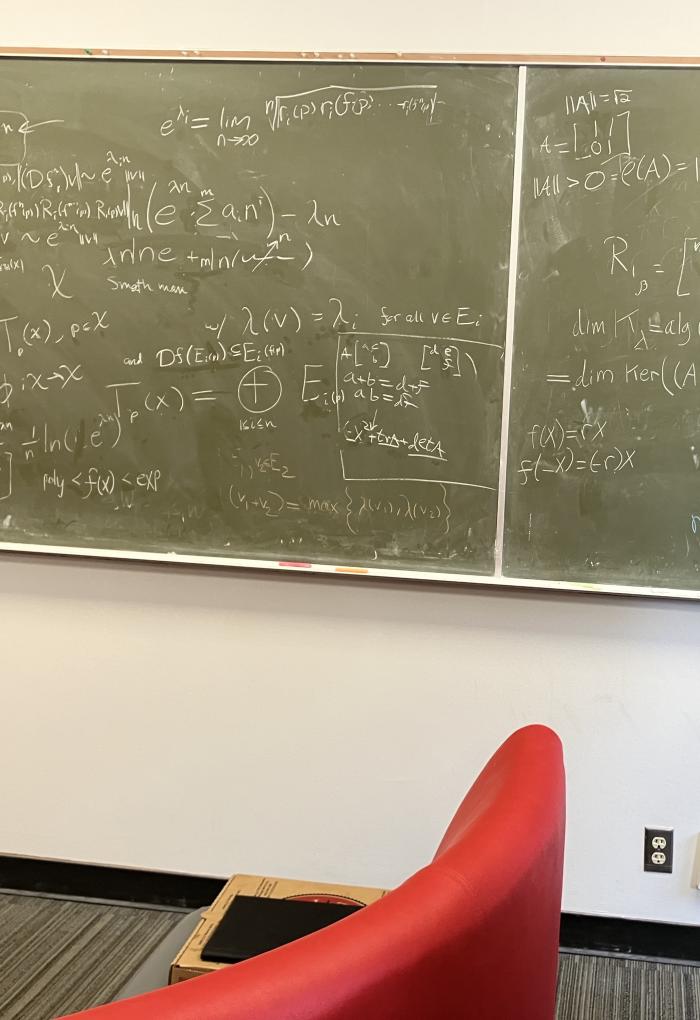
Mathematics equations on a blackboard.

During a conference Johnson attended in Utah, he learned about new research in the field of dynamics.

Finding connection through teaching

After graduating in June 2026, Johnson’s life won’t look drastically different. Thanks to the accelerated masters program, he started taking graduate level courses while he was still an undergraduate. This will help him finish an advanced degree sooner and hopefully secure a faculty position.

“I really enjoy it when someone has a question and they want to know why something works,” he said. “Whenever I’m successful at explaining something and the person goes, ‘Oh!’ I love that lightbulb moment. Maybe they will ask further questions and I can see how they took this idea and connected it and I can get a glimpse into their own creative thought process. I love that.”

He is excited to teach his own kids math but stresses that they don’t need to like it. He sees the beauty while also acknowledging it’s not everyone's cup of tea.

For him, mathematics and family life are not competing priorities by parts of the same picture. The same dedication that helps him work through abstract problems also shapes how he approaches fatherhood, faith and teaching. Whether he is proving a theorem, studying for class or spending time with his kids, he is drawn to the same outcome: understanding how something works and being able to share it with someone else.