Students

Students

Two students studying together in classroom

A summer of mathematical research

REU program in Mathematics at OSU

Ten students from universities and colleges across the country have gathered for the long-running and prestigious Research Experiences for Undergraduates (REU) Program in Mathematics at Oregon State University for summer 2017. OSU has offered a REU program in mathematics nearly every summer since 1987.

The eight-week program, co-directed by Associate Professors Holly Swisher and Clayton Petsche, has garnered high praise from alumni over the years. It has been commended for providing valuable mentorship and exposing students to the process of mathematical research as well as deepening their interest and passion for mathematics as a discipline and profession.

This year student research projects are directed by Oregon State mathematicians Nathan Gibson, Ren Guo, Yevgeniy Kovchegov, Juan Restrepo, and Mike Rosulek from the School of Electrical Engineering and Computer Science.

Students participating in the 2017 mathematics REU are: Jacqueline Alvarez (California State Polytechnic University, Pomona), Claire Campregher (California State University, Long Beach), Karina Cho (Harvey Mudd College), Andrew Fisher (Walla Walla University), Brian Frost-LaPlante (Cooper Union), Josh Gerstein (Carleton College), Jesse Johnson (Oregon State University), Jacob Naranjo (Kalamazoo College), Anna Raichev (University of California, San Diego), and Collin Victor (University of Nebraska).

The students are working on a broad array of mathematical projects in areas ranging from dynamic (time-varying) systems, classical geometry in Euclidean space, coalescent processes, uncertainty quantification, and cryptography.

The Mathematics REU at OSU has a stellar record in terms of student achievement and success. Almost 300 students have participated in this REU since 1987, and nearly 55 percent of its alumni from the years 2005-2013 have earned a graduate degree in the mathematical sciences. Female participation in the math REU has been consistently high, and data for a 10-year period (2005-2015) shows that nearly 47 percent of the REU participants were female.

After the term of their research is complete, REU students give talks and prepare research papers for publications. REU students and their faculty mentors at OSU have had considerable success in getting their papers accepted for publication at important mathematic research journals over the years.

Read more about the REU program in Mathematics at OSU and its achievements.

Calculus the musical logo with black and red heart and banner

Math Club hosts Calculus: The Musical for Pi Day

Calculus: The Musical

March 14 is Pi Day around the world, and if you love Pi(e), math and musicals, then the Department of Mathematics has a treat in store for you. The Math Club is sponsoring a special presentation of Calculus: The Musical!, a nationally touring production, on Tuesday, March 14, 2017, at 7:00 p.m. in Milam Hall 026. There will also be a pie reception starting at 6:15 p.m. in the foyer right outside of Milam 026. Everyone is welcome to attend the musical and indulge in their love of pi(e)!

This event is supported by the College of Science and the Department of Mathematics.

Calculus: The Musical! was originally created by Matheatre, composed of Marc Gutman and Sadie Bowman. The musical tells the historical story of the development of Calculus and features several scientists and mathematicians across eras who contributed to the development of modern calculus: Archimedes, Isaac Newton, Gottfried Leibniz among others.

Calculus the musical logo with black and red heart and banner

Calculus: The Musical official event poster

The musical is "a comic review of the concepts and history of calculus." According to its creators, the musical employs a mix of genres from light opera to hip hop to bring alive the concepts of limits, integration and differentiation. It promises to be entertaining to the "arithmophobe and the rocket scientist alike."

What makes Pi so special? Apart from the spirited contests over who can recite the more digits of pi (3.141592653...), pi is enthralling for other reasons. Pi, as we learned in school and memorized for the S.A.T.s, is the ratio of a circle’s circumference (the distance around the circle, represented by the letter C) to its diameter (the distance across the circle at its widest point, represented by the letter d). That ratio, which is about 3.14, also appears in the formula for the area inside the circle, A = πr2, where π is the Greek letter “pi” and r is the circle’s radius (the distance from center to rim).

According to mathematician Steven Strogratz (writing in The New Yorker), the beauty of pi can be attributed to a few factors: 1. Pi puts infinity within reach. The digits of pi never end and never show a pattern.They go on forever, seemingly at random—except that they can’t possibly be random, because they embody the order inherent in a perfect circle. This tension between order and randomness is one of the most tantalizing aspects of pi.

2.What distinguishes pi from all other numbers is its connection to cycles. For those interested in the applications of mathematics to the real world, this makes pi indispensable. Through the Fourier series, pi appears in the math that describes the gentle breathing of a baby and the circadian rhythms of sleep and wakefulness that govern our bodies. When structural engineers need to design buildings to withstand earthquakes, pi always shows up in their calculations. Pi is inescapable because cycles are the temporal cousins of circles; they are to time as circles are to space. Pi is at the heart of both.

Whether you love the mysteries of pi or not, don't miss this unique chance to celebrate the spirit and awesomeness of math!


Read more stories about: events, students, mathematics, art and science


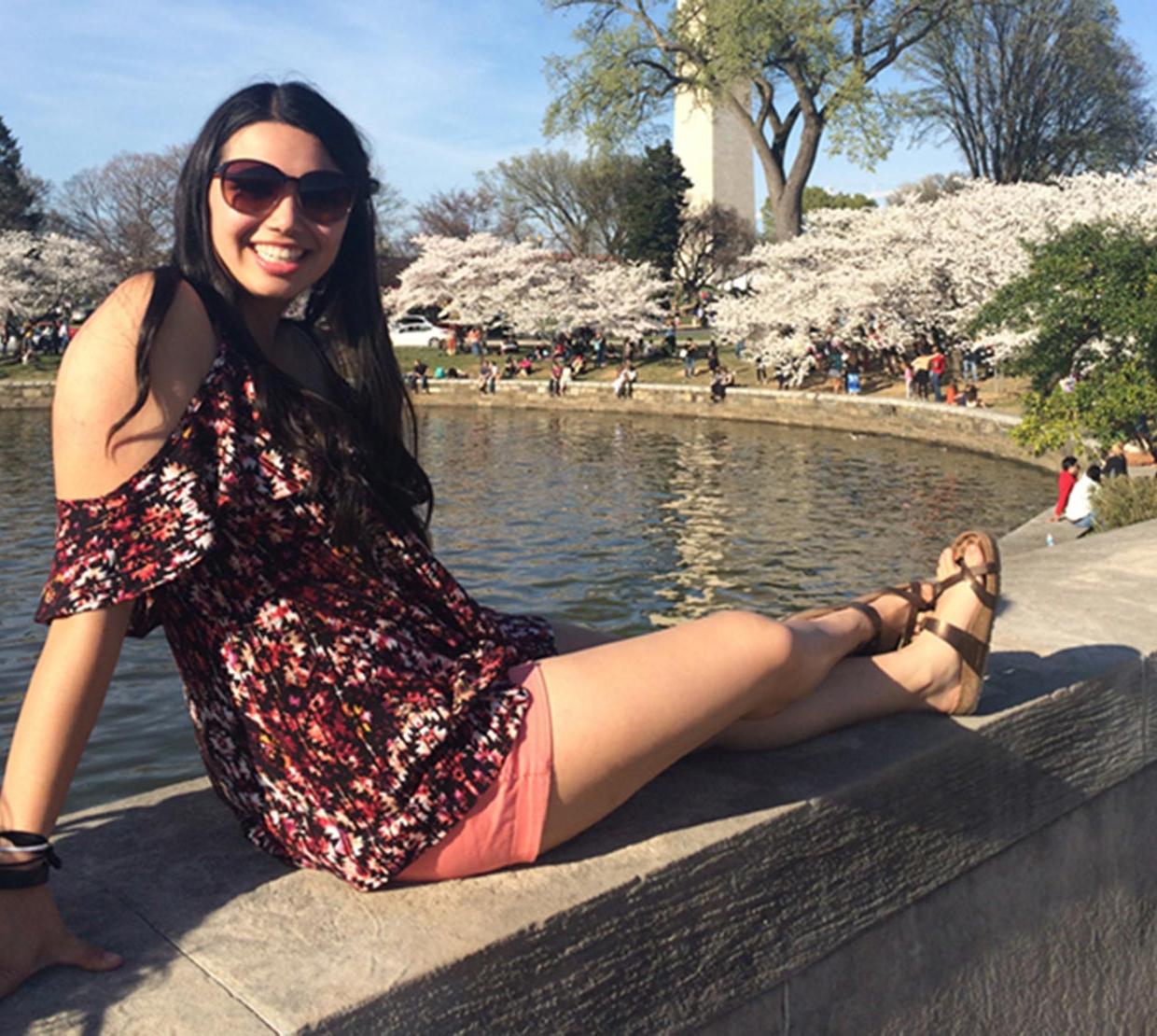
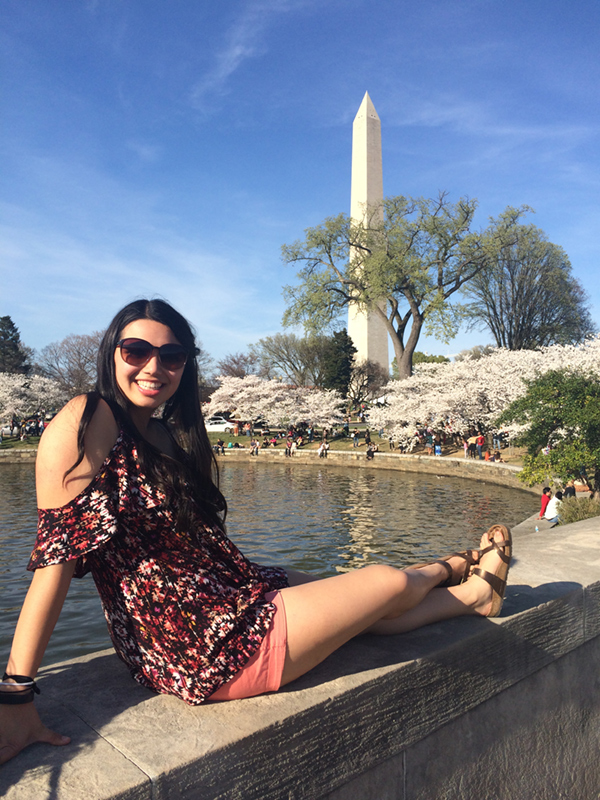
Josey Atsuko Sechrist sitting on fountain ledge

Science students receive more than $2 million in scholarships

By Srila Nayak

Josey Atsuko Sechrist, math major

The College of Science awarded more than $700,000 in scholarships and awards to 275 current science students for merit, need and undergraduate research experiences for the 2015-16 academic year. The university awarded $1.43 million to 403 incoming freshmen in the College of Science. In aggregate, 678 science students received more than $2.16 million in scholarship awards.

The distinguished and highly competitive Oregon State University Presidential Scholarships were awarded to outstanding Oregon high school seniors who will join OSU as freshmen in the College of Science in 2015-2016. Each of the 10 science students received an award amount of $10,000 per year (up to four years). The scholarships are made possible by the generous philanthropic support of alumni and friends.

Scholarships enable the College to attract, retain and inspire top students, most of whom go on to high achieving careers in industry, graduate school, medical school and other professional programs after graduation. Oregon State’s financial need-based scholarships also help academically talented low-income and first-generation students from Oregon and elsewhere stay and excel in college.

According to an article in the Chronicle of Higher Education last month, money is a constant worry for low-income students, whose parents can’t cover most college expenses. According to University of Michigan sociology professor Dwight Lang, loans and significant debt are inevitable but reduced with scholarship support. Summer vacations, he worries, are often spent working for wages instead of in unpaid internships that would significantly enhance a student’s "cultural capital."

First-generation college students typically have more financial need so scholarships play an ever-important part of their education equation. In the College of Science, the number of first-generation college students has risen from 20% to 29% in the last three years. Many of these science students are high achieving.

Many scholarship students in the College attest to the value of scholarships in easing the financial burden on their families and enabling them to focus on academics, research, enriching volunteer activities and post-college career goals. Scholarships help offset in-state tuition for three terms of $10,000 and the additional $16,300 for room and board as well as fees and books.

Junior Collin Nicholas Muniz from Portland, Oregon, has a voracious appetite for science. A double major in chemistry and physics with a minor in mathematics, Muniz’s conversation is a polyvalent encyclopedia of references to earth metals, isostructures, the De Broglie wavelength and multivariate equations.

However, after his NASA space grant scholarship ended, Muniz worried about how he would finance his education at Oregon State until he learned he had been awarded multiple scholarships by the College of Science for the following academic year, totaling $11,500. In addition, he has also won a $3,500 university-level diversity scholarship.

“If I hadn’t gotten the scholarships, I would have struggled tremendously academically. I have a position on campus for $10 an hour and I was planning to increase my work hours and that would have taken me away from my studies,” said Muniz.

Muniz received the Merrill Family Foundation, the Sally Runes-Hicks and Jerry Raymond Alexander scholarships. The Merrill scholarships are awarded annually to promising junior and senior science students who demonstrate high scholarship, community services and leadership. The Sally Runes-Hicks and Jerry Raymond Alexander scholarships support exceptional science students who also demonstrate financial need.

“I am extremely proud of our exceptional science students who will use the scholarships to shape their scientific careers at OSU and beyond.” said College of Science Dean Sastry G. Pantula. “Scholarships matter. The support not only makes a science education possible, it also can spare students from excessive debt. Scholarships allow our students to pursue graduate and professional schools, engage in public service, gain beneficial research experience, and follow their professional passions, all of which enable them to contribute significantly to our communities and the world.”

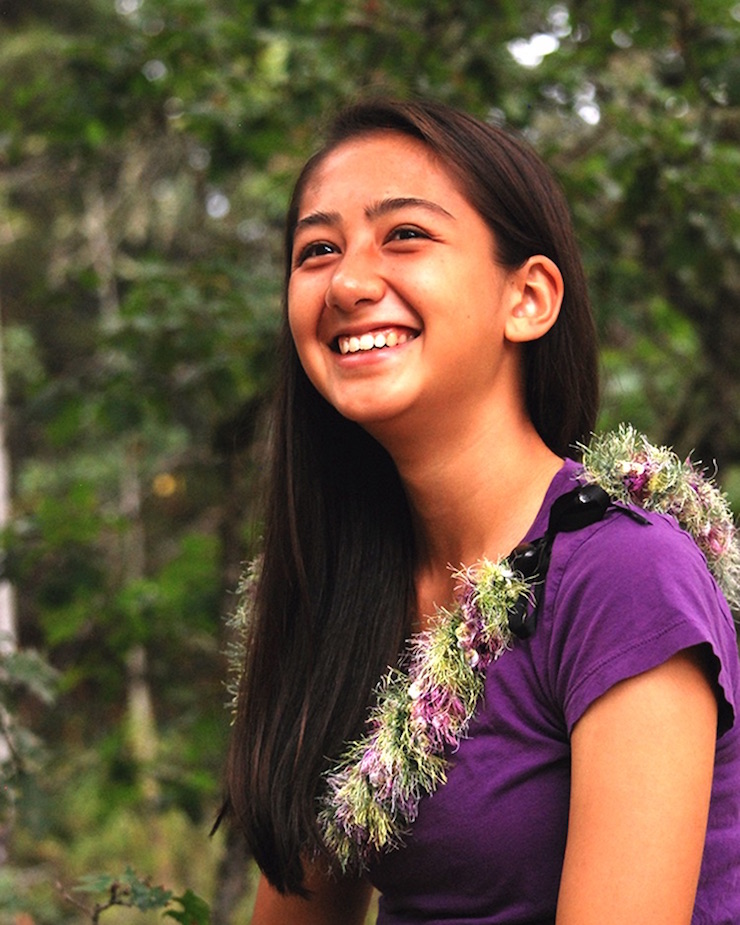
Biology sophomore Lorraine “Mamo” Waianuhea was ready for more research after she was introduced to it last year thanks to the university’s STEM Leaders Program. This summer Waianuhea, who is part-Hawaiian and a straight-A student, has dived into full-time research in a biology lab after winning a SURE Science scholarship.

Twenty-four students were awarded SURE Science scholarships for a maximum amount of $5,000 for 11 weeks to focus full time on contributing to impactful and socially beneficial research in the natural and physical sciences. With strong philanthropic support, the program is able to fund students so they can participate in summer research opportunities that can foster meaningful, scholarly connections with faculty mentors early in their academic careers and define their professional career path.

With the guidance of her faculty advisor, Waianuhea designed a proposal to investigate how nutrient availability affects the growth of host cells in sea-anemones and the efficiency of algal populations of host cells. She hopes to work in the area of conservation biology after she graduates.

“I am really grateful for the opportunity to continue research. It is a great opportunity to see how working in the lab full time would be like. I already feel like I have learned a lot and it has only been two weeks,” said Waianuhea.

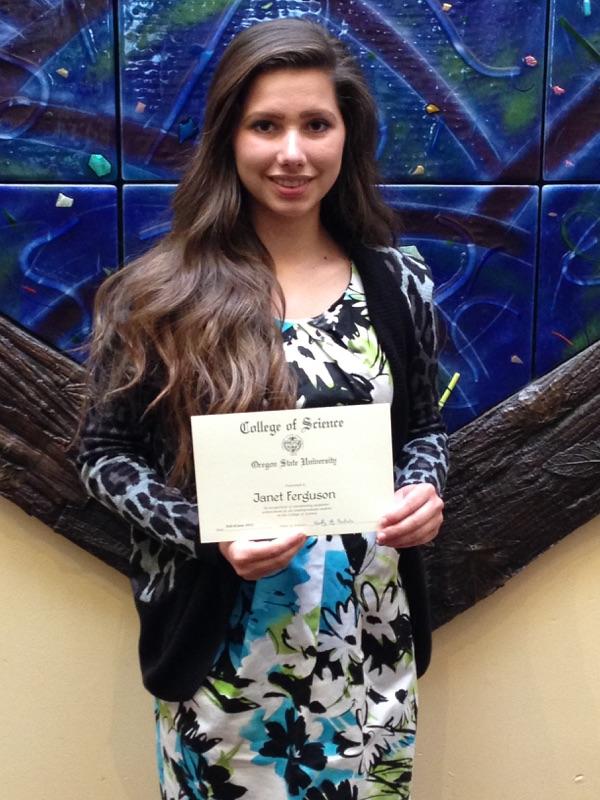
Another student, Janet “Lena” Ferguson, who is the daughter of a disabled Vietnam War veteran from Dallas, Oregon, is a junior chemistry major who had set her sights on Oregon State since she was in middle school. This year she won the $7,000 Fred and Mary Brauti Pre-Medical Scholarship as well as a $2,400 Merrill Scholarship.

Although she hasn’t yet traveled outside Oregon, Ferguson dreams of becoming a doctor for the navy or a dive doctor and wants to work in Guam or Puerto Rico. This summer she is traveling to Nicaragua with Global Medical Brigades to assist with dental and public health rotations and get her first taste of medicine.

“Because my dad is a veteran, I get benefits through the GI bill. But I didn’t realize how expensive universities are. These scholarships are amazing. I am so thankful to the donors. The scholarships are going to help me pay for pretty much everything—housing, food, fees and books."

“I can focus on school now,” said Ferguson, who had a job in Safeway’s floral department. By focusing on her studies, she can stay on track for graduation

BioHealth Sciences sophomore and San Francisco native, Joe Kenneth Li was awarded the prestigious $6,000 Wei Family Private Foundation Scholarship by the College of Science as well as a Provost’s Scholarship for 2015-2016.

The Wei scholarship honors the memory of Dr. Chung Kwai Lui Wei who arrived in the United States as an exchange student from China in 1936. Dr. Wei, a renowned physicist who worked on the Manhattan Project, was the first woman to receive a Ph.D. from Oregon State.

Li was drawn to the OSU by the reputation of its pre-pharmacy program and points out that OSU is one of the few reputed universities on the West coast that offers a major in pharmacy.

“I am really thankful for the scholarship because it does impact my tuition and helps my family since I pay higher out-of-state tuition. It feels great knowing the scholarship committee recognized my application out of so many applicants. I feel very honored to be one of the recipients,” said Li.

A $5,000 Anne Runes-Wilson Scholarship and a $1,000 mathematics scholarship have further strengthened senior Josey Atsuko Sechrist’s belief that she made the right choice in switching her major to mathematics at OSU.

The daughter of an American father and a Japanese mother, the multi-faceted Sechrist has also won the US Department of State’s Benjamin A. Gilman Scholarship to pursue Spanish language classes at the University of Grenada and the University of Oviedo. Upon her return, Sechrist, who is pursuing a minor in Spanish, will share her experiences about music and culture in Spain on KBVR, OSU’s radio station, where she hosts a show every week.

“If I hadn’t come to OSU, I would have gone to a small school that didn’t have a very good math department. Getting scholarships has helped me stay in the great mathematics department at OSU,” said Sechrist, who is a native of Vancouver, Washington.

Sechrist is passionate about improving the current standards of mathematics education in the United States. She wants to work on mathematics curriculum innovation and teach the subject to middle and high school students. Sechrist’s undergraduate thesis is on the experience of teaching mathematics to English language learners.

“Our scholarships empower exceptional students like Josey and many others to make powerful and positive changes in our society, both locally and globally." The scholarships also enhance the diversity of the Oregon State science community and help our students pursue impactful research and educational opportunities,” said Dean Pantula.

The payoff is tremendous for a science degree. According to a recent salary report by Georgetown University's Center on Education and the Workforce, all but two of the 25 highest-paying majors are in science, technology, engineering or mathematics fields.

Emerald Stacy in front of shrubbery

Math student nabs top graduate teaching assistant award

By Debbie Farris

Emerald Stacy, mathematics graduate student

Ten years after graduating from college with an undergraduate degree in math, Emerald Stacy was the owner of a bead-making business while also was running a coffee shop. She never imagined she would be pursuing a PhD in mathematics and researching number theory.

Her thunderbolt moment occurred while she was vacationing in Italy. While exploring the wonders of Italian Renaissance art in Florence, she was struck by a certain emptiness and boredom in her life. She wanted to do something more, something big, something more fulfilling.

Stacy recalled thinking, “I can do anything. I have a math degree!” She wanted to be driven by a passion and to be really good at something.

Math has always been part of Stacy’s life. She took her very first math class at the age of five at OSU and had her first math tutoring job at the age of 10. Her favorite book as a 13-year old was A Mathematician’s Apology, a 1940 essay by British mathematician G. H. Hardy. It explores the aesthetics of mathematics weaving in personal information, giving non-mathematicians insight into the mind of a working mathematician as well as the pleasure and power of mathematical invention.

After returning home to Olympia, Wash., she made up her mind to pursue a master’s degree in mathematics at Oregon State University. Stacy is no stranger to math, teaching and Corvallis: She was born in Corvallis and her father was an instructor in OSU’s Department of Mathematics as well as chair of the math department at Bellevue College in Washington state. Her father’s teaching philosophy guides her own teaching.

“My dad always said ‘Students learn math by doing it, not by watching others do it’ and ‘You can’t tell a student that something is hard or easy because it is not true for every student.’ I think about that all the time.”

Heading into the fourth year of her graduate program, Stacy has exceled as a graduate teaching assistant, helping hundreds of students tackle math at OSU.

Recently Stacy has been recognized for her teaching excellence: she has received OSU’s 2015 Herbert F. Frolander Award for Outstanding Graduate Teaching Assistant. The award recognizes OSU graduate teaching assistants with outstanding teaching and professional involvement with both faculty and students. The awardee is honored at University Day in September with a plaque and also receives $1,000 in funding.

"Life is riddled with unexpected obstacles,” asserts Stacy. “What is most important is what you do afterward. I teach my students that they can pull their socks up after a rough midterm, face the material they didn't understand and rise to meet the next challenge."

"For me this award is an indicator that after spending my twenties trying to pull my socks up, I was able to meet graduate school head on," said Stacy.

Stacy is committed to helping female students succeed and shrinking the gender gap in math. Her mentor is Associate Math Professor Holly Swisher, from whom she has drawn tremendous inspiration.

“She is so vivacious and relatable,” said Stacy. “Holly is a great teacher and role model for female mathematicians.”

Swisher has high praises for the aspiring mathematician:

"Emerald is a passionate graduate student with a tenacious and lively approach to mathematics. She applies her positive attitude and sense of humor to her teaching, her studies, and to any challenge she encounters. She's an inspiration to her students!"

Female mathematicians are a rare breed.

“Despite significant improvements over the last few generations, the discipline of mathematics still counts a disproportionately small number of women among its practitioners, which cause us (on average) to perceive and treat women and men differently and unfairly,” writes Greg Martin, Professor of Mathematics at the University of British Columbia in a recent paper.

Martin asserts that these mutually reinforcing biases begin in elementary school, remain through university study and continue to challenge women's careers in terms of hiring, evaluation, awards and inclusion in journal editorial boards and conference committees. He favors discussing in detail the biases against women in mathematics in order to create greater awareness in hopes of mitigating them.

“I think there is an underestimation of women in math,” suggests Stacy. “ Fortunately I only experienced one instance where I felt discounted in the field of mathematics. But it was addressed and resolved.”

Stacy was encouraged by the 50% of women in her cohort at OSU. In 2014, the Association for Women in Mathematics reported that 43% of undergraduate math majors are women and 28% of new math PhDs are women. Only 12% of tenured math faculty at PhD-granting universities are women.

Stacy noticed an interesting trend within her cohort after passing her qualifying exams recently: although 50% of her cohort are women, just half of those who registered for the exams actually showed up to take them. In contrast, all of the men in her cohort showed up for the exams. In fall 2013, just one of eight people who passed qualifying exams in the Mathematics department was female. In 2014, the exam was split into two parts and although 12 parts were passed, just two parts were passed by women.

Stacy is still reflecting on what factors might have influenced her female colleagues intent on taking the qualifying exams change course. Since beginning her graduate program in math 2012, Stacy has remained undaunted, finding power in her own mathematical journey.


Read more stories about: students, mathematics, awards & recognition


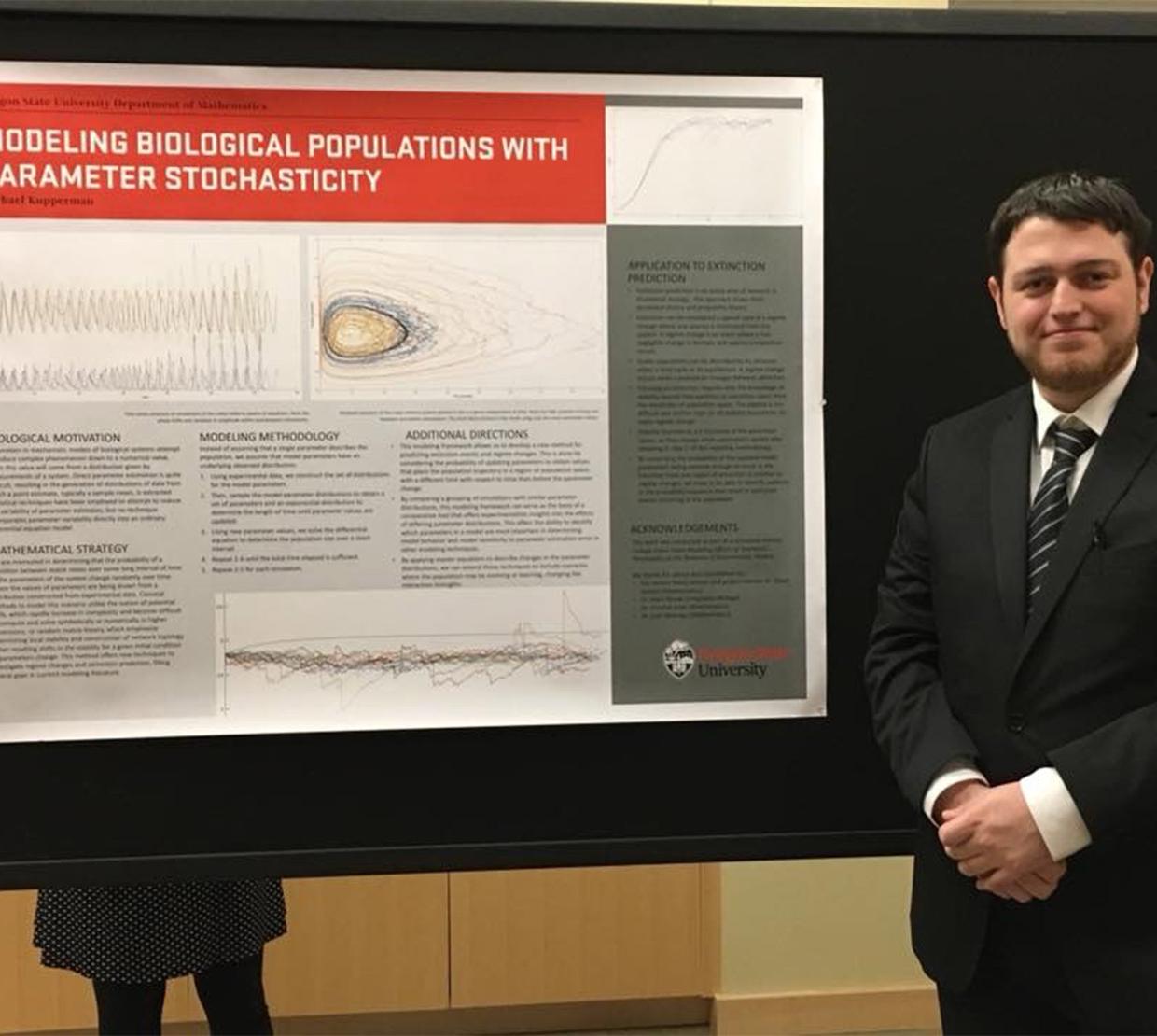
Michael Kupperman in front of his research poster

Prestigious research internship opens new possibilities for double-major science student

By Martha Wagner

Michael Kupperman, honors senior in mathematics and biology double-major

Senior Michael Kupperman loves to do research at the crossroads of mathematics and biology a deep interest the Honors student has explored as a double-major in the College of Science and in a prestigious summer internship.

Kupperman will graduate in June with honors degrees in mathematics and biochemistry and minors in chemistry and history. With his strong background in science, technology, engineering and mathematics (STEM) coursework beginning in his freshman year, it’s not too surprising that he was among the 20 percent of applicants accepted for a Science Undergraduate Laboratory Internship (SULI) at Los Alamos National Laboratory (LANL) in Los Alamos, New Mexico, last summer.

A mathematical biologist, Kupperman is also the only Accelerated Master’s Platform (AMP) student in mathematics this academic year. He’s a member of the University Honors College, an OSU presidential scholar, and he completed his honors thesis in mathematics in his third year. In February 2019, he teamed up with two other OSU undergrad math students to produce a solution to an optimization problem for the annual COMAP (Consortium for Mathematics and Its Applications) Mathematical Contest in Modeling, a solution that had to be completed within 97 hours and was awarded a meritorious distinction.

The paid 10-week internship program he experienced is designed to encourage undergraduates and recent graduates to pursue STEM careers through research experiences at one of the U.S. Department of Energy (DOE) national laboratories. Admittance to the program, says Kupperman, was based on statements he wrote about his research interests as well as his technical proficiencies, computer skills and letters of recommendation.

LANL is one of the largest science and technology institutions in the world, conducting multidisciplinary research in fields such as national security, space exploration, nuclear fusion, renewable energy, medicine, nanotechnology and supercomputing. Kupperman says that today LANL is arguably best known in scientific circles for its work on supercomputer mainframes and the Metropolis Hastings algorithm.

Kupperman explains his work at Los Alamos this way: “I’m a theorist largely— a majority of my work happens at a computer and a whiteboard rather than a laboratory bench— it’s a very collaborative environment. I had a research mentor, graduate students and post-docs who were also available to me.”

Kupperman took part in a different kind of collaborative effort on the OSU campus several months before his internship, when he and two other undergraduate math students entered an international competition to solve an optimization problem for the 2019 COMAP Mathematical Contest in Modeling. Their solution placed in the top 8 percent of more than 14,000 submissions worldwide, winning them a meritorious distinction. The problem tasked them with creating a detailed plan for packing disaster relief supplies in drones and calculating flight paths and schedules for delivery to an island after a theoretical hurricane based on the real hurricane that devastated Puerto Rico in 2017.

As a freshman from Hillsboro, Oregon, Kupperman started out as a biochemistry and biophysics major. “That lasted all of a week,” he says, “before I added a math major, which was by far the most rewarding decision I’ve made in college. I was interested in systems, be it the rules of evolution or the processes that govern cells. When OSU added the BMB (biochemistry and molecular biology) major, I switched from biochemistry and biophysics to BMB, which offered a computational option. With BMB, I could take the elective courses I wanted to take (computer science, genomics, etc.) within the major.”

Today Kupperman says that his research interests “lie at the interface of mathematics and biology, focusing on probability theory and dynamics.” The topic of his thesis was The Mathematics of Critical Shifts in Ecological Networks with Alternative Stable State Theory, a Potential Framework for Early Warning Indicators, available through the OSU Scholars Archive.

The SULI internship experience will likely benefit Kupperman’s graduate school and career plans. “My experience at Los Alamos shifted my focus from pure mathematics to applied mathematics. I continue to be interested in biological problems, but I’ve thought a lot more about the best path forward to that goal. Los Alamos opened my mind to considering national laboratory research and employment. It’s a unique type of place, somewhat removed from industry-specific pressures, but offering a bit more structure than a university research environment.”

Other thoughts about his Los Alamos internship? Kupperman enjoyed living in a town said to have the highest concentration of Ph.D.s per square mile in the world. “People like living and working there” he says. “For such a small town, Los Alamos also has great food,” he adds, not an insignificant detail for someone who considers himself a foodie and enjoys making gourmet ice cream, creating flavors ranging from bacon to figs and brandy.

Meanwhile, with graduation on the horizon, Kupperman is assessing graduate school programs and looking forward to that next chapter in his education.

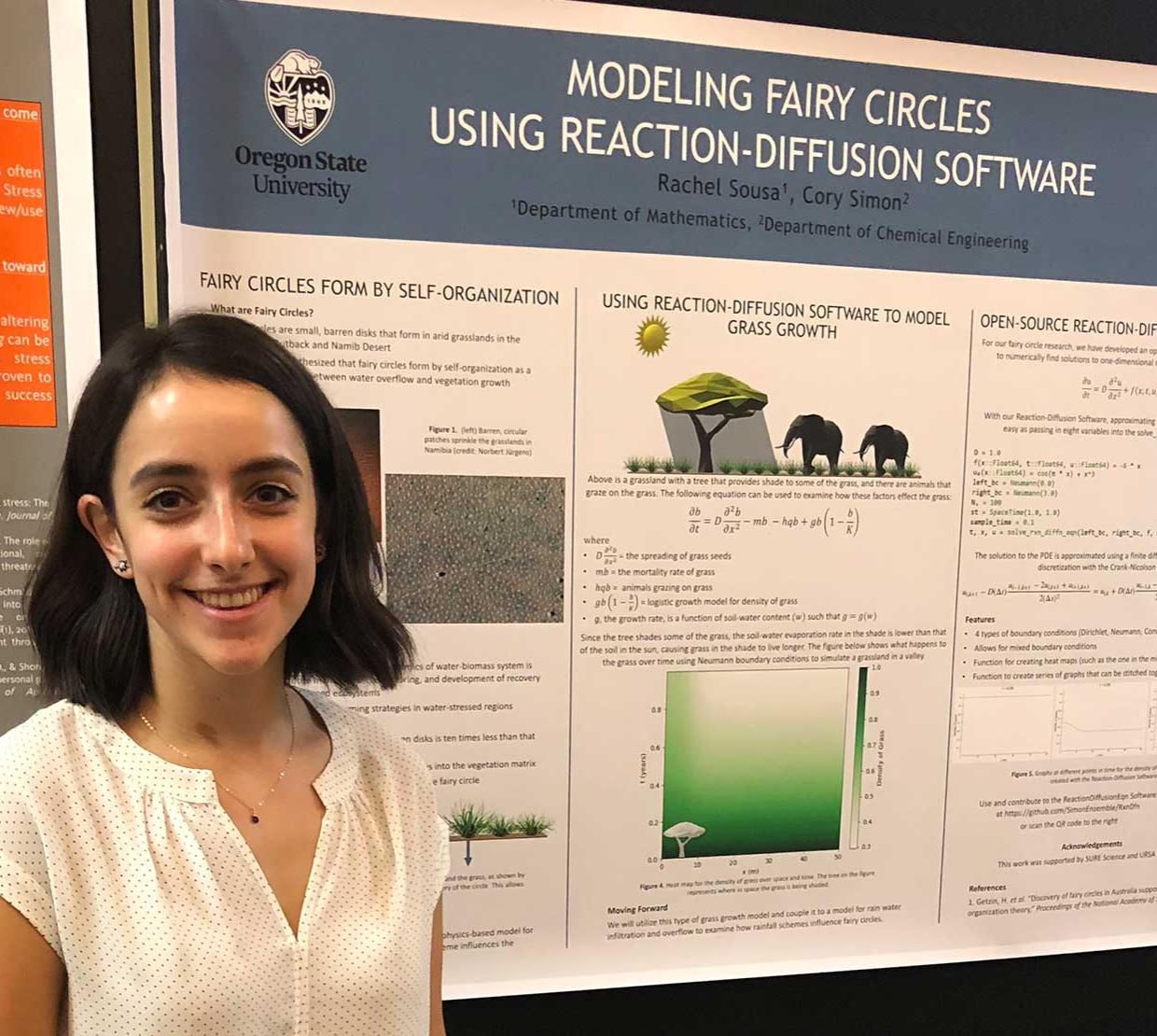
Rachel Sousa next to research poster

Using mathematical biology to explore everything from ecological phenomenon to cancer cells

By Mary Hare

Rachel Sousa, a mathematics senior

For Rachel Sousa, being a woman in a notoriously male-dominated field is no obstacle – it just motivates her to work harder. Sousa is a senior mathematics major with a focus on mathematical biology and a minor in computer science at OSU. She also works as an undergraduate research assistant in Assistant Professor of Chemical Engineer Cory Simon’s Lab and interned this summer at the National Cancer Institute at the University of Utah.

But the aspiring mathematician hasn’t always been interested in this career path or even believed it was possible. As a first-generation college student, she didn’t have access to many of the support and resources that her peers did.

“My parents were always very supportive. They just didn’t know what to tell me to do,” explains Sousa. Although their own lack of college experience did not stop Sousa’s parents from trying their best to ensure their children could have the best education possible.

“I have an older brother who’s two years older than me, and whenever we were on car rides, my dad would always quiz us on math,” Sousa said. “My dad said I used to be deterred from answering, because [my brother] was older and would always get things right before me.”

Of course, this all changed when she started second grade and began practicing math with peers her own age. “I remember maybe in second grade we had the timed multiplication tables, and I used to love racing through them. It really piqued my interest,” she explains.

After that, Sousa was hooked. She made the decision to become a math teacher, dual majoring in mathematics and education so that she could help other children overcome their fear of math as well.

“I think having a bad math teacher really deters you from liking math. I had a really good high school math teacher and a really bad one, so I wanted to become one of the good ones. I think math is super nice and beautiful, and I wish everybody could appreciate it,” Sousa said.

Then everything changed when Sousa got to OSU.

Talking with senior mathematics students and faculty in a prerequisite course for math majors, she learned that teaching math was only one of many possibilities that the major could offer.

“There was one student who was working with the baseball team on campus and doing stats on them, and another student who had been doing research over the summer on river water bed systems. I just had never thought about using math for all these other opportunities,” said Sousa.

Soon after, she dropped the education major to focus more deeply on math and added an emphasis in mathematical biology. Mathematical biology uses mathematical principals to model biological phenomena, such as using growth models to describe growth patterns of bacteria in a petri dish or infectious disease models to describe how a disease could spread throughout a community.

“I figured if after I graduate I still want to teach I can still do that. Whereas if I had stayed on the teaching track, I only had one path I could go down,” Sousa explained.

It was at a faculty mixer hosted by the College of Science during Sousa’s freshman year that she first was introduced to Dr. Simon, a chemical engineering faculty researcher in the College of Engineering who had a background in math.

In the Simon Lab, Sousa is working on an individual project using mathematical biology to study an ecological phenomenon known as ‘fairy circles;’ mysterious circular patches of barren land that occur in arid grasslands along the Namib Desert and in parts of Australia. Fairy circles have been a mystery to scientists since the 1970s and continue to fascinate scientists to this day.

“I’m not afraid to put myself out there anymore… I never thought I would get the National Cancer Institute’s summer research internship program, but I did.”

Sousa was awarded an URSA Engage scholarship and a SURE Science Award in 2018, allowing her to spend many hours in the Simon Lab throughout her years at OSU.

Recently Sousa contributed to a group project in the Simon Lab studying metal-organic frameworks, porous molecules that are able to store gasses that have a wide variety of functions. For her part of the project, Sousa used mathematical techniques such as Singular Value Decomposition to break down three-dimensional formulas into two dimensions to analyze the different components. She was also responsible for writing part of a research paper that was published in an academic journal in May 2019, and which earned her a listing as a coauthor, quite a feat for an undergraduate.

In the summer of 2019, Sousa’s research took her all the way to the National Cancer Institute at the University of Utah, where she used mathematical modeling of cancer cell plasticity to understand induced drug resistance and cancer immune cell therapies.

Sousa is grateful for her time at OSU for helping her grow her confidence and expand her horizons.

“I think the biggest thing to overcome was forcing myself out of my comfort zone and really learning about all the opportunities they offer here. I’ve definitely become more open, and I like saying “yes” to whatever opportunities are available,” reflects Sousa.

“I’m not afraid to put myself out there anymore… I never thought I would get the National Cancer Institute’s summer research internship program, but I did.”

Sousa has also participated in OSU’s Faculty-Student Mentoring Program, led by Science Dean Roy Haggerty, which aims to provide upperclassmen and faculty mentors to new and transfer students from underrepresented communities.

She also serves as Vice President of OSU’s Math Club and volunteers in Discovery Days, an annual event where elementary school children come to OSU’s campus to learn about science, engineering, technology and mathematics.

“I really enjoy being able to share my love of math with the kids and see their faces light up when they discover something they hadn’t known before.”

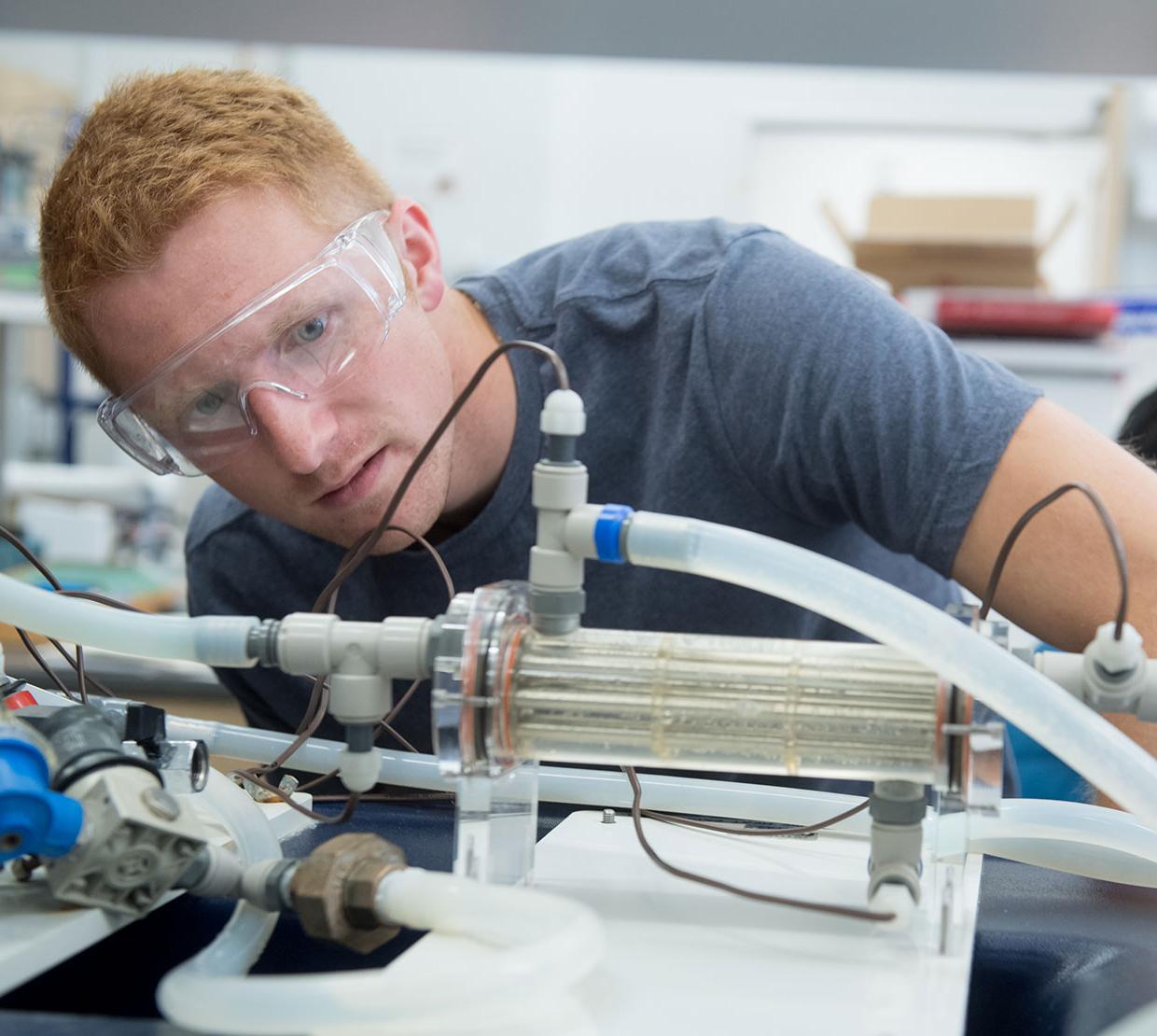
male student working with lab equipment

More than 50 students awarded scholarships for summer research

By Mary Hare

The College of Science warmly congratulates our 2019 SURE Science scholars!

Oregon State University and the College of Science have made it their mission to help students prepare for a bright future by providing potentially life-changing summer research opportunities.

This year, contributions from generous donors have helped more than 50 science students win competitive summer research awards, including the college-wide SURE Science Award (Summer Undergraduate Research Experience) as well as several department-specific awards.

Undergraduate research often plays a key role in developing student-faculty relationships, and gives students hands-on learning experiences that help them grasp the practical applications of science beyond the scope of the classroom.

“For me, a lot of it is about the students who wouldn’t be able to do research if they weren’t getting paid,” program coordinator Gabs James explains.

By providing fellowships to the greatest possible number of students, these awards give many undergraduate students the financial leverage to pursue career goals that would otherwise be unattainable.

The SURE Science Program is available to all full-time science students who meet the academic requirements. The scholarship provides the opportunity to conduct paid research for up to 440 hours over the summer. The scholarship includes a stipend of $5060 and an additional amount of $500 stipend that can be used as funding for activities that support their research. This year, greater donor support has made it possible for 40 students to receive the award — an unprecedented number with the award money totaling more than $220,000!

In addition to SURE Science, there are also several awards which may be received by high achieving students within a department.

New this year in Integrative Biology is the Alexei Lubchenco Menge Fellowship, which was awarded to Kris Bauer to support his research under the guidance of Postdoctoral Scholar Sarah Gravem and Professor Bruce Menge. The fellowship was established in memory of Alexei Lubchenco Menge, who died at age 27 in 2005. Like his biologist parents, Lubchenco Menge was deeply passionate about the ocean and the life it contains. The award seeks to help a student within the department who exemplifies these values.

Also receiving awards this summer are Ryley Tishendorf, who received a Special Integrative Biology Award, and Jiadi He, who received a Special Physics Award. Tishendorf will perform research in biologist Rebecca Terry’s lab, and He will be mentored by biophysicist Weihong Qiu.

In the biochemistry and biophysics department, students applying for the SURE Award are also eligible to apply for the CURE Fellowship. CURE is sponsored by the Ray and Frances Cripps Education Endowment, as well as by faculty mentors who match the awarded funds. This year, eleven biochemistry students received the award, in addition to eight other students from the department who received the SURE Award.

Congratulations to the inspiring next generation of scholars!

SURE Science awardees:

StudentMajorFaculty
1McKenzie BarkerBiologySally Hacker
2Kelley BastinMicrobiologySusan Tilton
3Dreagn BennettBiologySarah Gravem
4Nathanael BowlesMathematicsMalgorzata Peszynska
5Elizabeth CarrollBiologyClaudia Hase
6Cynthia CedenoChemistryPaul Blakemore
7Addison DeBoerBiochemistry & Molecular BiologyDaniel Rockey
8Luz Dimas-MunozBiochemistry & Molecular BiologyDaniel Rockey
9Haelyn EppBioHealth SciencesWeihong Qiu
10Rebecca FranceBiochemistry & Molecular BiologyColin Johnson
11Kailie FrancoBiochemistry and BiophysicsBo Sun
12Ilana Gottfried-LeeBiochemistry & Molecular BiologyRichard Cooley
13Cat HoangMicrobiologyElisar Barbar
14Kendra JacksonBiochemistry & Molecular BiologyMichael Freitag
15Jin KiatvongcharoenMathematicsDavid Roundy
16Taylor KuntzBiochemistry & Molecular BiologyMatt Andrews/Adam Higgins
17David LehrburgerBiologyStephen Atkinson
18Lauren LewisChemistryStaci Simonich
19Kitty LiuBiochemistry & Molecular BiologyAdrian Gombart
20Chantelle MacAdamsBiology & ZoologyBruce Menge/Sarah Gravem
21Anabel MendozaBioHealth SciencesCarla Schubiger
22Alanis MoralesBioHealth SciencesVirginia Weis
23Rina MullendoreBiochemistry & Molecular BiologyMaria Franco
24Duy NguyenPhysicsEthan Minot
25Makenzie NordChemistryJulie Pett-Ridge
26Acacia PattersonPhysicsJanet Tate
27Taylor PrichardBiologyKatja Duesterdieck-Zellmer
28Victor PuociBiochemistry & Molecular BiologyEhren Pflugfelder
29David RockowBiologyMark Novak
30Kelsey ShimodaBiochemistry & Molecular BiologyJaga Giebultowicz
31Leigh SkalaChemistryTaifo Mahmud
32Ulises Solis OcanaBioHealth SciencesDavid Dallas
33Jason SreyChemistrySandra Loesgen
34Yi Peng TeoPhysicsMatt W Graham
35Dustin TreecePhysicsElizabeth Gire
36Sophia VahsholtzBiologyDee Denver
37Andrew WilliamsBiologySusanne Brander
38Elizabeth WirschingBiologyVirginia Weis
39Tara WirschingBiologyDr. Felipe Barreto
40Wanling XieMathematicsYuan Jiang

CURE Foundation Awardees:

StudentFaculty
1Dorice Goune GoufackMaria Franco
2Mahir PalanMaria Franco
3Juno ValerioViviana Perez
4Brooke GalyonMichael Freitag
5Carolyn LazaroffMichael Freitag
6Maja EnglerMatt Andrews
7Audrey KorteWeihong Qiu
8Seth PinckneyElisar Barbar
9Jacob NorthRyan Mehl
10Isabella KarabinasAlvaro Estevez
11Asra NoorAlvaro Estevez

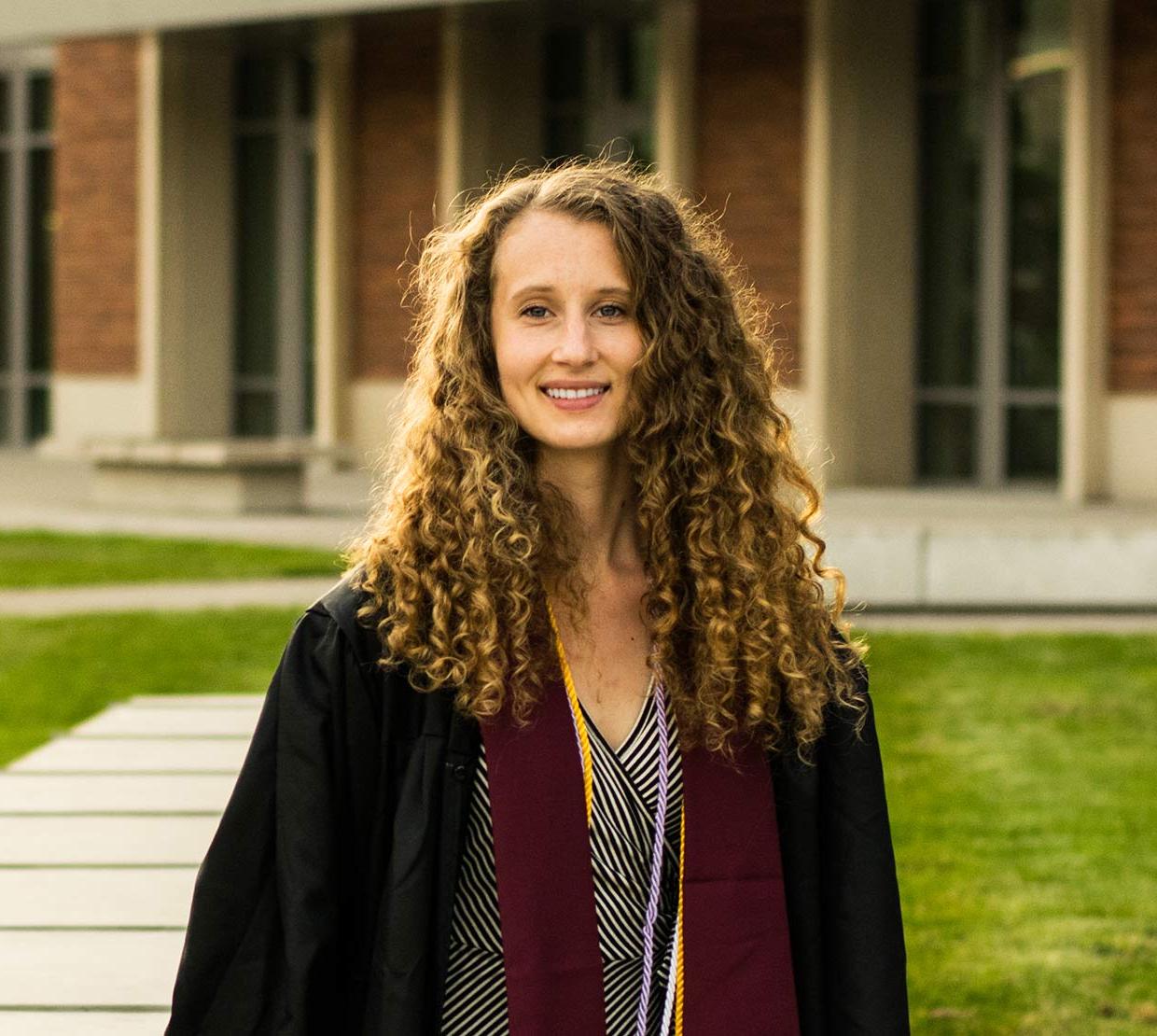
Sara Tro wearing graduation gown in front of the Learning Innovation Center

Math senior finds inspiration from women mathematicians at OSU

By Srila Nayak

Sara Tro, senior in mathematics

It is fairly uncommon to win a major international honor just a month before graduation — a sort of icing on the graduation cake. But mathematics Honors student Sara Tro has achieved just that. Tro and her teammates — fellow math majors Andrea Lanz and Michael Kupperman — were given a very high rank in the 2019 Consortium for Mathematics and Its Applications (COMAP) Mathematical Contest in Modeling. The team was awarded Meritorious Winner, placing it in the top seven percent internationally. Only 42 teams did better! To put things in perspective, 14,108 teams from around the world took part in the modeling contest.

This year’s COMAP contest ran for four days in January. During that time, Tro and her team researched, modeled, and submitted a solution to one of three modeling problems.

“It was an exhausting weekend, and we balanced classes and working on the modeling problem on Thursday and Friday. But I am very happy that we got a high rank,” said Tro.

Tro, who also holds minors in actuarial science and Spanish, completed her Honors thesis, in which she analyzed a proposed model by combining Maxwell’s equations with the Duffing model, under the guidance of mathematics professor Vrushali Bokil.

“While doing the research was valuable, just having a mentor who I met and had conversations with every week made a big difference.”

Tro has gained admission to the graduate program in the Department of Applied Mathematics at the University of Colorado, Boulder, where she will begin her Ph.D. in August. While she was offered a spot at other schools, Sara chose CU Boulder encouraged by her advisor, Bokil, who was excited about the program and recommended it highly. And for good reason. The graduate program in applied mathematics at CU Boulder ranks 14th in the nation.

Tro says that doing research for her Honors thesis with Bokil was one of the highlights of her time as an undergraduate student. Interactions with her mentor helped to demystify many aspects of academia.

“Doing the thesis with Dr. Bokil was a really important experience for me. While doing the research was valuable, just having a mentor who I met and had conversations with every week made a big difference,” said Tro. “We talked about what classes to choose, where I was going to graduate school and what to look for in graduate school.”

Tro grew up in Canby, Oregon, the daughter of a police officer and a nurse. She enjoyed science and mathematics in school and excelled at the subjects. She chose to major in mathematics towards the end of high school after discovering that she enjoyed physics and chemistry because they contained math. “To me, math was a lot more perfect and beautiful in and of itself than other fields that utilized math,” observed Tro.

After looking at liberal arts schools in Washington, Tro chose Oregon State University for undergraduate studies because she was offered a coveted spot in the Honors College. Plus, as an Oregon resident, OSU was going to be the least expensive school among her choices. But she didn’t know much else about the mathematics department at OSU before she arrived on campus as a wide-eyed freshman.

“As a high school student, I didn’t know what to look for in a mathematics department,” said Tro.

But things worked out very well for the next four years. “I am glad I ended up in a larger math department with a big focus on research, unlike the small liberal arts colleges that I looked at,” Tro observed.

As for a first impression, she was pleasantly surprised and inspired by the number of women math professors she met at OSU. In fact, the number of women mathematicians at OSU is well above the national average — 30% compared to just 16% at doctoral-level mathematics departments nationwide.

“In my very first term, I had a vector calculus class with Dr. Elaine Cozzi. I thought it was so great,” said Tro. “After taking a number of classes, I started to realize that all my favorite math professors were women. It helps to see other women in front of the room.”

Some of her favorite math courses include the ones on differential equations and mathematical biology with Bokil and mathematical modeling classes with Professor Malgorzata Peszynska.

Beyond mathematics, Tro has fulfilled another significant goal as an undergraduate student. An Honors Experience Scholarship led her to participate in the OSU in Cuba program for two weeks in 2017. The granddaughter of Cuban immigrants, Tro had always wanted to visit Cuba. During the trip, she visited museums and cultural centers, medical clinics, schools, the Bay of Pigs, and got a taste of the artistic, cultural, historical and political and landscape through conversations, lectures and lessons from a diversity of local experts.

Closer to home, a Research Experiences for Undergraduates scholarship took her to a program in computational and applied mathematics at UCLA. There she worked on a project to create new algorithms to analyze and classify video data from cameras worn by Los Angeles Police Department officers. While the mathematician in her didn’t find the machine learning-focused research project very compelling, Tro acquired the knack of reading academic papers, engaged in collaborative work with her team and honed her presentation skills.

A straight-A student, Tro has garnered several awards for her academic achievements. These include the mathematics department’s Edward Stockwell Award and the WIC Culture of Writing Award and OSU’s Finley Academic Excellence Scholarship. She was also inducted into the math honor society Pi Mu Epsilon and the academic honor society Phi Beta Kappa.

What drives Tro's passion for mathematics? “I love that math can represent reality, and one can use mathematics to accomplish that.” She adds, “But I also just enjoy doing math problems.”

As she moves on with her life as a mathematician, there is no doubt that Tro will continue to find opportunities to do what she loves best.

Rachel Legard in front of Kidder Hall

Math senior will use data to increase efficiency of governments and the private sector

By Mary Hare

Rachel Legard, mathematics and business double major

For Rachel Legard, a mathematics and business double major who will graduate on Saturday, participation and involvement in student life and activities have always been a priority. Throughout her time at Oregon State, she has endeavored to put herself out there and seize every opportunity that came her way. In addition to being a Peer Advisor in the College’s Science Success Center and treasurer of her sorority, Chi Omega, she is heavily involved in multiple campus organizations such as the Relay for Life club and the Student Alumni Ambassadors.

Now, it seems her hard work and dedication have paid off. After graduating, Legard already has a job waiting for her as an analyst as part of Deloitte’s Human Capital Team, located in the heart of downtown Portland. With only slightly over a 4% acceptance rate by the company, this is a stellar achievement in many ways.

At Deloitte, Legard will be able to combine the skills she learned in both of her majors to improve the efficiency of governments and private sector businesses, while traveling on-site around the country.

“It was fun to see that they were really interested in mathematics majors. Even though I’m not going to be doing derivatives every day, I’m still going to use the problem-solving techniques I learned in my major.”

Starting out as a math major with an option in statistics, Legard realized early on that what truly drew her to the field was “seeing data turned into something useful and meaningful” — more than purely investigative mathematical research. With this in mind, she began to consider a future career within the business sector, inspiring her to add a second major in Innovation Management within the College of Business. Later on, she added two minors in statistics and Spanish, which allowed her to spend an exciting term learning the language and traveling around Chile.

Legard first heard about the job at Deloitte by looking at job openings on Handshake, an OSU career tool that helps connect students with off-campus job opportunities. She applied online and was able to interact with the company personally through a career fair and interview sessions held on campus.

“It was fun to see that they were really interested in mathematics majors. Even though I’m not going to be doing derivatives every day, I’m still going to use the problem-solving techniques I learned in my major,” explains Legard.

Legard intends to remain at Deloitte for the foreseeable future, eventually planning to pursue a master’s in business administration while working at the company. Her decision to choose Deloitte was driven by the fact that it is close to her hometown of McMinnville, Oregon, where her father runs their family pet food store and her mother is the principal of her childhood elementary school.

“I still see them all the time,” Legard laughs. Both her parents are OSU alumni and have remained a dedicated part of the university community after graduating with degrees in accounting (her dad) and mathematics (her mom). Legard has fond childhood memories of attending OSU college football games with her family, who hold season tickets to this day.

In other words, her decision to go to OSU four years ago was basically a no-brainer.

“What makes Rachel unique and wonderful are her energy and interest in getting other people excited about studying science and math.”

Although Legard played sports throughout high school, she decided not to continue her athletic career in college and focus on school. “Of course, I still managed to get myself way too involved,” she jokes.

“As a kid, I wanted to be a tour guide at OSU,” Legard laughs. “I just loved it so much.”

In fact, this childhood aspiration is partly what inspired her to apply to be a Peer Advisor two years ago. Now, in addition to giving tours to prospective students, she is able to help other undergraduates with mathematics-related questions and other circumstances that arise in academic life.

“You have to work harder, and make sure your voice is heard in group settings.”

“What makes Rachel unique and wonderful is her energy and interest in getting other people excited about studying science and math. But also, she just loves the Beavers. She’s not putting on a show — it’s literally who she is,” explains Gabs James, Science Success Center Coordinator.

As one of the few women in her cohort, Legard admits that she has experienced certain difficulties as a female student in the field of mathematics.

“You definitely aren’t in the majority, Legard laughs. “You have to work harder, and make sure your voice is heard in group settings. It was a challenge, and I’m grateful for that. I wanted to prove myself when I showed up to class, and it made me study harder.”

Originally from a small town with only one high school, Legard was used to living in a community where she had known everyone since kindergarten.

“When I first got here, I thought the campus was so beautiful. But it was enormous,” Legard recalls. “Some of the biggest obstacles I had to overcome were just forcing myself to be friendly, knocking on a neighbor’s door in the dorm and stuff.”

Being active in several student and campus organizations proved to be key in building friendships and expanding her range of knowledge. In some cases, this meant accepting leadership roles that she might not have felt fully ready for. Freshman year, for instance, she joined the Relay for Life club and was soon after recruited to be the assistant co-chair. Despite the steep learning curve, Legard came away knowing how to run meetings, along with other life skills.

“What surprised me most about OSU is how fast it feels like a small group — you get to know people so fast. I used to think there’s no way I’ll ever walk down the street and wave to people. And now walking around senior year, I never see anyone I don’t know.”
Ryan Tollefsen in front of Kidder Hall

Goldwater scholar is “a physicist to his fingertips”

By Srila Nayak

Ryan Tollefsen, honors physics and mathematics student

Ryan Tollefsen is one of four Oregon State University students awarded the 2019 Goldwater Scholarship. Tollefsen, an Honors College double major in physics and mathematics, has an outsized talent for knotty research projects pertaining to thin-film semiconductors and spinning colloidal matter. Calling himself a “physicist to his fingertips,” Tollefsen aspires to be a professor of physics one day, specializing in quantum cosmology and applications of nuclear fusion.

In addition to Tollefsen, Biochemistry and molecular biology students Isabella Karabinas and Kendra Jackson and engineering major Kyzer Gerez also received the prestigious 2019 Goldwater Scholarship, the nation’s top undergraduate award for sophomores and juniors in the fields of science, technology, engineering and mathematics.

Tollefsen, who will be a senior next fall, felt inspired to apply for the Goldwater Scholarship after fellow physics major Mirek Brandt won the Goldwater award in 2017. His extensive preparation certainly helped. Tollefsen started taking graduate-level physics as a sophomore and he is on track to complete the entire graduate-level quantum mechanics and electromagnetic theory sequences by the end of his senior year.

“I find great satisfaction in learning about the universe, and theoretical physics will remain as one my core scientific interests. By the time I reach graduate school, I will be uniquely prepared for high-level field theory,” said Tollefsen.

In the lab of physics professor Oksana Ostroverkhova, he pursues research on developing stable and durable thin-film semiconductors. A skilled programmer, Tollefsen has created a code in Python and Labview to help automate and control complex experiments on semiconductors for his laboratory.

A Research Experiences for Undergraduates (REU) fellowship, awarded to top-performing undergraduates from across the U.S. and Puerto Rico, took Tollefsen to the Massachusetts Institute of Technology (MIT) in summer 2018. He further strengthened his computational skills by working on a project related to spinning magnetic particles in the Physics of Living Systems lab at MIT— a specialized center which studies biophysics, ecological dynamics and other topics in nonequilibrium systems. The MIT Summer Scholars program, begun in 1983, has a hallowed reputation for bringing the best science and engineering undergraduates in the country to the university for graduate-level materials research.

Tollefsen explains that his goal was to create a molecular dynamics simulation engine in FORTRAN, which would allow his group to corroborate experimental results and model physical systems that are too complex to create in-lab. Currently, Tollefsen is writing a paper capturing the high-impact results he obtained on the project.

“I can now confidently state that there couldn’t have been a better undergraduate program for me than OSU physics."

Via independent study, Tollefsen learned three new coding languages to help him tackle his research project at MIT in a short span of eight weeks and taught himself how to remotely manage computing clusters. “I discovered that a scientist must be a proactive learner; he must be willing to develop new skills whenever the research warrants it,” Tollefsen observed.

Physics majors like Tollefsen enjoy rigorous and collaborative learning experiences in the OSU physics department, long recognized as one of the country’s most pioneering undergraduate physics programs. The department was one of three in the country to win the American Physical Society’s award for Improving Undergraduate Education in 2018.

“The Department of Physics at OSU does an excellent job at preparing its majors with coding, digital electronics and numerical simulations skills,” says Tollefsen.

He graduated from Lake Oswego High School in Oregon. By his own admission, Tollefsen was an indifferent student and didn’t regard himself as particularly gifted in mathematics and science during his earlier school years. He made a split-second decision to switch his major while standing in line for an orientation event at OSU. “I joined the line as an engineering major, and I exited having made up my mind to switch my major to physics.”

Tollefsen credits the highly supportive, nurturing and friendly atmosphere, not to mention the excellent teaching, in the physics department for helping him achieve his academic potential. In high school, he had been surrounded by highly gifted classmates who went on to gain admission at elite, selective universities across the country.

“I can now confidently state that there couldn’t have been a better undergraduate program for me than OSU physics. Interacting with physics professors, friends and doing research in Weniger Hall have been the happiest parts of my educational journey so far,” shared Tollefsen.

The budding physicist has encountered and overcome significant obstacles on his path to academic success. Diagnosed with dyslexia, Tollefsen has encountered lifelong difficulties with reading starting from elementary school. He was able to thrive gradually as he discovered that his strong visual and spatial reasoning skills helped him perform well in mathematics and physics.

Tollefsen’s journey to college was also beset by financial difficulties. Relying on scholarships to support his undergraduate studies, Tollefsen found himself falling short by $1,300 in tuition at the end of his first year. Strong support by physics faculty and the College of Science administration led to OSU covering his fees and allowing him to register for the following academic year.

Straight-A student, Tollefsen’s impressive academic achievements have garnered him a number of awards and scholarships. Other than the Goldwater Scholarship, he has received the David B. Nicodemus Memorial Scholarship in Physics and OSU’s Finley Academic Excellence Scholarship. He has also been awarded the Ruth A. Beyer Honors College Scholarship, the Wayne R. and Julie Claire Spesock Memorial Scholarship and the College of Science’s Harriet R. Anderson Scholarship.

Read more: Physics, mathematics and biochemistry students named Goldwater Scholars

Aspiring neuroscientist grounded in science and the arts wins Goldwater Scholarship

Subscribe to Students