Outreach

Outreach

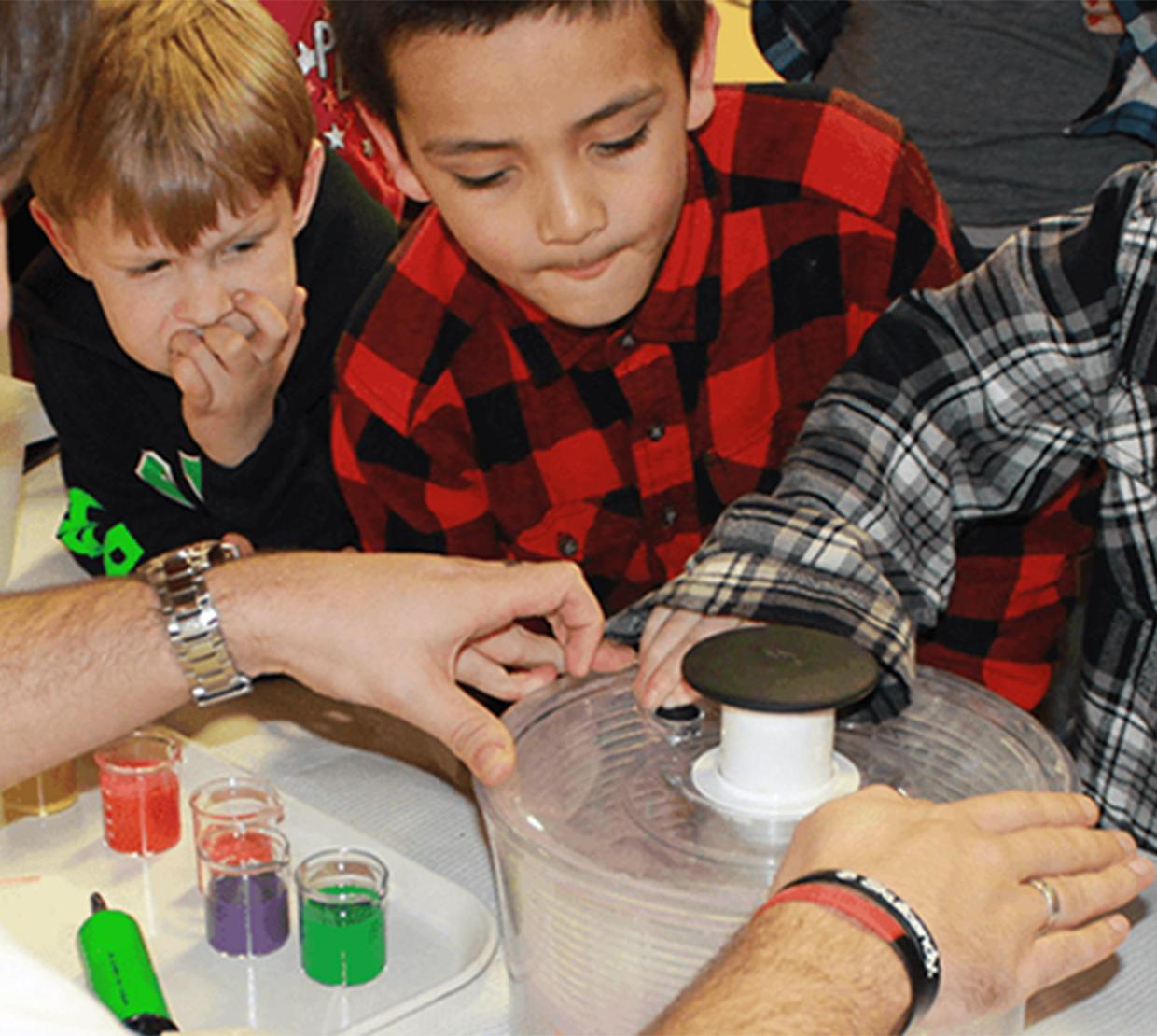
Two young kids work play with math tokens.

OSU faculty and students partner with Corvallis schools to make math fun

By Tom Henderson

Nathan Gibson was in fourth grade when he realized something shocking. Math is fun.

It happened when he started studying the oft-dreaded multiplication table. “I realized pretty quickly that you don't actually memorize it,” Gibson said. “There's a trick to it. You just count by seven or count by eight. That got me thinking of math as more of a game than a chore."

Gibson, the associate head of OSU’s Department of Mathematics, wants children everywhere to realize math is fun – with a little help from their friends.

He started forming “math circles” at Corvallis public schools in 2023. Groups of five to 15 students get together weekly after school to enjoy the company of numbers and each other. Mathematics faculty members and students help guide the groups.

The groups attract more than kids who are into math, Gibson said.

"Math circles are for kids who like math and for kids who want to like math, so it's possible that they just don't like the math they're doing in classes, and they'll enjoy this more,” he said.

Graduate student Sarah Alberson wishes there had been a math circle when she was a kid. “I loved doing math, and I would have loved to join a club where we work through problems together.”

Students tackle assorted math problems, but not exactly the way they’re tackled in traditional math classes. “The types of problems we do are more fun and more approachable than the types of problems they're forced to learn because that's just what their grade level says they're supposed to know,” Gibson said.

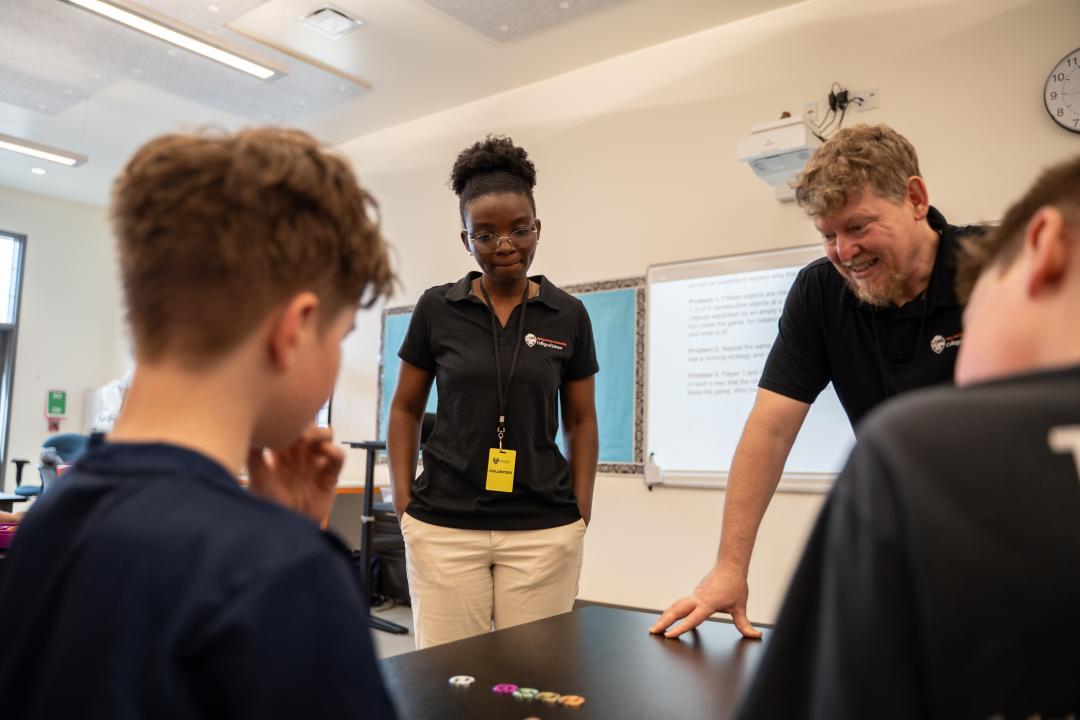
A woman and man talk to two students doing math.

Nathan Gibson and Abigail Adjei from Oregon State work with local Corvallis undergraduate students.

Math problems often depend on knowing the formulas or techniques from a previous math class. “The problems we look at have a lot more to do with logic or common sense or just sitting and thinking about it for a while -- puzzling it out,” Gibson said. “It's closer to Wordle than a traditional math problem."

The math circles began at Franklin School, a Corvallis school with kindergarten through eighth grade. After starting in the primary grades, the circles extended to the middle school level and have since spread to other local elementary and middle schools.

Gibson hopes to spread the program to two more elementary schools by next fall in order to have math circles in all of the Corvallis public schools.

“The main benefit for students is that they get a chance to see mathematics that is typically not found in the standard school curriculum, and they get extra mental stimulation/exercise,” said graduate student Hsaing Thum.

“We also seek to build understanding of these concepts by getting the students to come up with and provide explanations for their answers,” he said. “These skills easily extend to other areas where they need to be clear with their thinking.”

The most important aspect of the circles is the camaraderie, Gibson said. The groups do more than solve problems together. They talk about how the problems have similarities and differences as well as the solutions.

"We try to dig a little deeper, get more abstract to give them a hint on how to approach the harder problems," he said. "This type of problem solving is just more fun in a group.”

Thum said he wants to share his excitement for mathematics. “Looking back, as a kid and teen I failed to appreciate many aspects of the math clubs I had while growing up,” he said.

Gibson said he never failed to appreciate his early math education. His fourth-grade teacher gave him extra worksheets so he could play with numbers while others labored over 9x7.

"From that time on, I knew I would be a math teacher,” said Gibson, adding he hopes that feeling is contagious.

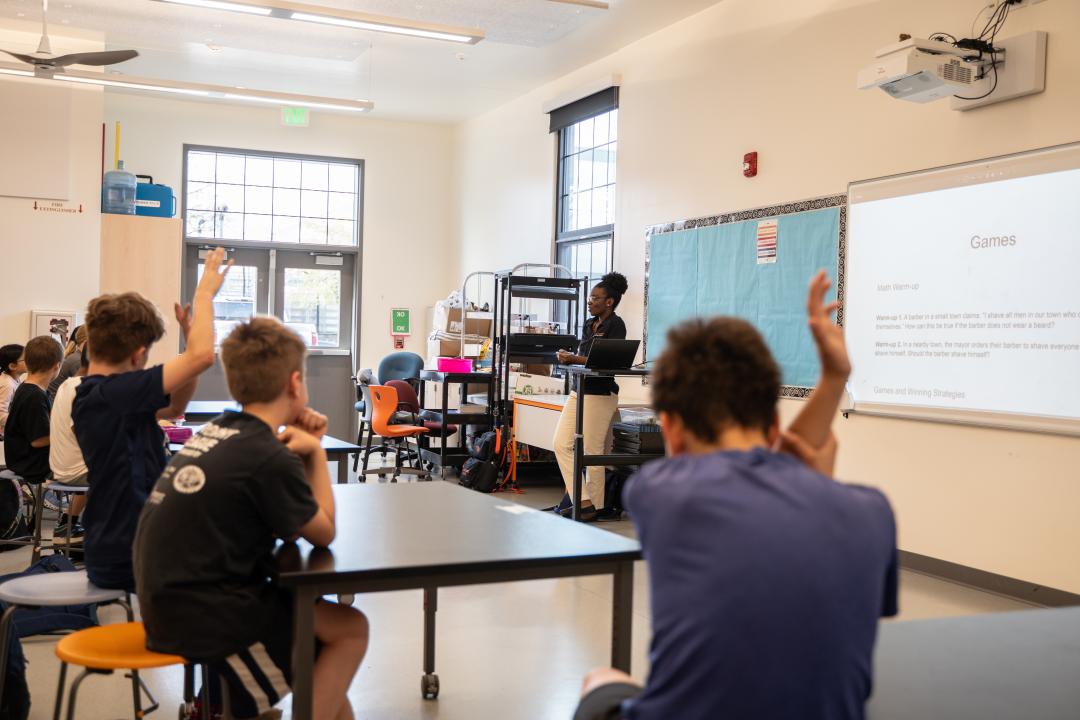
A woman teaches math to elementary students.

Abigail Adjei from Oregon State works with local Corvallis K-8 students.


Read more stories about: faculty and staff, students, mathematics, outreach


A male college student engages with children during Discovery Days

Empowering communities: Highlights from the College of Science’s 2023-24 outreach

By Hannah Ashton

The College of Science is committed to making science accessible, engaging and relevant to people’s lives. Through outreach, we support science literacy, connect with communities and help students see themselves in STEM. From hands-on activities in classrooms to public science events and student-led programs, outreach is one way we ensure science makes an impact. Here are a few examples of 2023-2024 outreach from across our departments:

In Integrative Biology, faculty and students participated in events such as Science Nights at local schools, Discovery Days, and sea-themed summer camps, with activities ranging from avian behavior trials to DNA sequencing workshops in Nepal. The department also contributed to public presentations and fundraisers for undergraduate research.

The Mathematics department hosted significant events like the Lonseth Lecture and Math For All Conference, while also providing educational enrichment through math circles and problem-solving sessions. Faculty gave lectures internationally and led outreach programs in local schools, aiming to make math accessible to all.

Biochemistry and Biophysics highlighted women leaders in STEM, hosted symposia and webinars, and engaged the public through biophysics demonstrations. The department's outreach extended to local schools, community events, and artistic projects that made science more approachable.

In Physics, outreach efforts included attending elementary school science nights and giving tours to high school students. Educators can visit the physics website to schedule a classroom visit from an OSU physicist.

The Chemistry department’s outreach initiatives aim to broaden access to STEM education and inspire a diverse range of students to explore science. Through a variety of programs, the department offers hands-on experiences, community events, and immersive camps that connect underrepresented and local students with real-world science opportunities. Learn more about chemistry outreach.

The Microbiology department organized creative and educational events such as agar art, career panels, and science nights, while also hosting a microbiology camp for high school students to explore STEM careers.

The Department of Statistics held outreach activities focused on recruitment and research growth including a joint research forum with Shanghai University of International Business and Economics. The department also held two conferences in Corvallis during the 2024 summer.

In the Dean’s Office, the Science Success Center organized Discovery Days where OSU welcomed more than 1,300 elementary students to experience science outside the classroom. Discovery Days, a biannual outreach event, brimmed with activities for kids to enjoy while they met graduate and undergraduate students eager to share their enthusiasm for the inspiring field.

The Dean’s Office also did recruitment outreach, visiting community colleges and middle and high schools to promote STEM programs and science career paths, engaging over 300 students in total.

These collective efforts typify the College’s commitment to science education, community engagement and inspiring future generations in STEM.

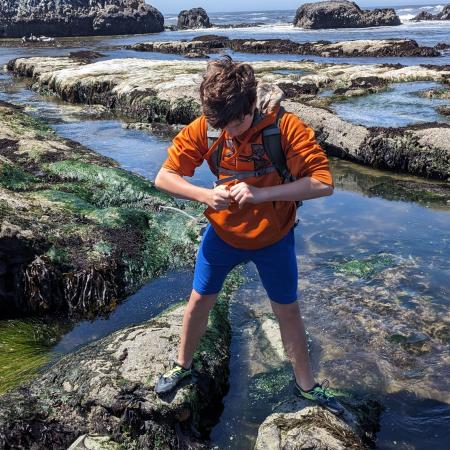
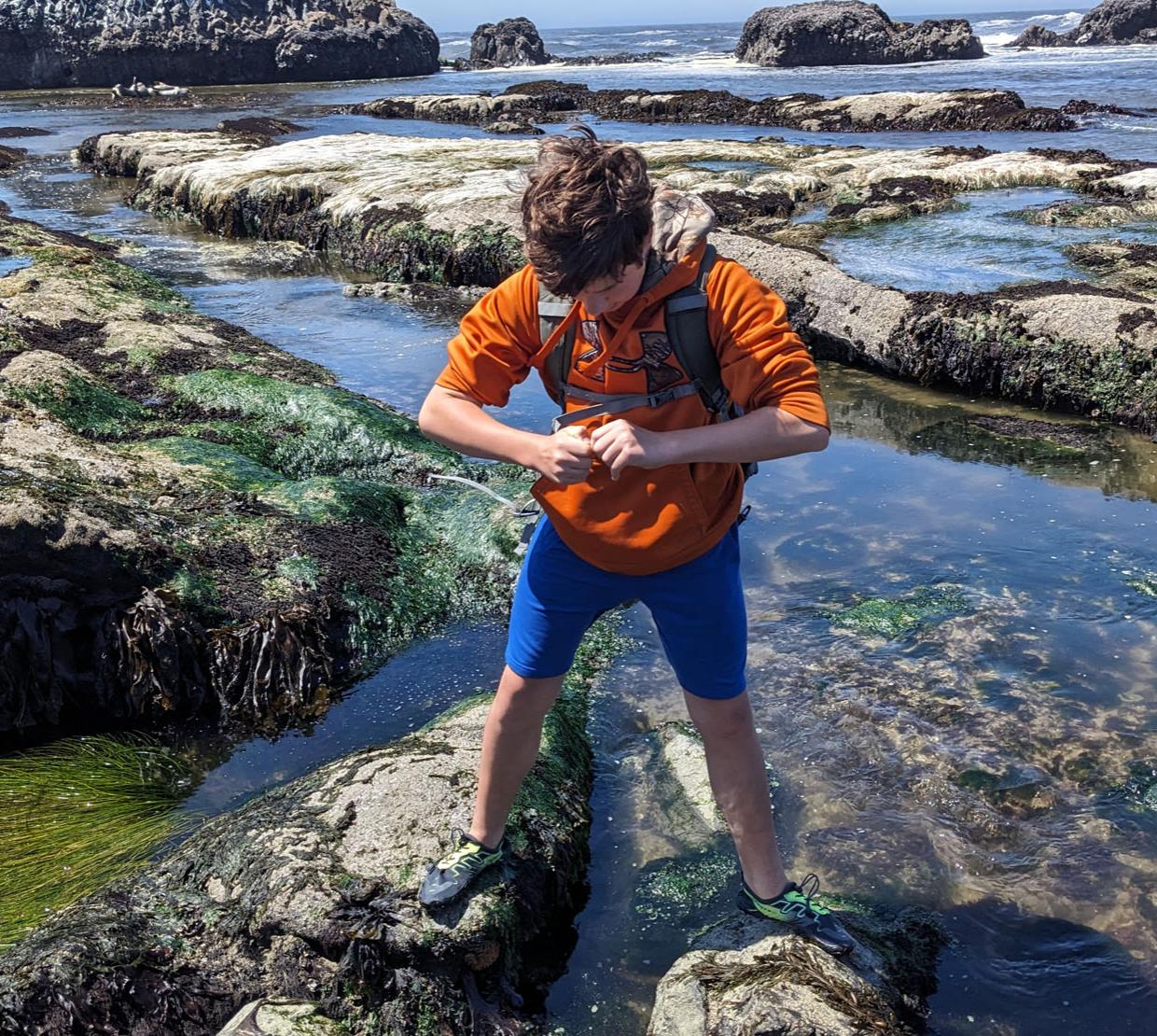
A kid stands in the water holding wildlife on the Oregon coast

Building bridges: College of Science outreach fosters science literacy and inclusion

By Hannah Ashton

Students from the Jamie Cornelius Lab helped plan Wild about Wildlife, a three-day summer camp for middle school students where they learned about biological science through experiences and field excursions to Hatfield Marine Science Center and the Chintimini Wildlife Center. Photo by Victoria Quennessen.

The College of Science is dedicated to enriching our community and promoting science literacy. Our recently launched Strategic Plan emphasizes making meaningful contributions on local, national, and global scales. Across our seven departments, we are actively implementing outreach initiatives that align with our mission to engage and create a positive societal impact. Last year, we supported events such as Discovery Days, Juntos Family Day, and others, all aimed at fostering a deeper understanding and appreciation of science..

Discovery Days is held twice a year as an opportunity to engage with local elementary school kids for a hands-on STEM fair experience. This event gathered more than 1,500 students and 300 OSU students, faculty and staff volunteers. In collaboration with Open Campus, Juntos Family Day provided Latinx students and their families with a dynamic college exploration experience in spring 2023.

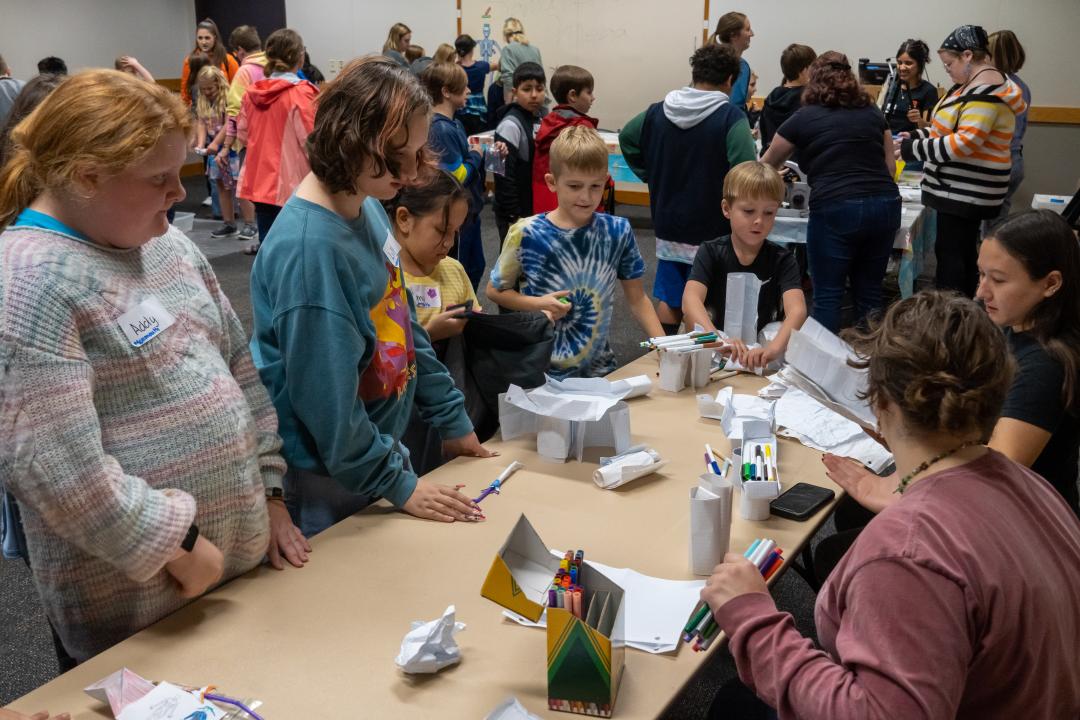
Students gather around a table.

Students participating in Discovery Days gather around a table for a fun hands-on STEM activity.

Our departments also prioritize creating access to science education and research, fostering community relationships and developing needed services.

Microbiology outreach makes science more colorful

The College of Science’s microbiology department created the Pernot Microbiology Camp to draw more local students from BIPOC, LGBTQ+, low-income and other diverse backgrounds to the study of microbiology. Faculty in the department also offered a session on Microbiology for the Advocates for Women in Science, Engineering and Math Club for both 5th grade and high school students. Microbiologist Jerri Bartholomew created the Art-Sci collaborative to build a bridge between art and science. This involves public galleries showcasing student work and local artists. The department also hosted internationally acclaimed microbiologist Jo Handelsman for the inaugural Berg Lecture. Open to the public, this lecture drew community members, students and faculty.

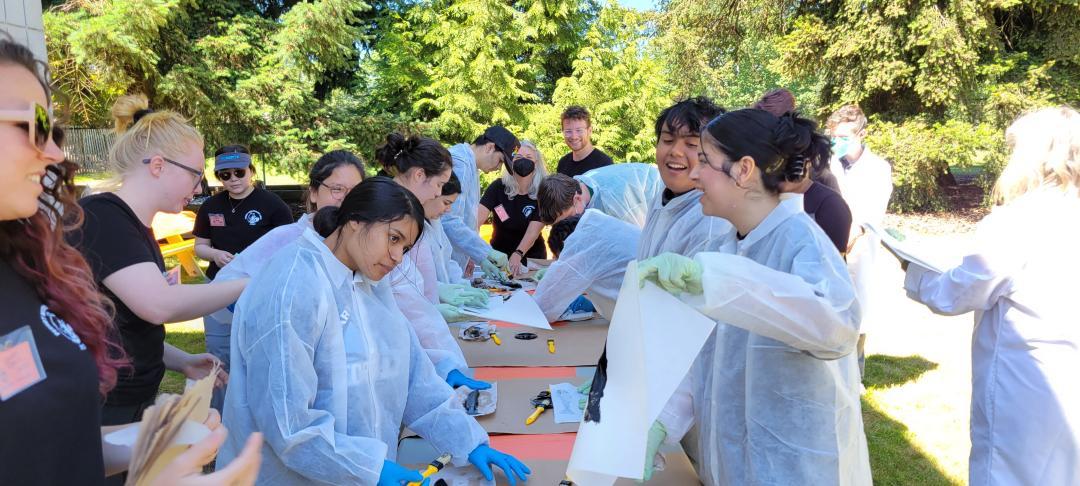
High school students work on fish rubs.

High school students work on fish rubs during the Pernot Microbiology Camp.

Statistics collaborates with Oregonians

The statistics department participated in the Statewide Crop Load Project annual meeting to discuss results with vineyard managers and wine producers in Oregon. Faculty also co-led a workshop in Lincoln County for the Pandemic Resilient Cities project to engage local public health, city officials, school representatives and more to begin a co-creation process for a National Science Foundation proposal. They discussed the needs of the county and priorities concerning future pandemic preparedness.

Physics brings science to high-school students

The physics department held lab tours for Corvallis High School students and created a Zoom version for Madras High School. Several faculty members also did presentations for the Corvallis High School Science Club. The department has a new outreach coordinator that will formally start in fall 2023.

Mathematics outreach seeks to break down common stereotypes

Members from the mathematics department organized the 2023 Math For All satellite conference. This event is an open and friendly space for people to gather and talk about mathematics, math education and how it relates to diversity, justice and equity. Professor Nathan Gibson organized a series of weekly Math Circle meetings for Franklin Elementary students. These circles aim to make mathematics fun, interesting, accessible and inclusive. The Association of Women in Mathematics OSU chapter also participated in many outreach events, including Discovering the Scientist Within, which aims to spark interest in science in young girls. The department also held its 38th annual Lonseth Lecture and invited alumna Corina Constantinescu (Ph.D. ’06) to talk about the “Mathematics of Inclusive Insurance.”

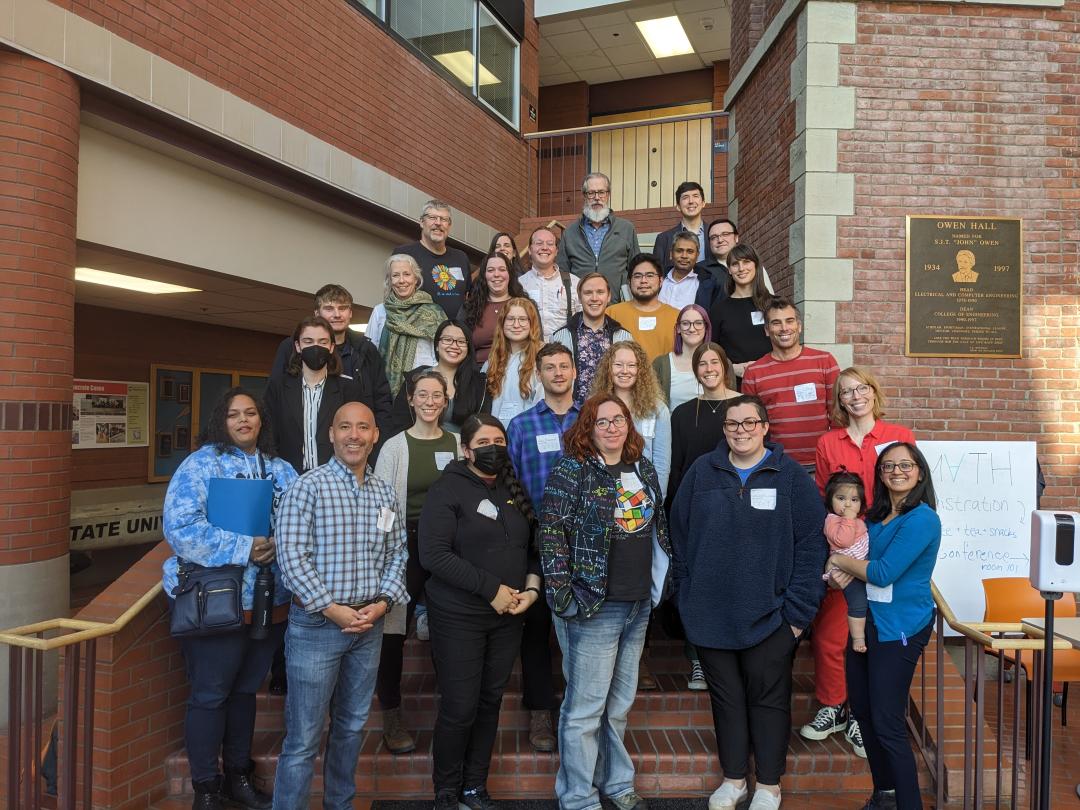
A group of individuals stand on a staircase for a photo during a mathematics conference.

Math for All participants pose for a group shot.

Integrative Biology shares research far and wide

The integrative biology department held its annual Doc Storm Lecture that drew more than 100 people to the LaSells Stewart Center. The Weis Lab participated in Meet a Scientist at the Oregon Museum of Science and Industry to educate visitors of all ages about the study of cnidarian-algal symbiosis and the threat of climate change on coral reefs. The lab also participated in OMSI After Dark. Students from the Cornelius Lab partnered with students from the College of Agricultural Sciences to plan Wild about Wildlife, a three-day summer camp for middle school students where they learned about biological science through experiences and field excursions to Hatfield Marine Science Center and the Chintimini Wildlife Center. In June, the department held its annual Robert M. Storm Distinguished Lecture. This year speaker George James Kenagy, Professor of Biology and Curator of Mammals, Emeritus with the University of Washington, spoke about "Survival in the Desert: Coping with Heat, Aridity, and Scarce Resources."

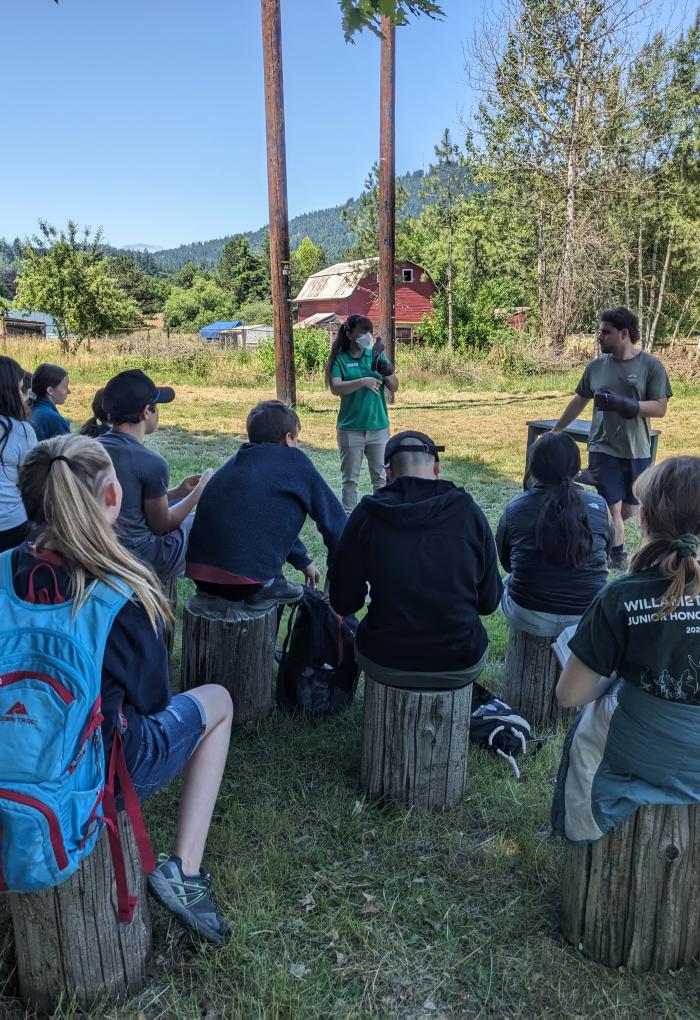
Students listen to a talk about birds.

Students in the Wild about Wildlife camp visit the Chintimini Wildlife Center.

Chemistry outreach helps high-school students find their passion

The chemistry department held the fifth annual Juntos Chemistry Overnight Camp in June. Twenty Latino high school students attended the camp from all over Oregon. The students participated in workshops and got an authentic taste of the OSU college experience. The department also held four lab tours for high school AP science students. Chemistry professor Marilyn Mackiewicz created a new week-long workshop called Ignite inSTEM designed to help students discover the wonders of designing nanomaterials.

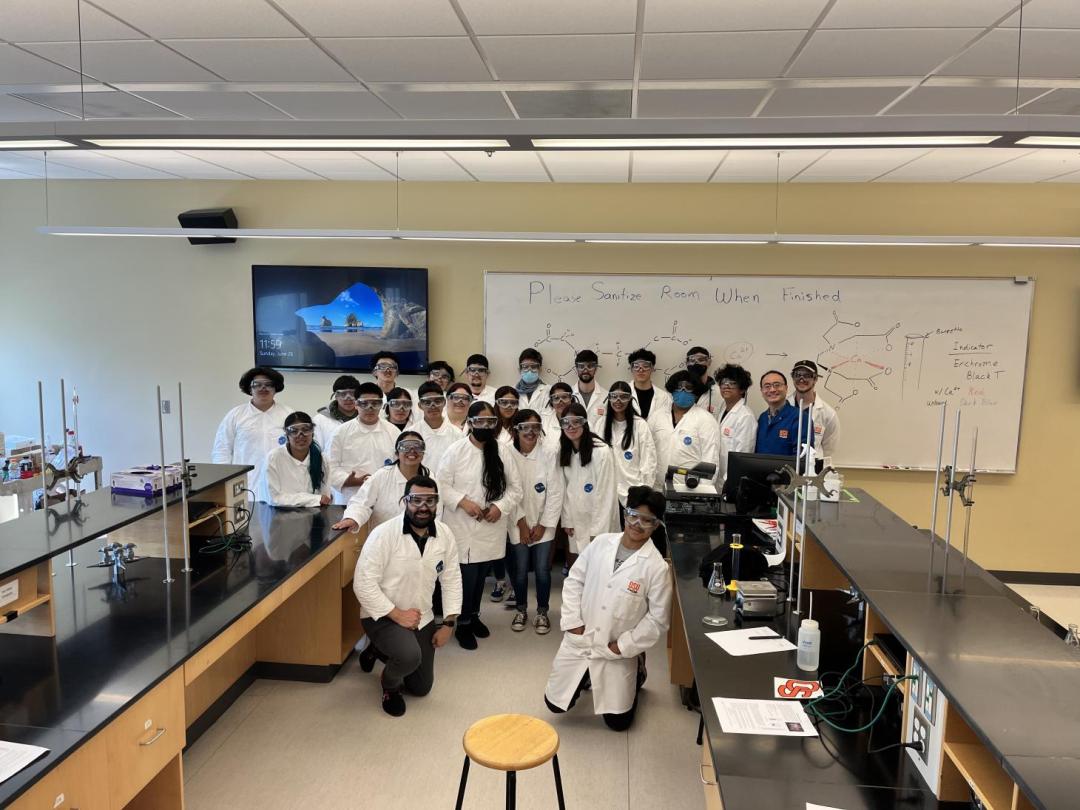
A group of students in white lab coats pose for a picture.

High-school students in the Juntos Chemistry Overnight Camp pose for a photo.

Biochemistry and Biophysics outreach has a national impact

The biochemistry and biophysics department was involved in middle school, high school and college outreach events. Faculty were involved in “How To Be A Scientist” and “Career Day'' at local middle schools. At the college level, faculty gave a science career talk at Idaho State University. Associate Professor Alysia Vrailas-Mortimer, just received funding to expand Fly-CURE RCN, a research coordination network that brings together faculty across the U.S. to create course-based undergraduate research experiences.

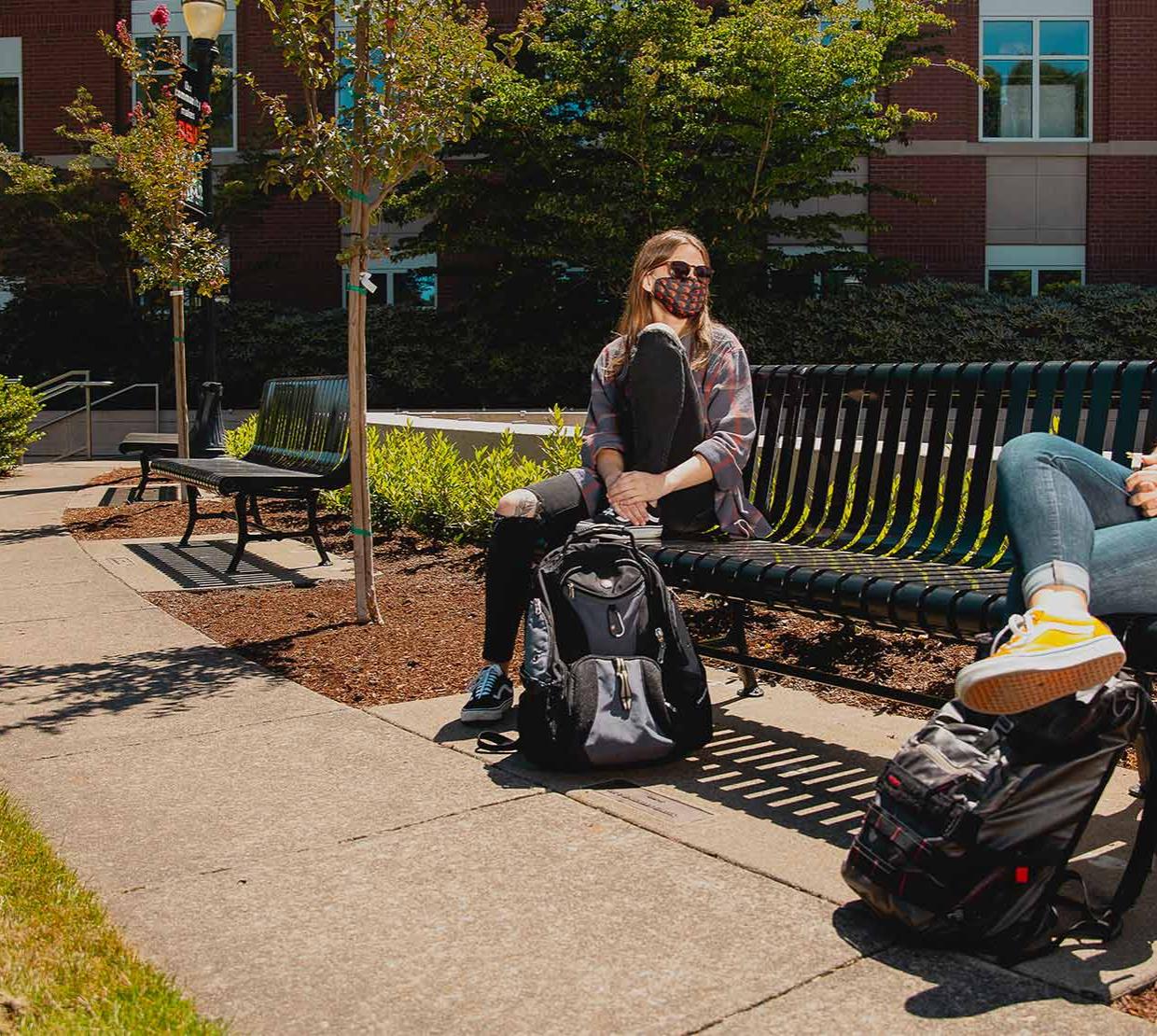
students in masks sit on a bench on OSU's campus

Oregon State University receives $2 million Packard Foundation grant to expand TRACE-COVID-19 nationally

By Steve Lundeberg, OSU News

Oregon State University researchers have received a $2 million grant from the David and Lucile Packard Foundation to create a national TRACE Center that will expand the OSU’s COVID-19 public health project to other states.

The center will harness the power of public health departments, universities and other institutions around the country to help measure the prevalence of the virus that causes COVID-19 by combining community surveillance sampling, wastewater analysis, viral sequence data and mathematical models of SARS-CoV-2 prevalence that OSU TRACE researchers have developed.

“In most communities across the country, it is still very hard to get reliable estimates of how many people are actually infected,” said TRACE leader Ben Dalziel, a population biologist in the OSU College of Science. “The TRACE Center will support a network of university-community partnerships that monitor local prevalence and develop new approaches for community-based COVID monitoring. We are extremely grateful to the Packard Foundation for helping us expand this work to other institutions and communities.”

Chad English, Science program officer for the Packard Foundation, said OSU’s TRACE work is different than most coronavirus testing strategies that rely on “trailing indicators” and provide more information about past infections than who is currently infected.

“The TRACE study and its approach to tracking the prevalence and spread of the coronavirus have proven invaluable to communities in Oregon," said English. “With the data and other insights that TRACE provides, public health leaders now have a powerful tool in their hands to better assess the threat of the virus and make decisions in the best interest of their community.

“We at the Packard Foundation are thrilled to support the expansion of this effort to other states and universities around the country.”

Dalziel said more than 100 research universities across the nation have the capacity to help scale up the TRACE project.

“Many universities have untapped capacity to help their states tackle the coronavirus,” he said. “The TRACE team at Oregon State University is looking for universities and public health departments interested in adapting the TRACE model to their states and their communities.”

Anyone interested in partnering on the TRACE project is encouraged to reach out to the TRACE Coordinating Center at [email protected].

Team-based Rapid Assessment of Community-Level Coronavirus Epidemics, or TRACE-COVID-19, was launched by OSU in April with door-to-door sampling in Corvallis, home to Oregon State’s main campus, and expanded to other cities around the state while also adding a wastewater testing component.

In late September, at the start of the academic year, TRACE also started conducting prevalence testing among OSU students, faculty and staff in Corvallis, at OSU-Cascades in Bend and at the Hatfield Marine Science Center in Newport, along with wastewater analysis of effluent from university buildings for COVID-19 viral markers.

“It’s been fantastic to merge sewer surveillance of the virus with the sampling and modeling going on in TRACE,” said project co-leader Tyler Radniecki of the College of Engineering. “Now we have the ability to extend our impact well beyond Oregon’s borders, and that’s a huge opportunity and honor.”

The TRACE project began as a collaboration of five OSU colleges – Science, Agricultural Sciences, the Carlson College of Veterinary Medicine, Engineering, and Public Health and Human Sciences – plus the OSU Center for Genome Research and Biocomputing. The project has functioned in partnership with county health departments around Oregon.

“Oregon State faculty, staff and students have really come together and mobilized to take on the hard work necessary to understand and combat this pandemic,” said OSU epidemiologist Jeff Bethel, also a project co-leader. “And of course we can’t take on this kind of challenge without the kind of support we’re receiving from the Packard Foundation and our other funders.”

PacificSource Health Plans and the Oregon Health Authority have also supported the TRACE project, whose diagnostic testing component operates through a partnership between the Oregon Veterinary Diagnostic Laboratory, which is located at OSU, and Willamette Valley Toxicology.

“One of the most exciting things about this project is that it shows how a land grant university can fulfill its potential to serve communities statewide – and nationally,” said Justin Sanders, a molecular pathologist at the Carlson College of Veterinary Medicine who is overseeing testing operations at the OVDL and is a member of the TRACE leadership team. “This project brings together experts from a broad range of fields motivated to quickly fill a critical public health need, and now we get the chance to take that to the national level.”

The national partnerships and collaborations afforded by the grant from the Packard Foundation, which comes on top of the $1.15 million it contributed to help launch the project, are critical in responding to a disease as widespread and deadly as COVID-19, said Javier Nieto, dean of OSU’s College of Public Health and Human Sciences.

“This pandemic requires all of us to do everything we can to mitigate the spread and damage of COVID-19,” said Nieto, a TRACE co-leader as well as a physician and epidemiologist. “If ever a situation demanded that we pool our resources, both at OSU and around the globe, this is it.”

The data gathered and analyzed by TRACE researchers provide important guidance for local and state officials deciding which public health actions make the most sense in protecting their communities, said Katie McLaughlin, an applied statistician in OSU’s colleges of Science and Agricultural Sciences and another TRACE co-leader.

“Among its other effects, COVID-19 is generating volumes of data that need statistical interpretation so our leaders can use the information for maximum benefit,” McLaughlin said. “Thanks to all of the support we continue to receive, and thanks to Oregon State’s overarching spirit of collaboration and service, we’re able to play a key role in helping communities stay safe.”

TRACE has tested traditionally underserved and racially diverse populations, Dalziel noted, adding that outreach materials and messaging have been made available in a variety of languages.

“We want to engage communities to get folks tested who might not otherwise be getting tested and as rapidly as possible,” Dalziel said. “We seek to have our samples be truly representative of the whole community, not just a portion of the community. In partnering with communities to monitor prevalence rapidly, we are achieving something that hasn’t been done very many other places during this pandemic. We hope the value of this approach appeals to others as well.”

Naveen and Sarah in front of Owen Hall

Mathematics graduate student's leadership, innovative teaching, outreach and research garners awards

By David Pengelley

Alumnus Naveen Somasunderam and Ph.D. student Sarah Hagen

New alumnus Naveen Somasunderam (Ph.D. ’19) and Ph.D. student Sarah Hagen recently received top mathematics department awards. Somasunderam received the overall Graduate Student Excellence Award, and Hagen is the William F. Burger Graduate Teaching Award recipient. Somasunderam finished his Ph.D. dissertation research in number theory this spring and will be a tenure track assistant professor at the State University of New York at Plattsburgh in the fall. Hagen’s ongoing Ph.D. dissertation research is in partial differential equations. Both have also shown enormous individual leadership in adapting active learning methods to their teaching, as well as initiating mathematics outreach activities.

Leading from below to promote active learning

Somasunderam created an active learning classroom in teaching calculus, and Hagen designed a week-long boot camp for incoming graduate students as well as a Ph.D. qualifying exam preparatory course. They each created classrooms in which students are provided opportunities to engage in mathematical investigation, communication and group problem-solving, while also receiving feedback on their work from both experts and peers. These classrooms feature practices that engage students in activities, such as reading, writing, discussion, or problem solving, that promote higher-order thinking. There is now clear scientific evidence that these active learning features result in better student performance and retention than more traditional, passive forms of instruction alone.

“I have had many classes where students were so engrossed in the learning that they lost track of time, and not a single student left until I requested them to do so. It is such a rewarding experience as an instructor to see my students enthusiastically take charge of their own learning.”

Both Hagen and Somasunderam adapted a particular tripartite approach for their pedagogy: Students read, then engage and pose written questions before class, and also prepare before-class problem work that is built upon in groups and as a whole class, guided by the instructor. Finally, further higher level homework is completed after class.

“I have had many classes where students were so engrossed in the learning that they lost track of time, and not a single student left until I requested them to do so. It is such a rewarding experience as an instructor to see my students enthusiastically take charge of their own learning,” said Somasunderam.

Hagen describes the active learning process in her classroom. “Students were much more engaged when their classmates presented on the board than when I presented on the board. The few times that I wrote on the board I could feel the room tense up and the students’ eyes glaze over (and I pride myself on being an engaging instructor!). The problem is that they felt like what I had to say was gospel, and so they didn’t engage as much or question as much.

Students often came up with solutions very different than what I had in mind. When there were multiple solutions to the same problem I had students write them all up. We then looked them over, compared them, and discussed the virtues and drawbacks of each attempt. This would *never* have happened if I had simply written my own proof on the board. Teaching with active learning was way more fun than I had anticipated. The fun was being able to interact with the students on a more personal level. Students also gain experience and confidence presenting their work.”

Hagen and Somasunderam are superb examples of “leading from below”, in which graduate students, postdocs, and young faculty are often leading the way toward adoption of evidence-based active learning teaching practices for increasing student engagement and success.

Engaging in mathematics outreach

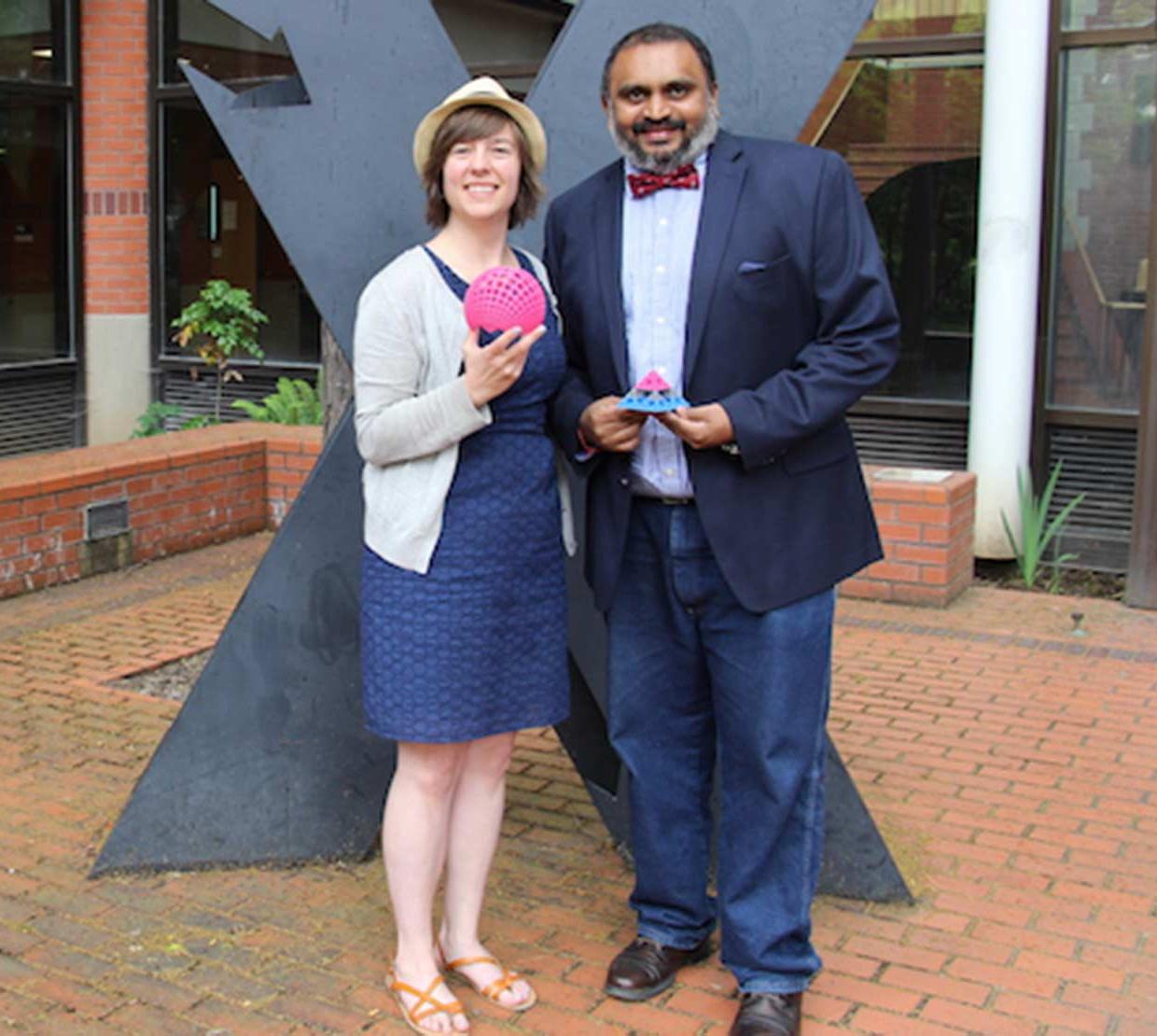
Both Somasunderam and Hagen have also led in creating outreach from the OSU Mathematics Department. Somasunderam co-created the Math Circus Project, aiming to bring out the artistic and aesthetic aspects of mathematics, by enabling children to play with 3-D printed mathematical objects. One example is an activity with stereographic projection spheres, which children use to investigate transformations of the plane and sphere, as well as to think about notions of infinity. Another theme is hands-on work with fractals. Math Circus events have included College of Science K-12 Discovery Days, Boys and Girls Club of Salem, Franklin School Science Night, and Periwinkle Science Night, Albany. The design and implementation of the Math Circus also includes OSU undergraduates.

Hagen likes to jokingly refer to herself as an “evangelical mathematician.” Intent on spreading the good news about mathematics, she engages in a wide variety of community outreach. Her outreach has targeted preschoolers, retirees and everyone in between. She has participated in outreach events far beyond OSU’s campus. She’s given talks in bookstores, pubs, science festivals and the public library, where her standing room only hands-on events have included topics such as Pi Without Circles, How Big is Infinity? and Ancient Greek Astronomy.

Her talks have been featured in the Corvallis Gazette-Times. She has run math demo booths and workshops at events aimed at children and adults, including an event with logic and probability puzzles for inmates at the Coffee Creek Correctional Facility, organized by and co-designed with fellow graduate student Branwen Purdy. For College of Science K-12 Discovery Days, she developed and recruited volunteers to help run Tic-Tac-Totally Crazy (an activity where participants play variations of tic-tac-toe but with different sized boards). For Mathematical Marvels Day at the Eugene Science Center she developed and ran a demo on the mathematics of fluid dynamics called Order and Chaos in Fluid Flow.

Hagen also performs her unique brand of math-themed comedy throughout the Pacific Northwest (including at the Majestic Theatre in Corvallis), and she co-produced a math-themed comedy benefit for the Eugene Science Center. In an effort to make the department’s outreach efforts more impactful and sustainable, Hagen helped form a mathematics outreach working group and is currently developing an outreach website for the department. She is also a founding member of the Graduate Student Outreach Council in the College of Science, and a current Oregon Museum of Science and Industry Communication Fellow.

Somasunderam and Hagen were together part of a team that developed and ran a Pi Throwing Contest at Da Vinci Days, where participants approximated π using Buffon’s needle experiment (dropping and counting toothpicks instead of needles for safety). Some visitors said it was the most interesting event at the entire fair.

Hagen’s research is in the analysis of the incompressible Navier-Stokes equations. Using the tools of Fourier analysis, complex analysis, dynamical systems, and number theory, she is working to develop theorems regarding the properties and dynamics of solutions that model fluid flow. For instance, a ghost solution is a non-stationary solution whose energy and enstrophy are nevertheless constant in time. She can prove that such ghost solutions exist only outside the (weak) global attractor. She is currently writing a paper to submit for publication. Her research advisor is Radu Dascaliuc.

Somasunderam’s research is in the area of p-adic Fourier analysis and equidistribution. Classical Fourier analysis, which can be described as the study of broad classes of functions using the theory of waves, is a centuries-old research area of deep historical importance to both pure mathematics as well as physics and engineering. His work applies similar principles to the study of objects of interest in number theory, which is the study of the divisibility properties of whole numbers. His results give a way to quantify how well-distributed general sequences are with respect to a certain type of geometry arising naturally from notions of divisibility by prime numbers.

This project required Somasunderam to develop mastery in both analysis and number theory, and his work contains elements of topology and dynamical systems as well. Some of his dissertation work has been submitted for publication in a leading journal on number theory. His research advisor is Clay Petsche.

“It was such an exhilarating experience to see the math that I first saw in high school physics, like taking the Fourier series of a function, having analogues in more advanced research level mathematics. I was awestruck now as much as I was then as a young high school student,” said Somasunderam

The recent awards to Somasunderam and Hagen reflect their extraordinary combination of teaching innovation, outreach, and research.

Young woman working in lab with other students.

Building a pipeline for young women in STEM

By Katharine de Baun

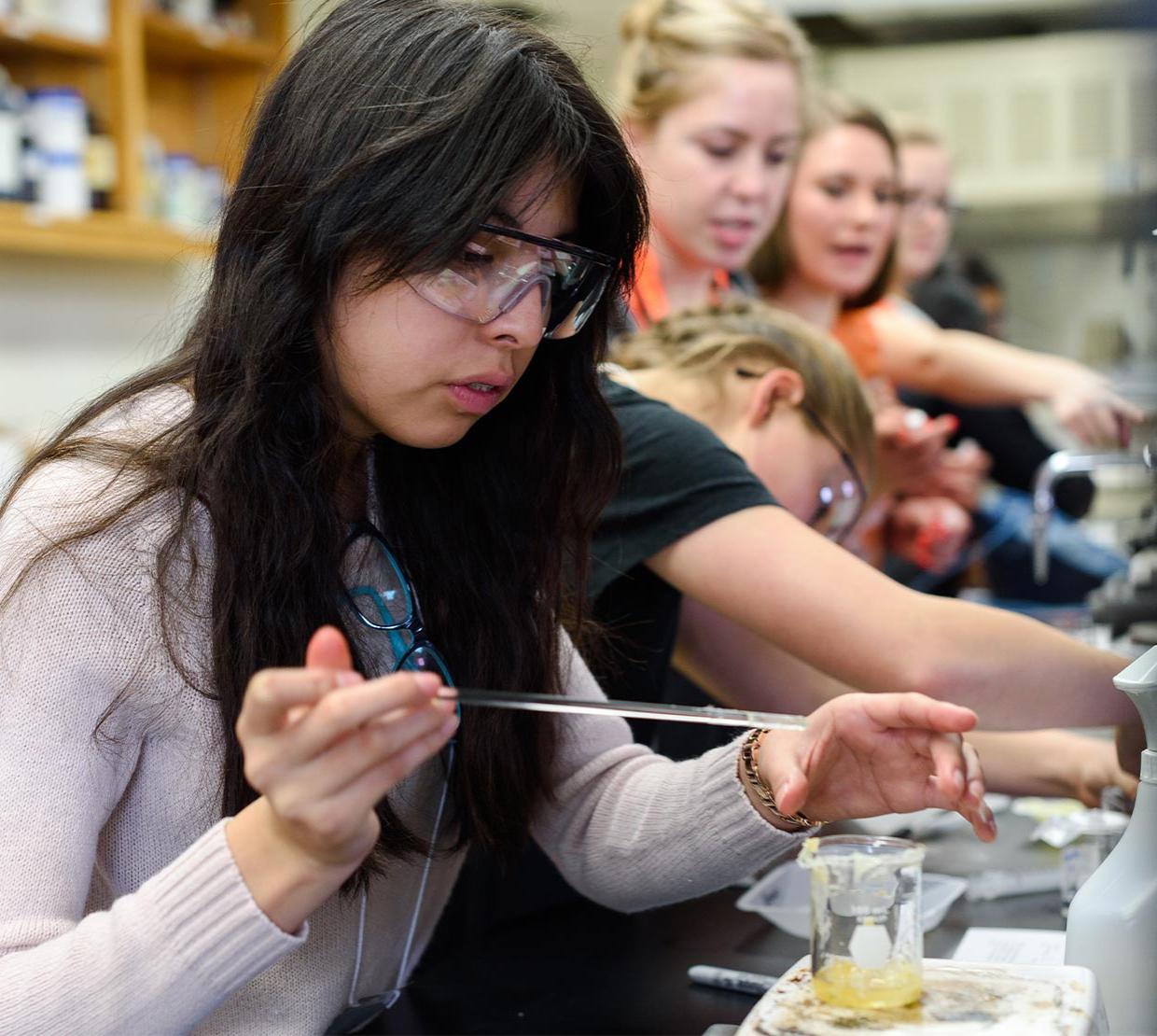
Young women explore hands-on science at Discovering the Scientist Within designed to introduce middle school girls to careers in science, technology and engineering.

Q: What is the common denominator between isolating strawberry DNA, building Knex vehicles, spalting wood, probing sea anemone symbiosis and whipping up a batch of queso fresco?

A: They are all hands-on activities designed to delight and inspire the 123 lucky middle-schoolers from across the Willamette Valley who visited OSU’s campus on March 3, 2018 for Discovering the Scientist Within, a free half-day workshop designed to encourage young women to pursue science, technology, engineering and mathematics (STEM) careers.

The program is sponsored by the College of Science, OSU Precollege Programs and STEM Academy@OSU.

Reaching young women in middle and high school is of paramount importance in our nation, as gender disparities in STEM begin to emerge when students enter college, especially for minority women. According to the National Girls Collaborative Project, women make up half of the total U.S. college-educated workforce but only 29 percent of the science and engineering workforce. Minority women comprise fewer than 1 in 10 employed scientists and engineers.

Discovering the Scientist Within, a long-running annual event at Oregon State, nurtures girls’ interest in the sciences by providing a program of hands-on activities paired with positive adult women STEM role models. The goal of the workshop is to introduce girls to STEM career fields in which women are traditionally under-represented and change the stereotypical perception that scientists are male and that science is ‘difficult’.

“When Discovering the Scientist Within was first started in the 1970s, women were definitely underrepresented in all fields of science,” said Kari van Zee, instructor in biochemistry and biophysics and member of the event planning committee. “While we’ve made progress in some areas, like the biological sciences, we still have a long way to go. This event is a powerful way to get young women to consider a possible future in STEM.

“There is nothing like seeing a seventh grader’s face light up as she works on an exciting project side by side with a female scientist, engineer, or coder.”

In collaboration with co-organizers Emily Nicholson (Precollege Programs), Cathy Law (STEM Academy @ OSU) and Diana Rohlman (Environmental Health Sciences Center), Van Zee recruited over two dozen scientists at all stages of their careers to host the event. Mathematician Mary Beisiegel opened the morning with an inspirational talk about her own unconventional path from a struggling math student to becoming a math professor and nationally recognized teacher. She encouraged the young women to believe in themselves, work hard, and find people and mentors to support them. “How do you want to change the world?” she asked them. “Use that to inspire your work in mathematics.”

Graduate and undergraduate students from the Linus Pauling Institute and the Departments of Mathematics, Biochemistry and Biophysics, Physics and Integrative Biology led small hands-on workshops. In addition to learning about these topics, the students also created 3-D models in a computer graphics lab, rode a hovercraft, made and ate a dry-ice cream treat and sketched out a viable pharmaceutical product.

The planners of Discovering the Scientist Within made the most of the opportunity to reach parents, too. During the event, 25 parents and 10 siblings from Woodburn attended a STEM preparation and college readiness discussion in Spanish, followed by a campus tour and lunch.

The middle schoolers, 116 girls and seven boys who included underrepresented minorities from Portland, Gresham and Woodburn, were inspired and delighted by the event. When asked what their favorite part of the day was in an anonymous survey post-event, students responded:

“I loved everything about today!”

“Everything was my favorite part!”

“Learning new things and finding new job opportunities.”

“I don’t know… ALL OF IT WAS SO MUCH FUN!”

Discovering the Scientist Within is organized by OSU’s Office of Precollege Programs, which supports and oversees a wide range of youth outreach activities designed to increase college access and academic preparation for Oregon’s youth.

Toothpicks scattered on a table

Making mathematics cool at Da Vinci Days

Founded in 1989, Corvallis's wildly popular community festival, Da Vinci Days, packed plenty of entertainment, learning and pageantry to engage people of all ages. Da Vinci Days 2018 featured a series of five of Science, Technology, Engineering, arts and Mathematics (STEAM) talks as well as arts and science exhibits, great music and the Graand Kinetic Road Race on July 21.

The STEAM lectures encompassing engineering, science and arts were held throughout the month of May at several venues in Corvallis. Mathematics Ph.D. student Sarah Hagen was one of the featured speakers. Her talk on "Ancient Greek Astronomy" described the tools used by the ancient Greeks for astronomical calculations. Hagen led the crowd on a journey of discovery that revealed how the ancient Greeks were able to measure the size and distance to both the moon and sun with surprising accuracy and how, in the present day, we could make such measurements ourselves.

On Saturday, July 21, members of the mathematics department contributed to the da Vinci Days festival at the Benton County Fairgrounds by hosting a booth where visitors could participate in a daylong crowd-sourced effort to approximate the value of pi via discrete trials of the Buffon Needle problem.

Nearly 4000 needles (toothpicks, really) were dropped by more than 150 participants. With parents, siblings, and friends egging them on, the event engaged many more than that. There were toothpick droppers of all ages, and judging from audience reaction it was truly math made cool (to quote one parent).

The final tally: Of 3890 toothpicks dropped, 2389 came to rest touching one in a grid of parallel lines spaced one toothpick-length apart. Can you calculate the resulting approximation of pi?

Better yet, Saturday’s experience suggests that this is a very interesting conversation starter with non-mathematicians!

Hats off to mathematics faculty and graduate students Sarah Hagen, Dan Rockwell, David Pengelley, Naveen Somasunderam, and Dionysus Birnbaum for making it happen on the day, and to Mary Beisiegel and Branwen Purdy for assistance with planning of this and related outreach efforts

Sarah Hagen, Branwen Purdy and Emerald Stacy standing in front of bush on OSU campus

Mathematics graduate students devote time to community outreach activities

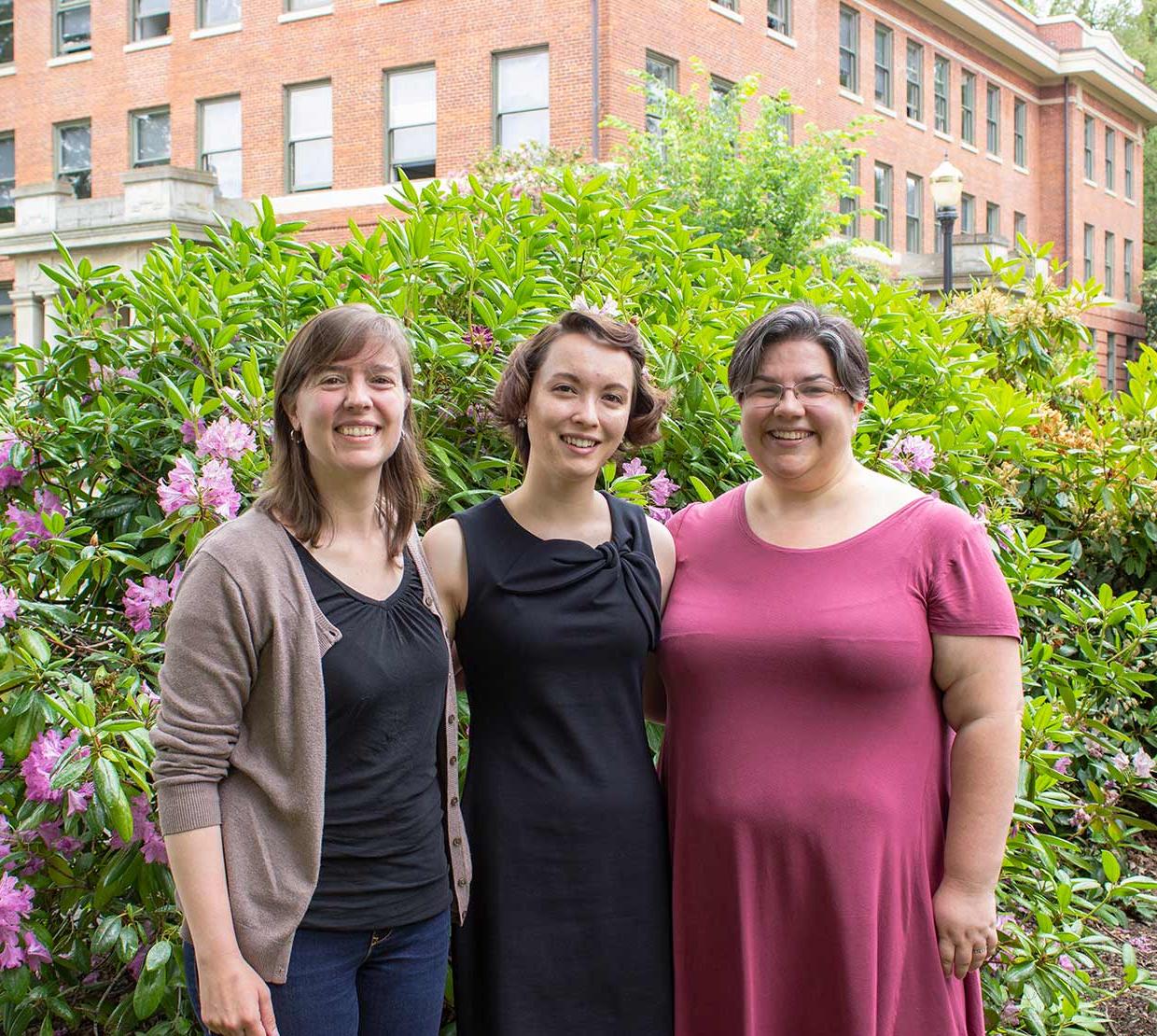
(left to right) Sarah Hagen, Branwen Purdy and Emerald Stacy

In addition to their busy schedules of research, teaching, coursework, and professional development, mathematics graduate students Sarah Hagen, Branwen Purdy, and Emerald Stacy have also been dedicating their talents toward sharing their love of mathematics with the broader public.

Sarah Hagen, a fourth year PhD student doing research in partial differential equations, likes to refer to herself as a "born-again mathematician." As an undergraduate philosophy major, she did not take a single math class. It was only years later that she fell in love with the subject, almost by accident. Ever since her "conversion," Hagen has been deeply interested in finding ways to communicate the pleasures of mathematics to those outside of the mathematics community.

In preparation for the total solar eclipse passing through Corvallis in 2017, Hagen combined her love of math, astronomy, and history, to give a series of talks on how the ancient Greeks used the eclipse events to measure the moon and the sun. She spoke at the Corvallis Public Library, Tsunami Books in Eugene, and the OSU Space Grant Festival. These talks were very well-received, and the Corvallis Public Library has since asked Hagen to develop more mathematics lectures directed towards the general public. To that end, Hagen developed an interactive presentation (with lots of props and audience participation) for Pi Day.

Math instructor David Pengelley was at the library for Sarah’s Pi Day talk and had this to say. "Sarah had a standing-room-only audience of over 100 members of the Corvallis community. The topic was of course π, specifically whether π is really a constant as one varies the size of circles and the nature of geometry, e.g., on a sphere rather than a Euclidean plane. The highly interactive presentation had groups of participants measuring, calculating and discussing π in different situations, using beach balls. The audience was of all ages, with young children and school children working enthusiastically together with adults up to well past retirement age."

Hagen gave a reprise of her ancient Greek astronomy for the Da Vinci Days festival in May of 2018, and is currently working on another talk for the public library on counting infinity. Hagen is excited to see the strong interest in the broader community and is honored to be an informal math ambassador.

Branwen Purdy is a second-year graduate student doing research in the area of topological data analysis. In May 2018, Purdy marked one year of volunteering at the Coffee Creek Correctional Facility (CCCF). The CCCF is a women’s prison in Wilsonville, OR that works with Portland Community College to offer several education opportunities to women, including a GED certificate program. Specifically, Purdy works with women who are hoping to enter this program and need a refresher on their mathematics skills. Common topics include long division, fractions, decimals, and percentages. Volunteering at CCCF is always a highlight of her week, and she finds it empowering to be working with women who are so dedicated to making a positive change in their future.

This past spring, Purdy was accepted into the Oregon Museum of Science and Industry (OMSI) Science Communication Fellowship, with generous support from the College of Science and the mathematics department. She has participated in four deep-dive workshops on informal science learning and how to communicate academic research with a general audience. In addition to connecting with graduate students in other departments here at Oregon State University, she has been able to join a wider Portland network of scientists and engineers who care about fostering science curiosity in the next generation. This summer she will be participating in several OMSI public events, such as Meet-A-Scientist Day and OMSI After Dark, to share hands-on learning experiences about her research in topological data analysis.

Emerald Stacy is a sixth-year graduate student in mathematics doing her research in number theory. Stacy describes herself as passionate about teaching mathematics and creating inclusive spaces for her students, and she has recently been involved in creating training programs for graduate students in equity inclusion and justice.

In April 2018, Stacy was an invited speaker at the March for Science in Salem, Oregon. She talked about science research and the roles of women and marginalized groups within it, and about the need for the physical spaces in science education to be accessible. In particular, she spoke about the importance of access to bathrooms, collaborative learning spaces, and seats in classrooms that can accommodate large or pregnant bodies.

In spring 2018, Stacy expects to finish her PhD in mathematics with a minor in women, gender, and sexuality studies and a graduate certificate in college and university teaching. Next fall, she will begin her career as an assistant professor at Washington College, a small liberal arts college in Chestertown, Maryland.

children looking at science themed booth

From the lab to the world: OMSI Science Communication Fellowships

The OMSI Science Communication Fellowship Program

Applications are open for Oregon's top academic and professional fellowship program: The Oregon Museum of Science and Industry's OMSI Science Communication Fellowship. For spring 2018, the fellowship is open to researchers or science professionals including faculty, graduate students, technicians, or other individuals in STEM and health related professions.

The deadline for applications is Wednesday, November 1.

Held primarily in Corvallis, OR on the OSU campus, OMSI Fellows participate in a series of professional development workshops that cover science communication best practices and provide opportunities for participants to practice new skills and techniques. In collaboration with OMSI, each Fellow will develop a unique hands-on educational activity designed to communicate their research to public audiences and will join OMSI in engaging museum visitors with these activities at Meet a Scientist events.

A series of four professional development workshops will focus on building skills to effectively communicate scientific research with broader audiences. Workshops are 3-4 hours each, spaced over the course of three to four months.

Tuition for the program is $1850 per participant. The Science Dean's Office will cover half the tuition for all accepted College of Science applicants.

The OMSI Science Communication Fellowship Program is an excellent way to fulfill broader impact and outreach goals for grant-funded research at OSU. Many of the participants in the Fellowship program secure their tuition through broader impacts or education and outreach components of current research grants.

An online application and further information about the Fellowship program can be found on OMSI's website.

Arial view of Austin Hall

2017 Oregon Invitational Math Tournament hosted on campus

37th Annual Oregon Invitational Math Tournament (OIMT) at OSU

Young mathematicians from across the state participated in the 37th Annual Oregon Invitational Math Tournament (OIMT) at Oregon State University's College of Science on Saturday, May 13, 2017. The OIMT has been hosted annually by the Departments of Mathematics at Oregon State University, University of Oregon, and Portland State University (and in previous years, Willamette University) for the past 37 years.

Students are invited to the Tournament based upon their performances at regional mathematics competitions held at community colleges throughout the state. Exceptional scores on the AMC-10 and AMC-12 exams may also earn them an invitation.

Coordinators Raven Dean and Katy Williams in the Department of Mathematics, along with the help of numerous mathematics faculty and graduate students, made the event a resounding success.

The statewide competition for top regional scoring high school math students included a 60-90 minute written exam and a team problem-solving competition.

Read the full article with a list of winners from each category.


Read more stories about: events, mathematics, outreach


Subscribe to Outreach