Students

Students

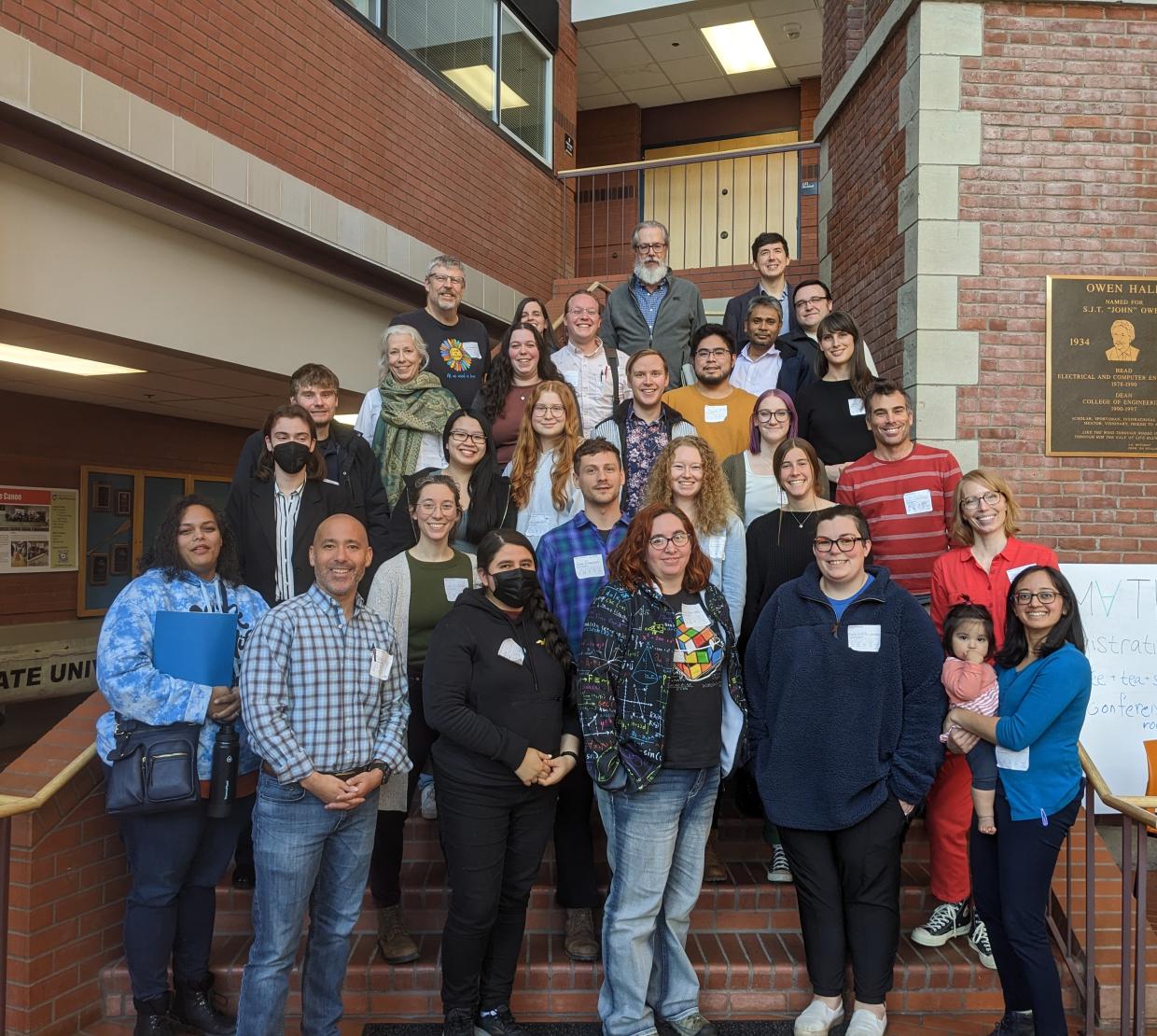
A group of individuals stand on a staircase for a photo during a mathematics conference.

Making math inclusive: Math For All satellite conference

By Kaitlyn Hornbuckle

Oregon State University Assistant Professor Swati Patel and two colleagues, Padi Fuster and Robyn Brooks, wanted to do something to counter systemic inequities in mathematics. In response, they founded the Math For All conference at Tulane University in New Orleans in 2020.

“We created this conference to try to build a more positive and welcoming culture in mathematics,” Patel said. “We thought of a conference that would be an open and friendly space for people to gather and talk about math, math education and how it relates to diversity, justice and inequity.”

Math For All is now a national conference that hosts regional programs annually throughout the country, including a satellite location at Oregon State where 40-60 people attend in Corvallis for free, thanks to generous donor support and scholarships. Attendees learn how mathematics applies to everyday life and experience a sense of belonging to a powerful scientific community. Talks and discussions tend to cover everything from human rights in data science to the mathematics of paper folding.

OSU's satellite conference often welcomes people from local community colleges and other universities, drawing mathematicians from undergraduates to instructors and faculty members.

Breaking down barriers in mathematics

Organizers ensure the conference is structured to promote dialogue between attendees, encouraging them to bridge the gap between their mathematical interests and other human interests that may spark commonality between them. One year, attendee nametags sported the person's unique interests like math as art, trivia or social justice.

“It makes me very happy when undergraduates feel comfortable in this space to ask questions. It takes courage to do that,” Patel said. “It’s not easy to raise your hand and ask a question to a speaker.”

Oregon State graduate student and co-organizer Leah Sturman said in 2023, the first guided discussion included an activity where participants matched important mathematical theorems to the actual societal impact.

Participants then split into groups and developed flowcharts that related those theorems to another branch of math they were familiar with. The activity asked the question, “What does my math mean for people around me?” Some groups decided to relate the theorem to a tool they use themselves, such as illustrating how the Pythagorean Theorem relates to GPS.

“Mathematics is far more doable than a lot of people think,” Sturman said. “It is not nearly as impenetrable or scary as people’s guts tell them. I’ve seen people who think they are bad at math actually be really good at it.”

After the activity, co-organizers posted these flowcharts on the wall for other people to see throughout the day.

“In the second session, we had a little bit more discussion around the thought behind the flowchart activity,” Sturman said. “You know, how can we be conscientious and choose to do mathematics that has a positive impact on society?”

The topics discussed are always varied, so attendees can see how mathematics impacts society as a whole, including the communities they are a part of. This enables everyone to bring their own experiences to the table, as the organizers intend.

"When I went to college, I don't ever remember having a space when I was an undergrad where the conversations like this were being facilitated and were encouraged."
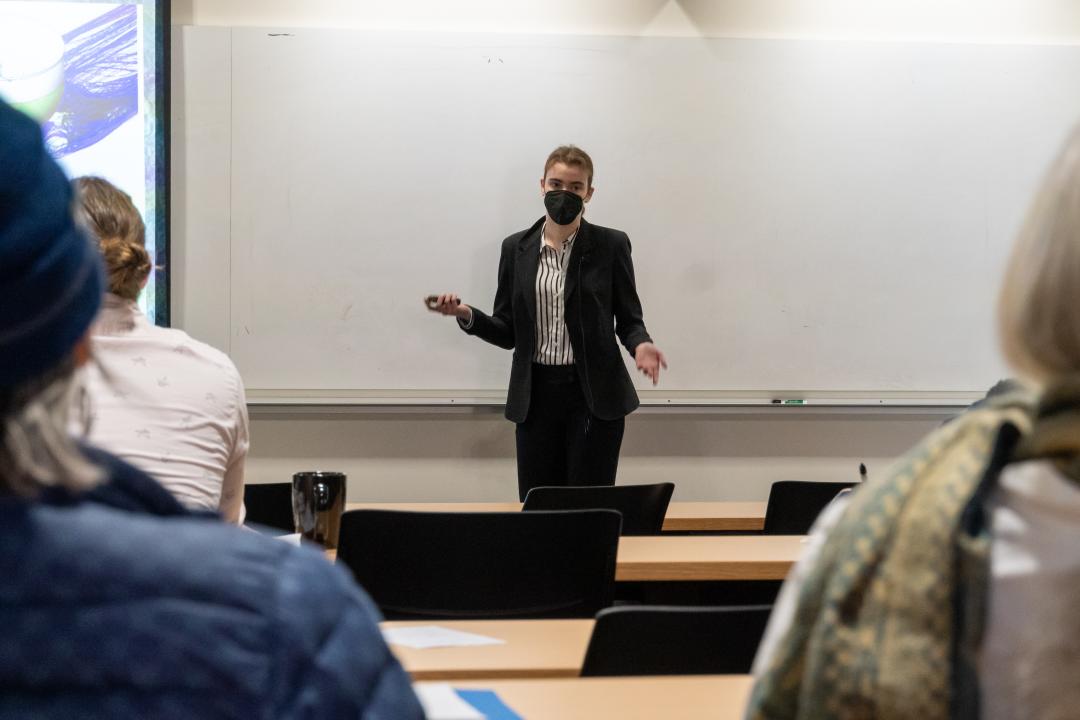
An individual in a black suit stands at the front of the room during the mathematics conference.

Fennel Connelly gives a presentation entitled, "Math, Marine Energy and MECC: An undergraduate perspective on wave energy converter design."

The conversations throughout the conference are not strictly mathematical. Oregon State Mathematics Instructor and co-organizer Michael Gilliam watched students partake in conversations where they wrestled with implicit bias, racism and other issues impacting communities.

“When I went to college, I don't ever remember having a space when I was an undergrad where the conversations like this were being facilitated and were encouraged,” Gilliam said.

For him, these types of conversations are beautiful to witness because students are able to combine the societal impact of mathematics with general concepts they learn in the classroom.

“The purpose of the conference was to create a space where mathematicians can present their findings and feel inclusive,” said Adaline De Chenne, a graduate student and co-organizer at Oregon State. “The way we set our conference apart is there's more attention to inclusivity, there's attention to making the participants feel like they belong, and there are discussions around those topics in mathematics, specifically how we can make our community more inclusive and diverse.”

From meeting new professionals to learning how mathematics applies to everyday life, Math For All is a place for participants to learn in an inclusive environment powered by diversity.

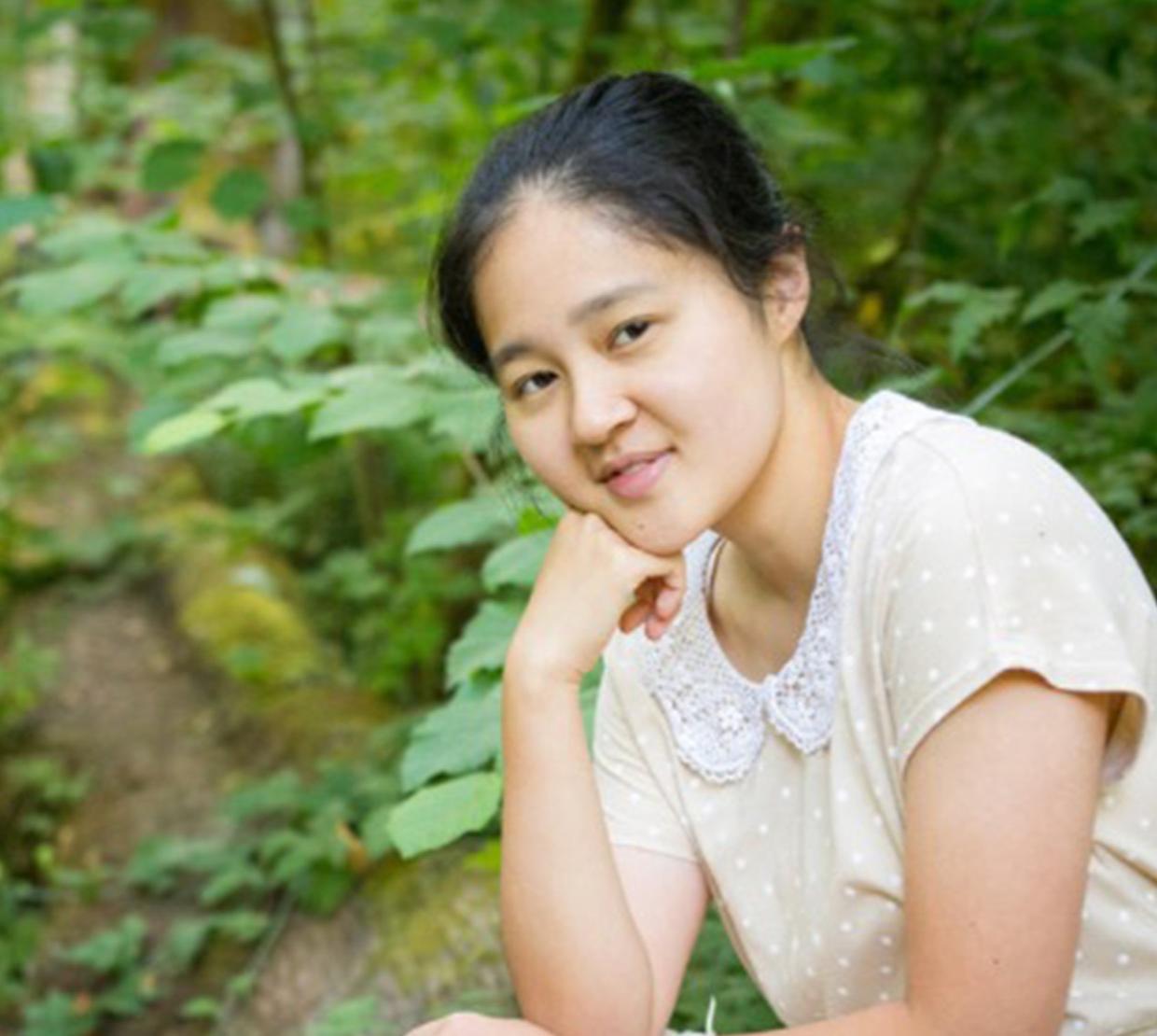
Saki Nakai sitting outside in a forest.

Mathematics graduate to research cross-cultural psychology for Fulbright

By Grace Peterman

France, Japan and Luxembourg: international experiences give Saki Nakai a rich, interdisciplinary perspective.

Saki Nakai is not your average pre-med student. The graduating senior double majored in mathematics and psychology at OSU and has spent the last two terms studying abroad in France to complete a French minor. She is also one of two College of Science students and alumni to receive the 2022 Fulbright Student Award. This award will support Nakai for one year of independent study in cultural psychology at the University of Luxembourg.

Nakai was drawn to OSU for its Honors College and the opportunity to weave her diverse research interests into a thesis project. She started as a psychology major, but she became really interested in how math could be used to answer questions relevant to medicine and psychology.

Using math to support mental health

Completing the math major on top of her pre-med courses was a challenge, but Nakai is glad she did. “Sticking with the math major gave me a more enriching college experience,” she said. “The nature of the subject requires you to take time to do the homework, so people just naturally come together and collaborate in the Math and Statistics Learning Center (MSLC).”

Embracing teamwork and collaboration paid off for Nakai during the pandemic, when she took one of her hardest courses, MTH 343 Introduction to Modern Algebra, over Zoom.

“The entire class time is spent doing math problems, and the instructor Filix Maisch would hop around between Zoom rooms to help us,” she said. “I did struggle with it a lot, but the challenge really brings students together. I made some of my best math friends in that class.”

“Sticking with the math major gave me a more enriching college experience.”

Growing in confidence as a mathematician, Nakai took on research that combined her two majors, math and psychology, through the Summer Undergraduate Research Experience (SURE) Science program. Exclusive to the College of Science, SURE Science allows students of any year to get paid to do 11 weeks of full-time research over the summer with faculty from any college. Nakai completed a project using ordinary differential equations and dynamical systems theory to model bipolar disorder, under the mentorship of Vrushali Bokil, professor of mathematics and College of Science associate dean of graduate studies and research.

“SURE was a completely new perspective on medicine,” said Nakai. “The project was important to me because it was the first time I saw how I can use mathematics to actually answer questions in psychology and medicine, and that’s my ultimate career goal.”

Nakai also used applied math in her research project for the NSF-funded Research Experiences for Undergraduates program, a fully funded research experience which she completed at the University of Nebraska-Lincoln summer of 2019. Nakai’s project investigated reciprocal and non-reciprocal support in an Inuit community in Labrador, Canada using social network analysis. “My poster won first place in sociology at the REU program, and I got to go to the Emerging Researchers National Conference in STEM in Washington, D.C. to present it,” she said.

Cultural identities at home and abroad

Both of these projects were meaningful to Nakai because her motivation for pursing medicine is to help vulnerable populations and expand acceptance of diversity. Nakai was born in the U.S. to Japanese parents, so cross-cultural competence deeply informs her perspective. “That aspect of my personal experience has been a big part of the research I’ve done,” she said.

After high school, Nakai took a gap year to work in an international primary care clinic in Japan. “Since it was an international clinic, we had both Japanese- and English-speaking patients. The doctor spoke English, but some of the nurses didn’t,” she said. Nakai worked as both receptionist and translator wherever she was needed in the clinic.

Being immersed in both Japanese and U.S. cultures, Nakai researched some of their differences in her psychology coursework. She did a statistical analysis comparing the manifestation of shyness in Japan and the U.S. “Rates of shyness are higher in Japan, but a lot of it comes from cultural differences,” she said. Japanese culture is more collectivist, while the U.S. is more individualistic. How self-expressive or reserved people are is influenced by these cultural mindsets. Thus, we cannot apply the same scale to measure shyness in Japan that we would in the U.S.

“Doing that kind of research is empowering because it gives a voice to people who might not otherwise be heard,” Nakai said.

An internationally-informed physician

For the last six months, Nakai has been studying abroad at the University of Poitiers in west-central France. Living with a host family and studying exclusively French for six months has brought a new dimension to Nakai’s multicultural awareness.

Inspired by the experience, she will use her Fulbright award to complete a research project on cross-cultural psychology in Luxembourg, a small country that borders France, Germany, and Belgium. The project will explore identity construal and acculturation in American and Japanese expatriates living in Luxembourg’s unique multicultural and multilingual setting.

Nakai will use hybrid images and visual primes to analyze how people respond to cultural mixing. “I might show American participants a picture of a hamburger, a picture of a typical Luxembourgish lunch, and also a hybrid image, for example, a lunchbox with both. I can then ask them what they feel about these images, and with the hybrid image, do they think it’s the best of both worlds, or do they react to it with disgust?”

“Doing that kind of research is empowering because it gives a voice to people who might not otherwise be heard.”

Nakai has embraced living in the best of both worlds during her time in France. She and her host family have traded off cooking Japanese and French foods for each other. “I made sushi for them, and they were pretty fascinated by the whole process,” Nakai said. In return, they introduced her to delicious raclette and boeuf bourguignon.

Ultimately, Nakai wants to be a physician, and she anticipates that all of her multicultural experiences will enable her to be a dynamic, effective communicator with many different types of patients. She sees herself eventually serving Japanese-American communities in the U.S. “Multicultural Luxembourg will serve as a blueprint for the multicultural U.S. I want to make a society that would really value diversity,” she said.

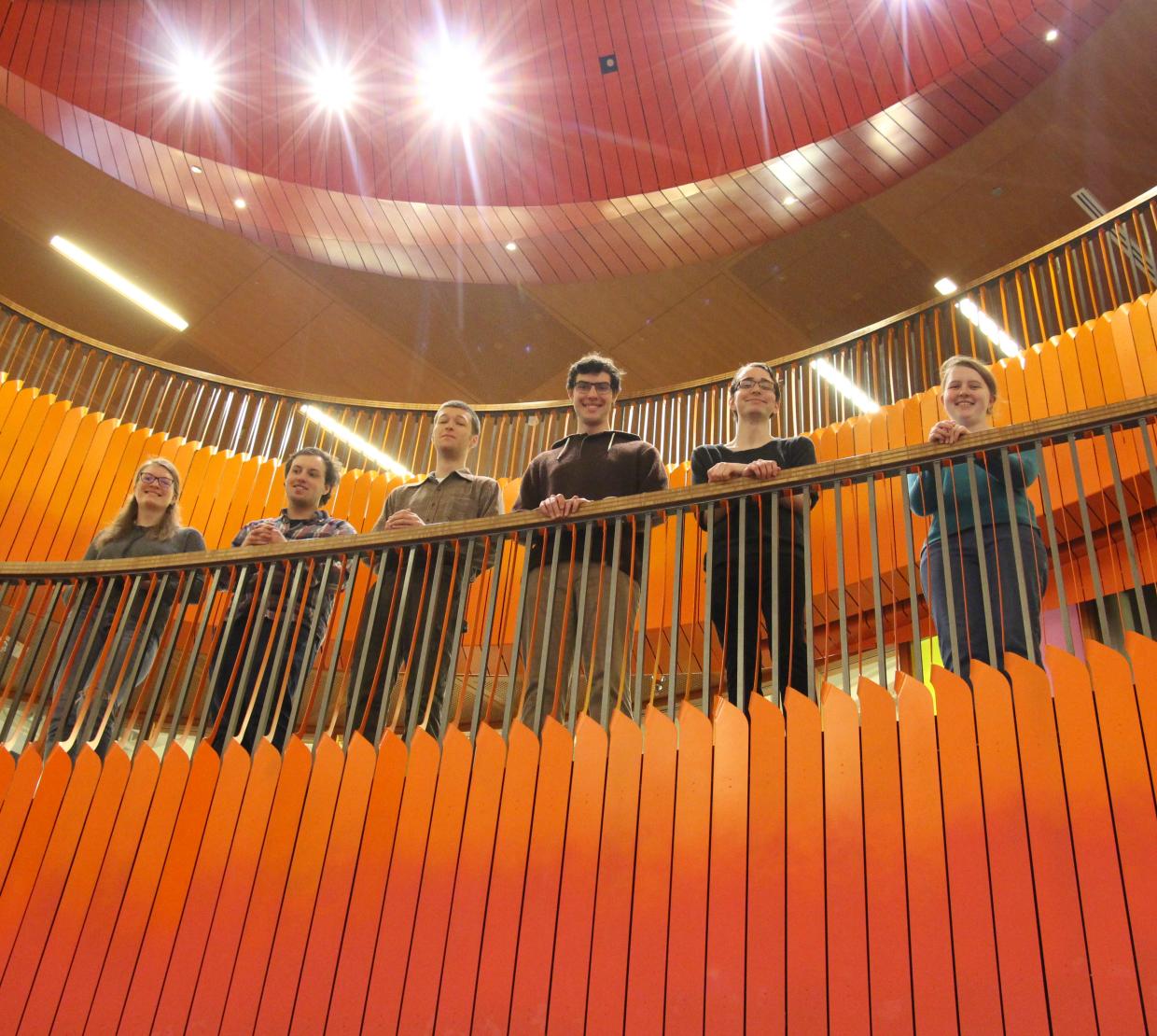
Six undergraduate students who participated in URSA in 2019. They are standing on the stairwell in the Student Experience Center.

URSA Engage funds undergraduates to work on mathematics research

(From left to right) Anneli Brackbill, Cooper Nicolaysen, Alan Schultz, Darwin Nesheim, Nathanael Bowles, Elizabeth Riutta (missing: Abigail Bernasconi). Photo session arranged by David Wing. Photos taken at the Student Experience Center.

The Office of Undergraduate Education through its URSA Engage program has funded seven undergraduate students to work with three mathematics faculty on mathematical research projects. URSA Engage is designed to establish mentoring relationships for undergraduates early in their academic programs at OSU. The goal is to provide first and second year students, or transfer students in their first year at OSU, opportunities to pursue research under the guidance of an OSU faculty member. Projects that integrate interdisciplinary work are particularly encouraged. Project summaries were drafted by faculty and posted on the URSA Engage website. Interested students were encouraged to meet with faculty to discuss details. While mentors can help students formulate ideas, the applications were written in the students’ own words. Students were assessed on their ability to articulate the professional and personal impacts of the project and their grasp of their role in the project and what needs to be accomplished.

Congratulations to Alan Schultz and Cooper Nicolaysen who will work with mathematics instructor, Dr. Hoewoon Kim; Darwin Nesheim, Abigail Bernasconi and Elizabeth Rayona Riutta who will work with Visiting Assistant Professor Blessing Emerenini; and to Nathanael Bowles and Anneli Brackbill who will both work with Professor Malgo Peszynska.

The students will meet weekly with the mentors for 15 weeks (mid-Winter 2019 to the end of Spring 2019). Each participant will be expected to present their results at the Celebrating Undergrad Excellence Symposium in May or the Summer Undergraduate Research Symposium in September. Students will also participate in a professional development workshop sponsored by the URSA Engage program.

The project supervised by Dr. Kim involves solving the linearized incompressible Navier-Stokes equations. The first component of the work is developing a mathematical and physical understanding of the motion of incompressible fluids (e.g., water) in the interior and exterior of a sphere through basic differential equations such as the diffusion equation and the Laplace equation. Secondly the stability problem deals with the following interesting question: “under what conditions can we show that a mathematical object which satisfies a certain property approximately must be close to another object which satisfies the property exactly?"

Alan Schultz is a freshman physics major. After graduation, he is thinking about either going to graduate school or joining the United States Air Force. Cooper Nicolaysen is a sophomore physics and math double major.

"I live by the idea that we must challenge ourselves and we must do that by taking on the most impossible tasks!" -Cooper Nicolaysen

Dr. Emerenini’s project is related to the mathematical modeling of super-spreading of infectious diseases, specifically relating to disease transmissions, persistence and extinction. The projects will involve significant efforts in modeling (creating equations), analysis (understanding properties of solutions) and simulations (solving numerically).

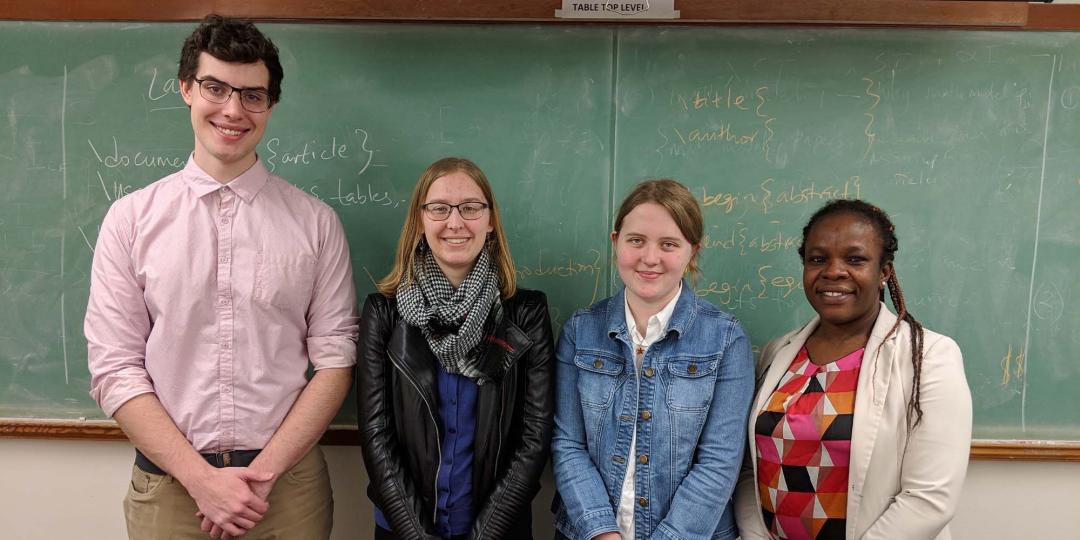
Dr. Emerenini's URSA Engage research group (from left to right): Darwin Nesheim, Abigail Bernasconi, Elizabeth Riutta and Blessing Emerenini.

Dr. Emerenini's URSA Engage research group (from left to right): Darwin Nesheim, Abigail Bernasconi, Elizabeth Riutta and Blessing Emerenini.

Elizabeth Riutta is currently a freshman biophysics and biochemistry major but is considering a switch to mathematics. She is interested in the medical profession and plans on going into emergency room surgery as a career path. Abigail Bernasconi is a sophomore double major in Public Health and German, with a minor in statistics. She is currently studying abroad at the Universität Tübingen near Stuttgart, Germany. After graduation, Abigail plans to go on to graduate school and study epidemiology. Darwin Nesheim is a sophomore majoring in mathematics.

“I have been interested in mathematical modeling for a long time and seeing this opportunity come up was fantastic!" -Darwin Nesheim

The projects supervised by Prof. Peszynska are related to phase transitions and porous media flow. The first project involves understanding the effects of climate change on the thawing and refreezing of permafrost. The second project is to create a model to predict the spread of nuclear waste through different mediums: air, water, and several types of soil. Each project entails examining existing data, then creating a mathematical model, and finally simulating the solutions in MATLAB.

Nathanael Bowles is a first year transfer student majoring in math. Nathanael went to an art focused middle school and high school. So going from theater, choir, and photography to mathematics has been a very interesting process for him. Anneli Brackbill is a double major in nuclear engineering and mathematics (in the Applied and Computational Mathematics option). She plans to go to graduate school after graduation.

This article was created by the Newsletter/Media Committee with photo editing by Joy King. Please email [email protected] with any comments.


Read more stories about: students, mathematics, undergraduate research


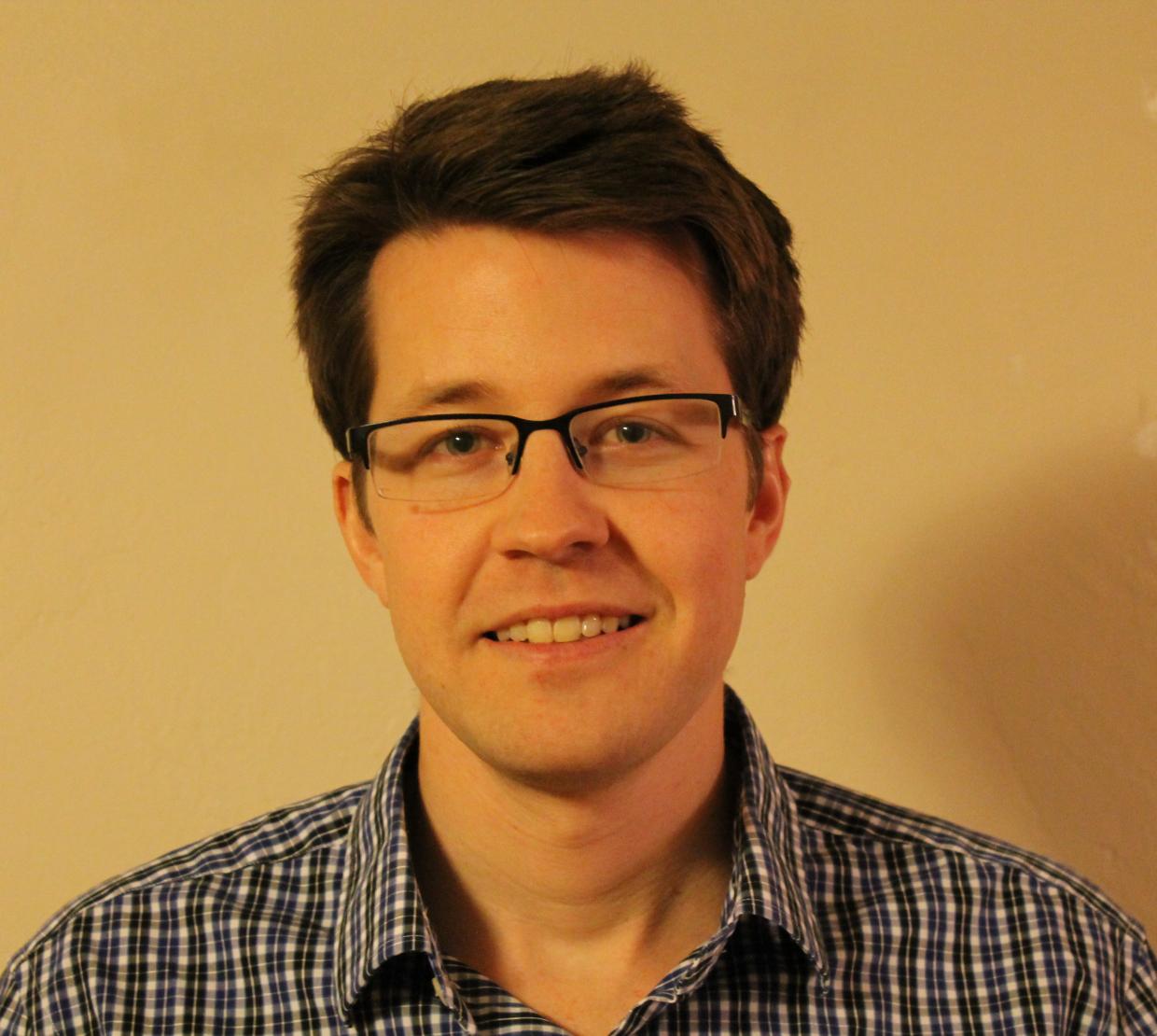
A portrait image of Tim Costa.

Math student's extraordinary research accomplishments

By Stephanie Wise

Tim Costa's journey through mathematics has taken him through various interdisciplinary fields.

Tim Costa’s path took him from pure mathematics through the world of semiconductors to multiscale porous media and nonlocal mechanics. His academic career began in political science, but his underlying passion for mathematics brought him back to school as a post-bacc in 2010. This social science background proved useful to him: "My background in the softer sciences has been a major strength," Tim believes. "It has provided me with the skills to communicate my work to those outside my specific field, which is critical to interdisciplinary collaboration." Still, he found himself drawn to a career in mathematics research: "I knew that ultimately I wanted my work to make a tangible difference in the world."

Tim entered the Mathematics graduate program in 2011 with enough depth in undergraduate mathematics through coursework at the University of Oregon to guarantee success in the core classes. However, he had a rather modest exposure to the breadth of mathematics and in particular to the opportunities in applied mathematical modeling. Soon after arriving at OSU, Tim became very interested in a career involving Computational Mathematics. "It became very clear that computational and applied mathematics, and in particular numerical analysis, contained the blend of mathematical beauty and real-world impact that matched my career goals," Tim says.

An opportunity arose for Tim to be involved in an interdisciplinary project: the NSF "SOLAR: Enhanced Voltaic Efficiency Through Heterojunction Assisted Impact Ionization," led by Physics Professor Stephen Kevan, in which Professor Malgorzata Peszynska and Physics Professor Guenter Schneider were co-Pis. Under Prof. Peszynska’s direction, Tim dove headfirst into self-guided study of basic physical principles governing the physics of semiconductors. He picked up enough computational skills and basic numerical analysis skills in his coursework to be productive, and within a few months he joined the SOLAR project. A year later, Tim had contributed already to a specific subproject with a particular mathematical problem due to the so-called "tyranny of scales." A popular physical model for the heterojunction involved accounting for a jump in one of the variables and in a flux, while all the known mathematical theory required continuity. This exciting challenge was the first step in the collaborative study, which yielded various publications and conference invitations, the latter of which Tim finds one of the "great rewards" of his time at OSU.

Guided by his long-term goals, Tim also pushed himself to become acquainted with the latest computing technology. In fact, Tim recently founded a company called Numerical Solutions with his brother, Anthony. The Numerical Solutions consulting group works with clients to develop scientific questions, numerical methods, and software implementations for their efficient solution.

As the SOLAR project came to an end, Tim switched to another multiscale application, on flow and transport in porous media. Though clearly different, the project was in an abstract way quite similar, as it dealt with multiple spatial and time scales, and with an inability to handle these with standard techniques. Here the challenge included learning enough of the enormous background to make meaningful contributions. Prof. Peszynska is pursuing a new direction of hybrid modeling in which Tim is making progress, combining pore network modeling with microfluid modeling at porescale and deriving effective models at macro scale.

By the time he graduates next year, Tim will have published (at least) 5 papers, presented at 9 national and international conferences, spent a summer at Sandia National Laboratories, worked collaboratively with peers in other disciplines. And he’s been offered his "dream job" nine months prior to his defense date. Tim says, "I'll be leaving OSU having accomplished everything I had hoped to accomplish in graduate school, and more."


Read more stories about: students, mathematics


Subscribe to Students