Women in Science

Women in Science

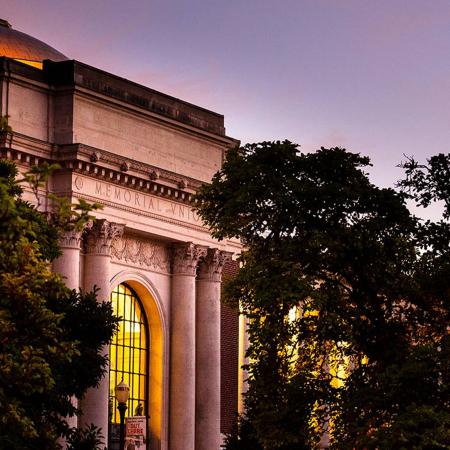
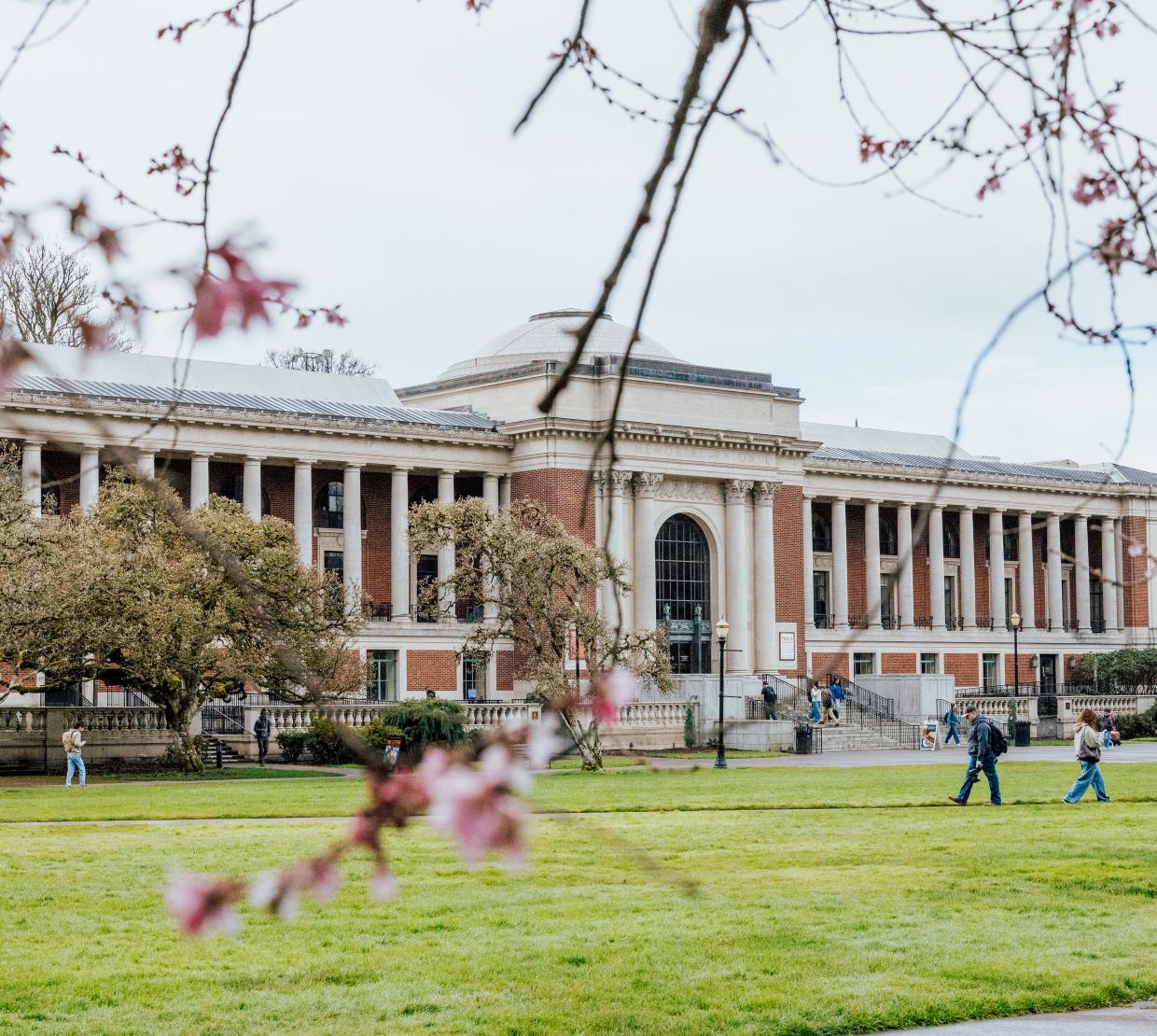
A general shot of memorial union on OSU campus with flowers.

The Wei family science legacy continues at Oregon State

By College of Science

The Wei Family Private Foundation supports Oregon State students working on complex problems across disciplines — from tracking PFAS in urban environments and studying Alzheimer’s disease at the molecular level to modeling vaccine protection and developing new battery materials — advancing work that addresses global challenges in health, the environment and energy.

Established to honor Dr. Chung Kwai Lui, the first woman to earn a Ph.D. from Oregon State, the Wei Scholarship reflects a lasting investment in scientific discovery and the students who drive it forward.

In February, the College of Science brought that work into focus, hosting the Board of Trustees of the Wei Family Private Foundation for a student research showcase. The event brought together undergraduate and graduate Wei Scholars to share their work and connect directly with the foundation whose support helps make it possible.

Representing the foundation were Edward Chen, Janet Chen, Dee Chen and John Donnelly.

“This scholarship carries forward a remarkable legacy, and we deeply appreciate how that legacy is expressed through personal connection,” said Dean Eleanor Feingold. “The trustees take a genuine interest in the scholars, which helps them feel known and supported. That came through clearly at the showcase.”

The foundation was welcomed by Dean Feingold, Executive Associate Dean Vrushali Bokil and Oregon State University Foundation partners. The College’s Research Development Unit played a key role in organizing the showcase.

People talk in a conference room.

Wei Family Private Foundation Board of Trustee Member, Edward Chen (center), engaged in conversation during the luncheon, as is fellow Board Member Janet Chen (back right).

Research across disciplines

At the showcase, Wei Scholars presented their research across chemistry, mathematics, microbiology and statistics, with projects examining disease at the molecular level and modeling health and environmental systems at scale.

Presentations included:

  • Paint: A potential source of PFAS in air and urban runoff
    Mitchell Kim-Fu, chemistry, fifth-year Ph.D.
  • A clustering method for functional data
    Xinyu “Erica” Li, statistics, second-year Ph.D.
  • Investigating lipid alterations in Alzheimer’s disease using MALDI mass spectrometry imaging
    Phoebe Lee, chemistry and mathematics, fourth-year B.S.
  • How well can we identify spatial patterns in gene expression within cell types?
    Weiqi “Grace” Li, statistics, second-year M.S.
  • Exploring the myxozoan sensing and signaling mechanism
    Laila Brubaker, microbiology, fourth-year M.S.
  • Introduction to the volume conjecture for knots
    Hsiang Thum, mathematics, fourth-year Ph.D.
  • An introduction to persistent homology transform
    Zejing Wang, mathematics, second-year Ph.D.
  • Measuring intrinsic vaccine protection across time and space
    Zhuoya “Joya” He, statistics, fourth-year Ph.D.
  • Glowing from invisible: Photon upconversion and its applications
    Mingcan Huang, chemistry, first-year Ph.D.
  • Making cheaper batteries by letting salts store energy
    Ziang Jiang, chemistry, second-year Ph.D.
  • Application of statistics in social science
    Jingtian Yu, chemistry, fifth-year Ph.D.

Additional Wei Scholars attended the showcase to support their peers, reflecting the strong sense of community within the program.

A man in sweat pants and a black sweatshirt stands at the front of a room near a computer screen.

Persistent homology transforms are explained by mathematics student Zejing Wang.

A community of scholars

For many students, the impact of the Wei Scholarship extends well beyond financial support.

“The Wei Scholarship has been instrumental in my graduate career by reducing financial stress and allowing me to focus on my academics,” said Mitchell Kim-Fu, a Ph.D. student in chemistry. “It has provided me with access to a network among the scholars and trustees. I’m impressed by the Wei Board of Trustee’s commitment to us because they foster a supportive and engaged relationship.”

Scholars also pointed to the relationships built through the program — with one another and with the foundation’s trustees.

“Their belief that we can contribute work that makes a meaningful impact on the world is especially inspiring,” said Ziang Jiang, a Ph.D. student in chemistry.

“I value the Wei Scholarship’s impact on my undergraduate career with gratitude and appreciation. This scholarship greatly supports my studies at OSU and inspires me to pursue graduate school. The Board made sure to connect with each of the scholars individually and showed interest in our research and academics,” said Phoebe Lee, a fourth-year student in a dual-degree bachelor’s program in mathematics and chemistry.

Others described the sense of connection and continuity that has developed around the program.

“The Wei Board has been nothing but kind to me and I sense that we are all immensely appreciative. I really like the annual dinner and appreciate them taking the time to come out to visit the scholars,” said Hsiang Thum, a fourth-year Ph.D. student in mathematics.

“It reminds me that there are people who truly believe in advancing science and supporting the next generation of researchers, and I feel very grateful and honored to be a Wei scholar. What stands out most to me is how genuine and caring the Trustees are. They travel from the East Coast each year to spend time with us, listen to our research and build personal connections that create a strong sense of support and belonging,” said Zhuoya He, a fourth-year Ph.D. student in statistics.

Hsiang Thum is a Mathematics student and here presents a theoretical discussion on the volume conjecture of knots.

Hsiang Thum, a mathematics student, presents a theoretical discussion on the volume conjecture of knots.

A black background with orange glitter, an apple and the year 2026.

Celebrating excellence in teaching and advising: 2026 College of Science Awards

By Hannah Ashton

The College of Science gathered on Feb. 17 to recognize and celebrate our high-achieving faculty and staff at the 2026 Combined Awards Ceremony. The evening celebrated the very best in the College, from teaching, advising and research to inclusive excellence, administration and service.

The following faculty and staff received awards in teaching and advising.

Congratulations to all the awardees!

Loyd F. Carter Award for Outstanding and Inspirational Teaching in Science (Undergraduate)

head shot of Matt Waterhouse

Matt Waterhouse, from the Department of Integrative Biology, received the Loyd F. Carter Award for Outstanding and Inspirational Undergraduate Teaching in Science.

Matt Waterhouse, from the Department of Integrative Biology, received the Loyd F. Carter Award for Outstanding and Inspirational Undergraduate Teaching in Science.

Waterhouse is known for creating an engaging, supportive and inclusive learning environment where students feel both challenged and genuinely cared for. Students consistently describe his teaching as passionate, thoughtful and deeply invested in their success. His courses emphasize real-world applications of ecology, helping students move beyond memorization and toward long-term understanding, critical thinking and practical skills they can carry into their future careers.

Students also highlighted Waterhouse’s responsiveness to feedback and his commitment to continuously improving his courses. From revising course structure after exams to building assignments that scaffold skills over time, he makes learning feel achievable without lowering expectations. His lectures are carefully organized, visually engaging and often infused with humor, creating a classroom atmosphere that is both welcoming and motivating.

“No instructor has put effort in like Matt to make the course as approachable, flexible and achievable,” one student wrote. “His flexibility when I was sick for much of the term and his compassion for other students has been nothing short of saintly. He stands as a model for excellent teaching to human beings, not just the empty vessels older generations believed students to be. Not once did he fail what we expected of him.”

Loyd F. Carter Award for Outstanding and Inspirational Teaching in Science (Graduate)

A woman in a red shirt with dark hair stands in front of a green leafy background with white flowers.

Elaine Cozzi, from the Department of Mathematics, received the Loyd F. Carter Award for Outstanding and Inspirational Teaching in Science (Graduate).

Elaine Cozzi, from the Department of Mathematics, received the Loyd F. Carter Award for Outstanding and Inspirational Teaching in Science (Graduate).

Students describe Cozzi’s classroom as a place where open inquiry is not only welcomed but expected. She encourages students to seek their own understanding, collaborate thoughtfully and speak up to check their reasoning. Her passion for mathematics is evident in every lecture, and students note how she brings them into the process through questions, discussions and creating an environment where everyone feels included in the intellectual conversation.

Her teaching style is grounded in clarity and accessibility. Students appreciate her straightforward notes, her use of the whiteboard to build ideas step by step and her ability to make challenging material feel approachable without sacrificing rigor. Beyond the classroom, she is known for being warm, supportive and exceptionally approachable during office hours.

For some students, her influence extends even further. “As someone who aspires to be a math educator one day, I see a lot of teaching habits in Elaine that I want to emulate,” one student shared.

Olaf Boedtker Award for Excellence in Academic Advising

A woman in a white lab coat sits on a stool in a laboratory.

Kari Van Zee, from the Department of Biochemistry and Biophysics, received the Olaf Boedtker Award for Excellence in Academic Advising.

Kari Van Zee, from the Department of Biochemistry and Biophysics, received the Olaf Boedtker Award for Excellence in Academic Advising.

Students describe Van Zee as a compassionate, dedicated and deeply impactful presence in their academic journeys, often from the very beginning of their time at Oregon State. For many, she is the first person who helped them see what was possible for their future, and she continues to provide that same encouragement and guidance throughout their degrees. Known for her accessibility, organization and unwavering commitment to student success, Van Zee routinely goes above and beyond to support students, often working evening and weekend to ensure they have the tools and confidence they need to thrive.

“Kari has been my advisor since my first year at Oregon State; in fact, she was the first faculty member I spoke with when I reached out as a high school senior,” one student wrote. “Her intelligence, compassion and integrity stood out to me even in our initial conversations and she helped me realize that I could accomplish virtually anything I set my mind to at Oregon State.”

Students also credit Van Zee with fostering a culture of support and belonging within the biochemistry program. Whether helping students navigate degree planning, meeting important deadlines or simply feel seen and supported, her influence is felt across undergraduate, post baccalaureate and graduate communities.

Fred Horne Award for Excellence in Teaching Science

A woman in a grey shirt and blue pants and brown hair smiles.

Devon Quick, from the Department of Integrative Biology, received the Fred Horne Award for Excellence in Teaching Science.

Devon Quick, from the Department of Integrative Biology, received the Fred Horne Award for Excellence in Teaching Science.

For more than 15 years, Quick has demonstrated an extraordinary commitment to teaching excellence at Oregon State, with a lasting impact on both her students and the broader teaching community. Her courses in Human Anatomy and Physiology are known for their rigor, clarity and deep engagement, consistently earning outstanding student evaluations and maintaining remarkably low DFW rates.

Quick’s teaching is distinguished by her commitment to active learning, inclusive pedagogy and real-world application. She integrates case-based assessments, collaborative problem solving and diverse instructional media to support students in mastering complex material. Her thoughtful use of tools such as TopHat and CATME ensures that all students can participate meaningfully, while her extensive office hours, review sessions and open door policy create a welcoming environment where students feel supported both academically and professionally. Each year, she mentors 25-30 learning assistants and teaching interns, transforming students into partners in the teaching process.

Her impact extends far beyond her own classroom. Quick co‑founded the College of Science Learning Assistant Program in 2014, which now supports more than 25,000 student enrollments annually and has become a cornerstone of active learning across the college. She has played major leadership roles in InclusiveExcellence@OSU, ESTEEME, SUMMIT‑P, and other faculty development initiatives, championing evidence‑based and equity‑focused teaching practices that have influenced dozens of instructors and tens of thousands of students.

Students consistently describe her as an advocate, mentor and source of unwavering encouragement. As one student nominator wrote, “Her passion for teaching, her ability to foster deep connections, and her commitment to creating an open and inclusive learning environment have profoundly shaped my academic journey and personal growth in a way no other professor has.”

Students wander around looking at thesis posters.

OSU Honors College degree for science students, built around undergraduate research

By Hannah Ashton

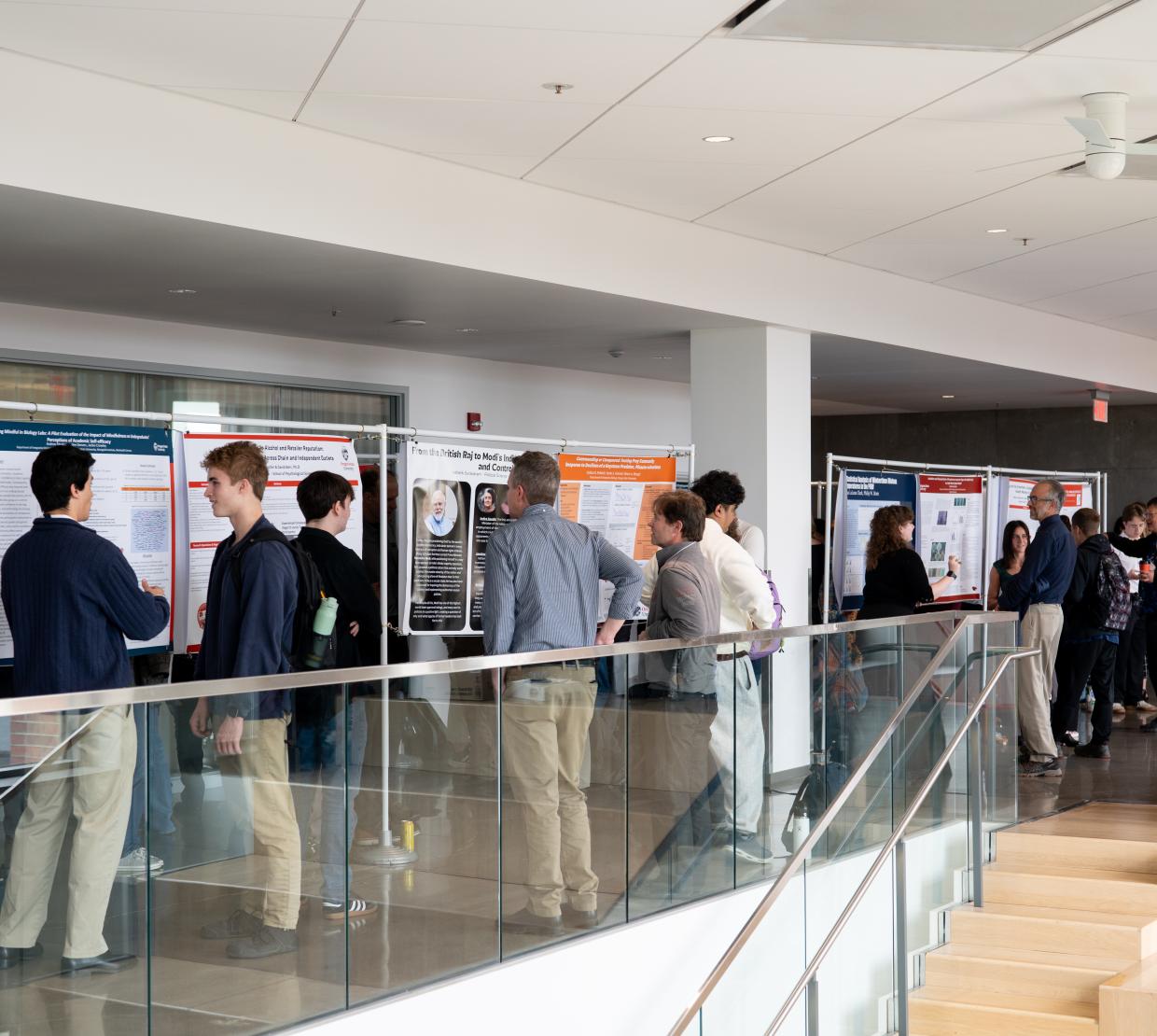
Students take part in the 2025 spring Honors College Thesis Fair.

Science students at Oregon State are driven by curiosity. They want to ask big questions, join research teams early and build strong relationships with faculty. The Honors College gives them an additional space to do that. Nearly 14% of College of Science students choose honors — double the university-wide percentage — because it opens more doors.

For science majors balancing heavy course loads, research ambitions and competitive postgraduate pathways, the Honors College offers structure, access and support that can elevate their experience.

At OSU, that support is anchored in a rare distinction: unlike universities where honors is a transcript notation, honors students earn a unique degree at OSU. And the benefits don’t stop there: Honors science courses double down on engagement between and among faculty and students alike. Early research opportunities to support required honors thesis turns undergraduates into published scholars. At multiple levels, OSU’s Honors College delivers an educational model that deeply aligns with the goals of future scientists.

Research: the heart of the Honors College experience

The emphasis on research begins early, with some science students finding opportunities through honors in their first year — an experience echoed across the College of Science for all students who proactively pursue opportunities.

Eleanor Courcelle, an Honors mathematics and chemistry major, discovered her current research mentor after seeing her present at an Honors College Faculty Research Showcase. She reached out afterward, and that connection led to a funded URSA project and ultimately her honors thesis, which applies mathematical modeling to biological systems.

Biochemistry and molecular biology Honors senior Katya Karlapati had a similar experience. As she settled into her major, she realized she didn’t want to wait to get hands-on research experience.

A woman with black hair sits at a table and looks into a microscope.

Katya Karlapati is part of Alysia Vrailas-Mortimer's laboratory. Her lab explores how different factors such as aging and exposure to toxins contribute to neurological disorders and muscular dystrophies. Vrailas-Mortimer uses fruit flies as a model organism.

“Research helps drive a field forward, and it’s really at the forefront of giving better patient care or improving medications,” she said. “The Honors College really helped give me opportunities and gave me a structure because I knew we had to do a thesis.”

Karlapati ended up in Alicia Vrailas-Mortimer's lab, a fly lab that focuses on Alzheimer’s research. This became the cornerstone of her thesis, which examines different mutations that can accelerate the development of Alzheimer’s in flies and lead to neuron death.

When science students reach out to faculty, she said, being in honors signals commitment.

“Professors know you have to do your thesis and you’re willing to put in that extra mile,” she said.

For students eyeing medical, dental or graduate school, the thesis shows a level of scholarly ability that stands out. Every honors thesis is published on OSU’s open-access ScholarArchive, meaning each undergraduate has contributed to a global body of knowledge.

“It is a pathway that sets them apart… they’re making their contribution available to the entire world,” said Honors College Dean Toni Doolen.

A unique honors framework

Unlike many universities where honors is a transcript note or participation program, OSU stands apart as one of the only institutions in the country where honors is its own degree.

Students graduate with an Honors Baccalaureate degree, which is simultaneously conferred with their major. A biochemistry major, for example, graduates with an Honors Bachelor of Science in Biochemistry, a title that signals not just engagement in honors coursework, but academic rigor backed by measurable learning outcomes attached to the honors coursework.

“Our program isn’t just about participation or just taking honors sections of classes that you might normally take a non-honors section of. We have learning outcomes specific to the Honors College, including scholarly inquiry and engaged inquiry,” Doolen emphasized.

Students sit around a table and look towards an instructor in a salmon colored shirt.

Honors College students engaging in an interactive class discussion in a small, seminar-style setting that encourages participation and critical thinking.

The scholarly inquiry learning outcome is fulfilled primarily through students doing independent research or scholarly work under the advisement of a faculty member and a committee that culminates in their honors thesis.

“This helps them grow their writing and oral communication skills. For many students, it also gives them a chance to do a really deep dive into what it looks like to be a scholar and to make a contribution to a body of knowledge,” Doolen said.

The engaged inquiry learning outcome coincides with the Honors College’s belief that students need to be able to communicate outside of their area of expertise. All students are required to complete unique classes to the Honors College called seminars. These courses offer students the opportunity to explore cross-disciplinary spaces that they might not otherwise be comfortable in. Seminars are taught pass or no pass so there is no risk to a student’s GPA.

Karlapati said those courses broadened her academic world.

“They give you an opportunity to learn about subjects in a different way,” she said. “They offer a low-stress environment to learn more and they’re also really fun.”

She took classes on leadership, astronomy, fashion and even a course built around board games that examined the history of finance.

For science students accustomed to lab reports and problem sets, that variety is often refreshing and useful.

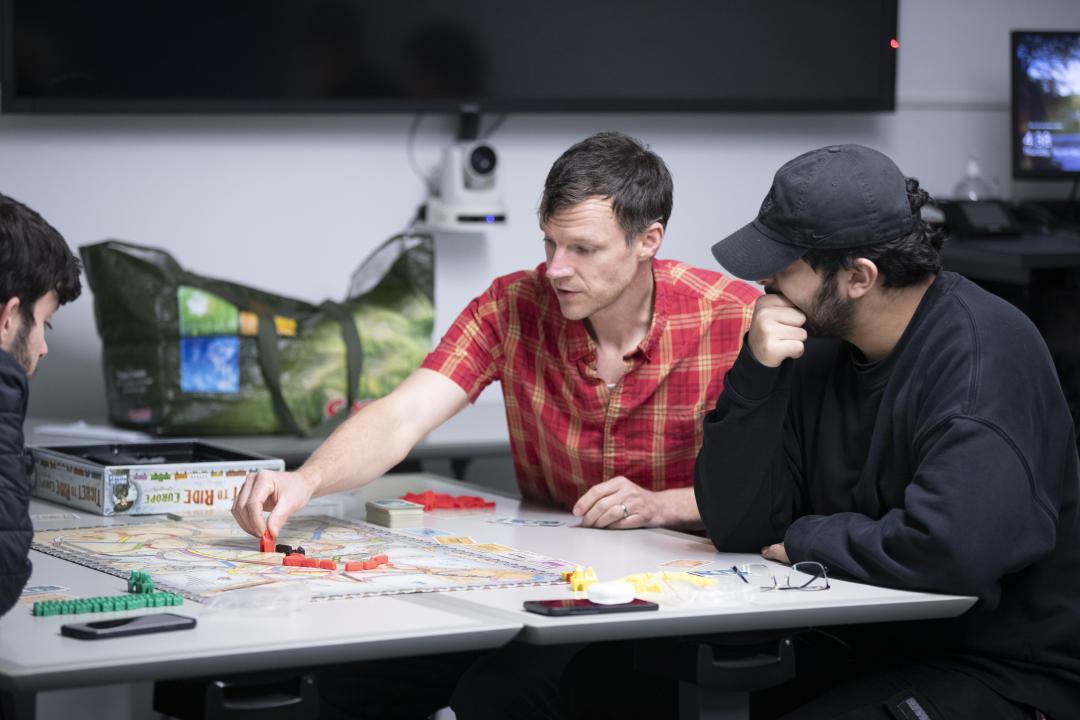
Two students and a professor sit a table and play the board game ticket to ride.

Students explore the History of Commerce through board games in an Honors College seminar. This unique course uses interactive gameplay to examine the evolution of trade, finance and economic systems in a fun, low-stress learning environment.

Building relationships in a big university

Many students said one of the strongest Honors College benefits is the highly engaged class environment, especially early on in demanding science sequences like chemistry, biology and genetics.

Courcelle said this makes first-year classes less daunting.

“The core honors classes were a lot smaller,” she said. “It made a big difference when I was applying to outside opportunities my first year …. professors knew me well.”

Karlapati agreed. “Especially if you’re just starting out, it can be an easier path to get the help you need,” she said. “It’s a really big help to have that personalized attention.”

Dean Doolen emphasized that while some honors courses are small, others are intentionally large, but use an “engaged pedagogy” marked by interaction, discussion and experiential learning.

Another benefit is community-building opportunities outside the classroom.

Karlapati lived in West Hall, parton of the honors living and learning community, and she said the friendships she made there shaped her entire OSU experience.

“I have suitemates who are going to be my lifelong friends,” she said. “Most of them are the ones going to class with you…it’s great to go into the study room and you’re seeing all your classmates.”

The SLUG — the Honors College student learning space on the Corvallis campus — is another space that supports honors students. "SLUG" stands for Students Learning UnderGround and dates back to the Honors College's early days in Strand Agricultural Hall, when the student learning space was in the basement.

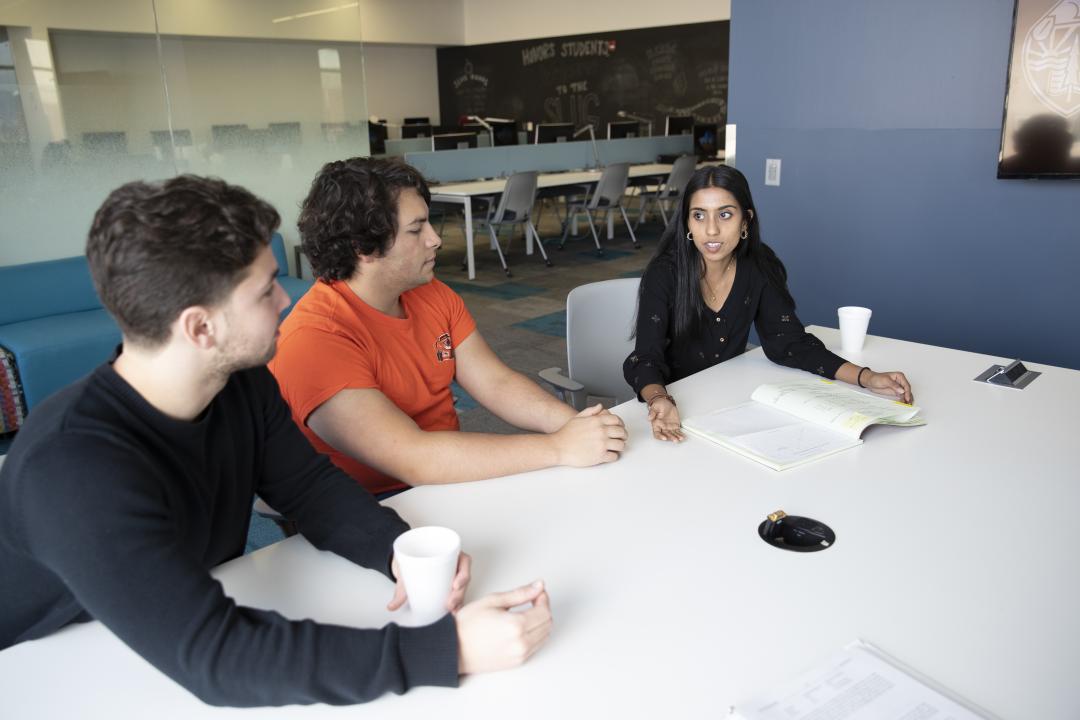
Three students sit at a table.

Honors College students study and collaborate in the SLUG, a dedicated space designed for connection, group work and academic support.

“It’s a great study spot, and the best part is the food,” Karlapati said. “There’s always a meal in there you can take whenever you need.” The Honors College supports students through its Forgot Your Lunch program, which provides food in the SLUG for anyone who forgot their meal or needs a little extra help.

The Honors College provides community for students who might otherwise feel overwhelmed.

“OSU is a big place now,” Dean Doolen said. “For a lot of students, the Honors College is a way of creating a smaller community of like-minded folks.”

A good fit for curious, driven scientists

Both Courcelle and Karlapati say the benefits of honors stack up, academically, personally and professionally.

The college becomes not just an academic distinction, but a launchpad. A hub for friends, mentors, engagement in research and personal and professional growth. A smaller, tighter world inside OSU’s expansive scientific ecosystem.

And for students like Courcelle and Karlalpati, it’s hard to imagine their scientific journey without it.

A blue background with the year 2025

Celebrating inclusive excellence, administration, service and performance: 2025 College of Science Awards

By Hannah Ashton

The College of Science gathered on Feb. 26 to recognize and celebrate our high achieving faculty and staff at the 2025 Combined Awards Ceremony. The evening celebrated the very best in the College, from teaching, advising and research to inclusive excellence, administration and service.

The following faculty and staff received awards in Inclusive Excellence, Administration, Service and Performance.

Congratulations to all the awardees!

Headshot of Hannah Stuwe, a woman with short curly hair and black shirt.

Hannah Stuwe, graduate student in the Department of Biochemistry and Biophysics, received the Inclusive Excellence Award.

College of Science Inclusive Excellence Award

Hannah Stuwe, graduate student in the Department of Biochemistry and Biophysics, received the Inclusive Excellence Award.

Department Head Elisar Barbar, who nominated Stuwe, said she has engaged in a wide-ranging set of service, outreach and training that is truly impressive. First, Stuwe conducted a GFP protein purification activity for middle and high school students from the Chemawa Indian School, Jewell High School (Seaside), and visited groups of black and Latinx students from the Portland area.

She planned, wrote and edited a handbook of science experiments geared towards middle school aged students, their parents, and teachers to fill the void of not having a BB summer camp. This handbook now serves as a free and open access resource for community members.

Stuwe is the founder of the non-profit organization Corvallis Music Collective. They have engaged in community service and activism by providing live music for events and rallies. Recent events include the Basic Needs Center Fall Welcome Party, the Disabled Students Union Disability Justice Rally and Jackson Street Youth Services National Runaway Prevention Month “Skate Park After Dark” Show.

Amy Timshel

Amy Timshel, assistant head to the department head in the Department of Microbiology, received the Gladys Valley Award for Exemplary Administrative Support.

Gladys Valley Award for Exemplary Administrative Support

Amy Timshel, assistant head to the department head in the Department of Microbiology, received the Gladys Valley Award for Exemplary Administrative Support.

Her colleagues describe her as proactive, always seeking ways to improve processes and deeply committed to making the department a better place for everyone. She is highly regarded by students, faculty and staff for her professionalism, broad knowledge and ability to get things done. In fact, Department Head Anne Dunn noted that when she polled faculty on department strengths during strategic planning exercises, Timshel's critical role in the department was consistently highlighted.

She has a deep understanding of university policies and constantly looks for ways to improve them. She listens, advocates for students and colleagues, and takes initiative to make the department more inclusive and equitable. For example, her work on the Core Values Committee led to the addition of gender-neutral restrooms in Nash Hall and improvements to scholarship and travel fund policies.

Beyond her administrative role, Timshel actively fosters a sense of community within the department. She organizes fundraisers and charity events and regularly attends student events to show her support.

A woman in a red top poses in front of plants.

Elaine Cozzi, assistant head and associate professor in the Department of Mathematics, received the Distinguished Service Award for her impactful service to her department, the College and the broader mathematics community.

Distinguished Service Award

Elaine Cozzi, assistant head and associate professor in the Department of Mathematics, received the Distinguished Service Award for her impactful service to her department, the College and the broader mathematics community.

Cozzi served as interim associate dean of academic and student affairs for the College in Spring of 2024, managing various projects, including the university’s revision of its undergraduate advising system, assessing teaching resources and addressing countless student issues. She was overwhelmingly generous with her time in responding to the many challenges and the needs of her colleagues.

Before and after serving as associate dean, Cozzi served as assistant department head for mathematics, responsible for scheduling upper-level courses and ensuring adequate staffing for the Department’s teaching mission. This affects the hiring of instructors, graduate students, and undergraduate graders.

Jon Kujawa, Department of Mathematics head and Cozzi’s nominator, noted, “It is hard to overestimate the impact of Elaine’s planning on the smooth operation of the teaching side of the department. And she readily pivots when unexpected events disrupt the plans.” Additionally, Elaine led the assessment of the Mathematics undergraduate program for several years, playing a crucial role in student success, he shared.

Cozzi also contributes significantly to the mathematics profession as Associate Editor for the American Mathematical Monthly – the most widely read mathematics journal in the world. She is also an active member of SIAM, a professional society for applied mathematics, where she helps organize meetings and contributes to administrative efforts and regularly serves as a grant evaluator for the NSF and the Simons Foundation, helping to shape the future of mathematical research.

Virginia Lesser in front of shrubbery

Virginia Lesser, Department of Statistics Head, received the Champion of Science award.

Virginia Lesser, Department of Statistics Head, received the Champion of Science award for her significant contributions to the field of statistics and to Oregon State University throughout her distinguished career. After earning her PhD in Biostatistics from the University of North Carolina at Chapel Hill, she joined OSU’s Department of Statistics in 1992.

A year later, she became Director of the Survey Research Center, a role she held until her retirement in December 2024. Lesser's expertise in probability sampling, survey design, and data collection methods ensured that the center upheld the highest standards. Under her leadership, the center became a premier institution, offering expertise in survey methodology, sampling and data analysis – supporting projects that inform policy, environmental monitoring, economic studies and public opinion research. Its work has helped agencies such as the Oregon Department of Transportation, the Oregon State Marine Board, and the Oregon Department of Fish and Wildlife make data-driven decisions, not to mention numerous initiatives within the University.

Lesser's groundbreaking research in survey methodology, environmental statistics, applied statistics and ecological monitoring has advanced the field and influenced practice. She has authored over 55 journal articles and conference proceedings, earning national and international recognition – including being named a Fellow of the American Statistical Association and an elected member of the International Statistical Institute.

Lesser's leadership also transformed the statistics department and elevated Oregon State University’s role in the field as department head from 2011 to 2018.

Lesser has also been a dedicated mentor and advocate for students and colleagues. Over the course of her career, she guided more than 220 graduate students and fostered a welcoming, supportive community within the department. Her colleagues regard her as an exceptional mentor and an inspiring leader, someone who consistently goes above and beyond – whether leading major academic initiatives or simply making sure the department potluck had a home-cooked turkey.

A woman in a purple suit coat stands in front of a chalkboard for a headshot.

Advances in mathematics education net Elise Lockwood the presidential award

By Hannah Ashton

Photos by Karl Maasdam

Elise Lockwood, a professor in the Department of Mathematics in the College of Science, has been honored with the Presidential Early Career Award for Scientists and Engineers (PECASE), the highest honor bestowed by the U.S. government to outstanding early-career scientists and engineers.

Nearly 400 scientists and engineers received the PECASE from President Biden in January 2025. This award recognizes Lockwood’s innovative research in mathematics education and her potential to advance the field.

Lockwood’s research focuses on how college students learn mathematics, especially combinatorics, the branch of mathematics that focuses on counting objects and identifying patterns within defined parameters. Her work sheds light on how students approach and solve complex counting problems, offering insights that significantly enhance mathematics education.

“I’ve dedicated significant time and effort to carve out this space of trying to improve students’ combinatorial reasoning, and it means a lot that it’s being appreciated. I’m also very fortunate to have had wonderful colleagues and collaborators, as well as the support of the NSF, Oregon State and my students,” Lockwood said. “It’s an honor, and I feel very fortunate and blessed.”

She switched to a mathematics major late in her academic career, initially unaware that studying mathematics education was even an option. Her original plan was to attend graduate school and become a high school mathematics teacher. However, one class changed her trajectory.

“I took a combinatorics class and was fascinated by these problems that were easy to state but kind of difficult to solve. I had a bad experience with them as an undergrad, and I realized I could study ways to improve how these problems are taught and understood by students. That became my passion,” she said.

Unlike solving a calculus equation, which often seems like following a well-lit trail with a pre-existing path to reach an answer, combinatorics problems can feel like they are all unique. Lockwood has discovered that students want more structure, and she has accomplished this by helping them focus on the nature of what they are trying to count instead of focusing on applying a formula.

“Oregon State values STEM education and STEM education research.”

By focusing on how students conceptualize and reason through combinatorial problems, she has redefined traditional approaches to teaching this foundational area of mathematics. Her work integrates deep theoretical insights with practical applications, enabling educators to move beyond rote memorization and formulaic problem-solving to foster genuine mathematical understanding.

Her career path and numerous awards showcase her dedication to mathematics education. She joined Oregon State in 2013, partly because she was excited that “Oregon State values STEM education and STEM education research.”

Two women sit at a desk with a laptop.

Elise Lockwood (right) and Ph.D. student Rebeckah Kuss explore strategies for improving how students learn combinatorics in the Mathematics and Statistics Learning Center.

She is currently a co-editor in chief of the International Journal of Research in Undergraduate Mathematics Education. She is also an academic staff member of the Center for Computing in Science Education at the University of Oslo, Norway.

From 2021 to 2024, Lockwood served as a program officer at the National Science Foundation in the Division of Undergraduate Education, where she was involved in overseeing and managing NSF-funded projects aimed at improving undergraduate STEM education. This role further informed her research on effective teaching practices, and she influenced broader policies and practices in STEM education.

In 2019, she was part of a $141K, one-year grant from Google to enhance and increase integration between computer science education and mathematics teacher education curriculum. The project was aimed at better equipping teachers to teach computational concepts and practices in Oregon high schools.

In 2017, Lockwood received a $800K five-year NSF CAREER Award to study how computational tools and activities, specifically introductory Python programming, can aid students in solving complex combinatorial problems. Her published research on using basic Python programming for undergraduate combinatorics problem solving paves the way for novel and creative methods of using computing to support students’ mathematical reasoning.

In addition to her PECASE award, Lockwood has received the John and Annie Selden Prize for Research in Undergraduate Mathematics Education, the Promising Scholar Award from Oregon State and a Fulbright award. Her work has already influenced the field of mathematics teaching and curriculum development, enabling students to gain a deeper, more intuitive grasp of combinatorial concepts — skills that are critical for careers in science, technology, engineering and mathematics.

A graphic of a star is in front of lab test tubes.

College of Science graduate students earn prestigious awards in 2023-24

By Hannah Ashton

As a land grant institution committed to teaching, research, and outreach and engagement, Oregon State University promotes economic, social, cultural, and environmental progress for the people of Oregon, the nation, and the world. Oregon State University is deeply committed to the principle that every student we admit — in person or online — should achieve their goal to graduate, and awards of Scholarships and Fellowships contribute to this goal in an impactful way. The College of Science invests in the success of our graduate scholars by providing financial support to students that we recruit and students that are currently enrolled among other ways of supporting their development, progress and growth.

Graduate students in the College of Science earned notable recognition during the 2023-24 academic year, receiving a range of awards which highlight their achievements and contributions to Oregon State. Below, we highlight some of these noteworthy Graduate School Awards. From state specific honors like the ARCS Foundation Scholarship to institutional support through the Provost’s Distinguished Fellowship, these awards recognize graduate students who embody the values of Team Science.

ARCS Foundation Awards

ARCS (Achievement Rewards for College Scientists) Foundation, Oregon Chapter seeks to advance science and technology in the United States by providing financial awards to academically outstanding students who are U.S. students studying to complete Ph.D. degrees in science, engineering, mathematics, technology and medical research at Oregon Health & Science University, Oregon State University and the University of Oregon.

In 2023-2024, two College of Science graduate students were awarded ARCS scholarships. Karlie Wiese, doctoral student in Chemistry, received the ARCS Oregon 10th Anniversary OSU Scholar Award. Lucas Kolanz, doctoral student in Physics, received the Beth Ray ARCS Foundation Scholar Award. This award is funded through ARCS, the OSU Graduate School and by contributions from past OSU President Ed Ray in memory of his wife Beth.

Delson Bridge to the Future Fund

Pritha Biswas, doctoral student in Physics, is the recipient of the Delson Bridge to the Future Fund, designed to assist graduate students who are facing critical financial emergencies that could impede degree completion.

Dissertation Completion Award

Two doctoral students were awarded the Dissertation Completion Award. This award supports outstanding doctoral students who are in their final stages of their dissertations by offering an award to cover the cost of three graduate credits of tuition and mandatory fees for one academic term. The recipients are Adaline De Chenne from Mathematics and Njesa Totty from Statistics.

Graduate Dean’s Catalyst Fellowship

Two doctoral students, Theodore Bambakidis (Microbiology) and Jesse Howe (Biochemistry and Biophysics) were awarded the Graduate Dean’s Catalyst Fellowship. This award is a pilot program launched for the 2023-24 academic year to support graduate students nearing completion of their doctoral degrees.

Herbert F. Frolander Graduate Teaching Assistant Award

Steven Tran (Chemistry) received the Herbert F. Frolander Graduate Teaching Assistant Award, which recognizes outstanding and professional involvement with both faculty and students by a graduate teaching assistant at Oregon State University. This award is presented to one graduate student from across the entire university during University Day in the fall. Hear from faculty and staff who nominated Tran here.

Laurels Block Grant Program

The purpose of Laurels funding is to provide financial support to academic units so they may diversify and strengthen their graduate programs. This is achieved by providing tuition support to assist with the recruitment of new graduate students to OSU. Two College of Science students received funding in 2023-24, masters student Bailey Sharon (Mathematics) and doctoral student Courtney Clement (Microbiology).

Oregon Lottery Graduate Scholarship

Three doctoral students received funding from the Oregon Lottery Graduate Scholarship. Funds for this scholarship are provided through the Oregon State Lottery and are awarded on the basis of academic merit and financial need. The 2023-24 recipients are Matthew Nguyen (Chemistry), Steven Tran (Chemistry) and Kaitlin McHugh (Integrative Biology).

P.F. and Nellie Buck Yerex Graduate Scholarship

Nilanjana Das, masters student in Microbiology, is the recipient of the P.F. and Nellie Buck Yerex Graduate Scholarship. This scholarship is awarded to graduate students who are pursuing study in a scientific or technological field. It is awarded on the basis of academic achievement and promise for the future.

Prestigious Diversity Fellowship

Two doctoral students received the Prestigious Diversity Fellowship, intended to support the recruitment and retention of graduate students from historically underrepresented backgrounds who demonstrate scholarly promise at Oregon State. The recipients are Hallee Boyd (Chemistry) and Nyazia Sajdah-Bey (Integrative Biology).

Professional Development Award

The purpose of the Professional Development Award is to help cover costs for qualifying training, resources and activities that contribute to professional skills development. In 2023-24, the Graduate School funded the following students:

Alice Welch (Integrative Biology)

Olivia Burleigh (Integrative Biology)

Emily Taylor (Integrative Biology)

Pritha Biswas (Physics)

Kevin Dimmitt (Physics)

Provost’s Distinguished Graduate Fellowships and Scholarships

The purpose of the Provost’s Distinguished Fellowship and Scholarship program is to support programs in the recruitment of Oregon State’s most meritorious graduate students.Ian Clifford (Integrative biology) and Ben Daniels (Microbiology) received the distinguished Provost Fellowship award.

In 2023-24, the College of Science awarded Provost Scholarships to the following students:

Joline Nguyen (Biochemistry and Biophysics)

Emily Hiatt (Chemistry)

Sanpreet Hira (Chemistry)

Jack McLaughlin (Chemistry)

Gage Rios (Chemistry)

Rodrigo De Almeida Alves (Integrative Biology)

Brysyn Goodson (Integrative Biology)

Olivia Noonan (Integrative Biology)

Stefanie Fazekas (Mathematics)

Heather Fogarty (Mathematics)

Mansi Sanjay Mahajan (Mathematics)

Courtney Clement (Microbiology)

Lynn Kaneko (Microbiology)

Katelyn Spadavecchia (Physics)

Kalista Wayt (Physics)

Ian Moran (Statistics)

Scholarly Presentation Award

The Graduate School offers the Scholarly Presentation Award to provide graduate students with financial support to assist with certain costs associated with presenting their scholarly work at academic conferences and meetings. In 2023-24, the following College of Science students received this award:

Mona Khorani (Chemistry)

Nan-Chieh Chiu (Chemistry)

Anshika Nagar (Chemistry)

Ankit Yadav (Chemistry)

Jesse Laney (Integrative Biology)

Angelika Kurthen (Integrative Biology)

Jun Cai (Integrative Biology)

Erick White (Integrative Biology)

Jalyn Devereaux (Integrative Biology)

Jared Freedman (Integrative Biology)

Jesse Fritz (Integrative Biology)

Dorothy Zahor (Integrative Biology)

Jessica Karr (Integrative Biology)

Giovanni Crestani (Integrative Biology)

Kaitlin McHugh (Integrative Biology)

Kenneth Glynn (Integrative Biology)

Jazlee Joon Crowley (Integrative Biology)

Brenna Prevelige (Integrative Biology)

Jeremy Lilly (Mathematics)

Måns Mattsson (Physics)

Thurgood Marshall Graduate Fellowship

The Thurgood Marshall Graduate Fellowship is intended to support the retention of meritorious graduate students whose accomplishments and activities demonstrate leadership, service and commitment to fostering a just and equitable community. Val Sawiccy (Integrative Biology), currently an instructor at the University of Oregon, is this year’s recipient.

Wei Family Private Foundation Scholarship

The Wei Family Private Foundation, a non-profit organization, was established to honor the memory of Dr. (Mrs.) Chung Kwai Lui Wei and Mr. Hsin Hsu Wei. Its purpose is to award scholarship grants to graduate students with high academic credentials in science and math, with a preference for those who have lived in or are related to persons born in China. In 2023-2024, the College of Science awarded one Wei Family scholarships to Lemeng Li (Statistics).

Mark and Vicki Hehnen Veterans Science Scholarship

The Mark and Vicki Hehnen Veterans Science Scholarship supports science students who are veterans and provides financial support other than tuition. This award was established by Mark Hehnen (’78 Ph.D.). In 2023-2024, the College of Science awarded two scholarships to Ebony Stretch (Microbiology) and Angela Mellisa Thompson (Zoology).

Jesse A Hanson General Science Scholarship

The Jesse A Hanson General Science Scholarship is awarded to students who show high scholarship, potential for success, unimpeachable character and service to the university. Jesse Hanson was an OSU professor of poultry science from 1911-66. The following four students received this scholarship during the 2023-2024 academic year: Joshua Byrnes (Statistics), Jessica Etter (Chemistry), Elena Gasiorowski (Integrative Biology), and Mikaela Lee (Microbiology).

Fred W. Durbin and Helen E. Bette Pierce Durbin Endowment

Created by Fred and Helen “Bette” Durbin, this endowment supports graduate fellowships as determined by the Dean. Fred received a bachelor’s in general science from OSU and Bette graduated with a bachelor’s in home economics (now the College of Health). The College of Science awarded two Fred and Helen Durbin Scholarships to Ameh Benson Agi (Chemistry) and Jonathan Dutra (Biochemistry/Biophysics).

Science Graduate Fellowship

The Science Graduate Fellowship is to be used to support students enrolled in the College of Science with a preference for students in chemistry, biochemistry and the life sciences. The College of Science awarded one Science Graduate Fellowship during the 2023-2024 academic year to Emily Parker (Integrative Biology).

*When possible, links to students' directory profiles are included.
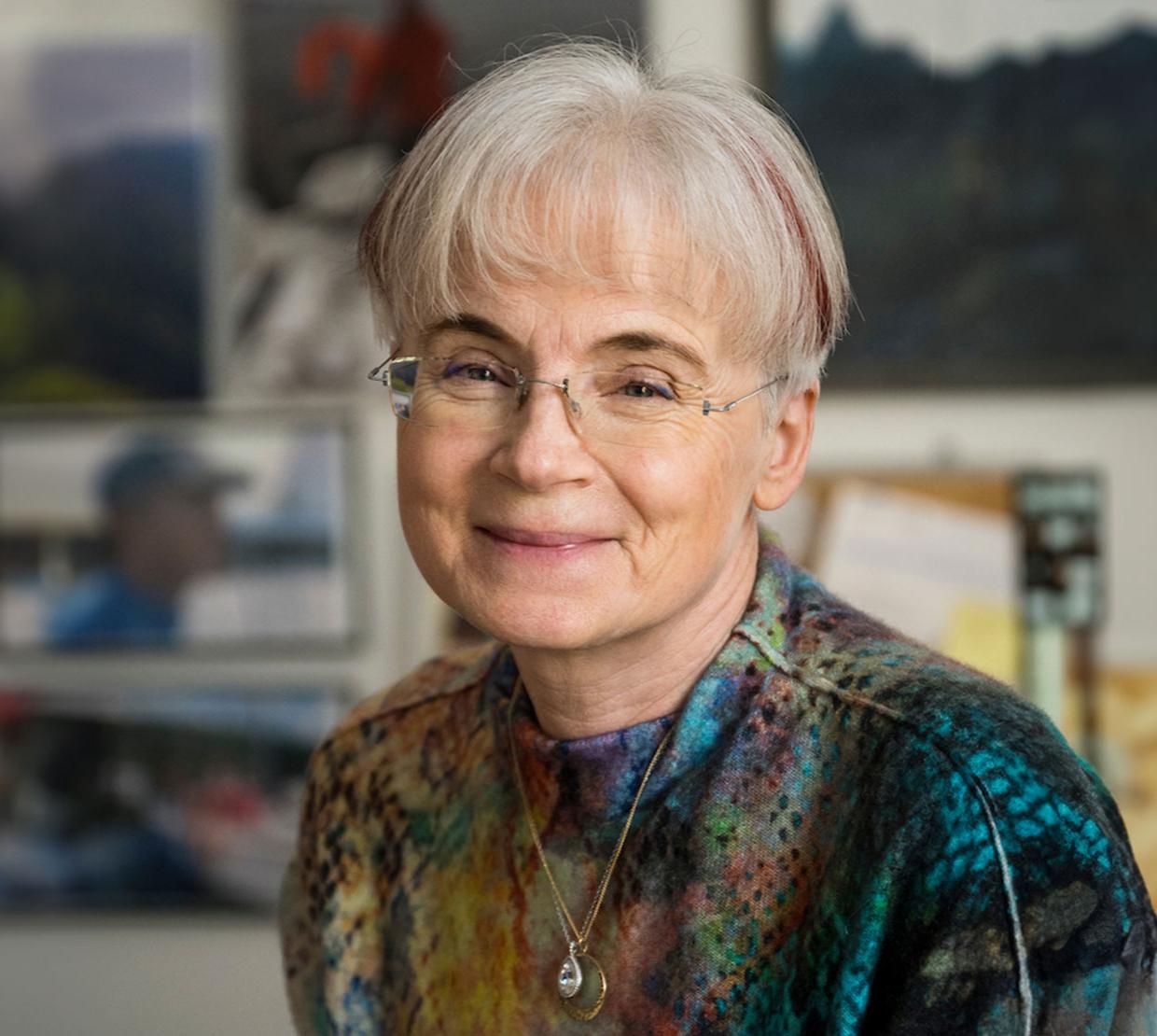
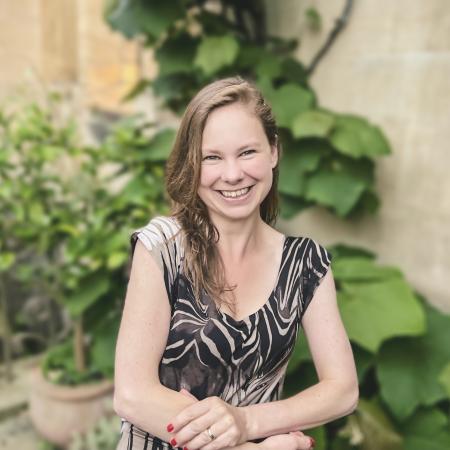
A woman in a multi-colored blouse poses for a headshot to celebrate being announced as a Distinguished Professor.

Malgorzata Peszynska named a University Distinguished Professor

By Tamara Cissna

Malgorzata Peszyńska, newly honored as a University Distinguished Professor at Oregon State University, has charted a remarkable path — shaped by uncommon talent, grit and a spirit of joyful independence.

Renowned for her exploration of the physical world through the prism of mathematics and computation, Peszyńska's work has yielded fascinating insights over her distinguished career. Her research has fostered innovation and enabled applications with global impact on pressing environmental concerns and natural resource management.

In recognition of her achievements, she has earned Oregon State's highest academic honor. The university awards this distinction to a select few faculty nominated by their peers, with the College of Science having the highest number at 19.

"Dr. Malgorzata Peszyńska is nationally and internationally recognized as a leader in mathematical and computational modeling of complex processes, and her work has been particularly significant in building bridges across disciplinary boundaries," Provost Ed Feser wrote in the university’s announcement of this honor.

Peszyńska will present a university distinguished lecture, along with one other 2024 distinguished professor: Todd S. Palmer in the College of Engineering. She will present her lecture on Wednesday, May 8, at 1:30 – 3 p.m. in the Memorial Union Horizon Room. Her lecture is titled, “Math Matters: Multi-* Modeling, Analysis and Simulation.”

“This is an honor and accomplishment, and evidence of appreciation coming from the many colleagues, students and collaborators,” Peszyńska said. “It is also a responsibility, and I am not the only one deserving, but now I can stand on the shoulders of giants and pay it forward.”

As the Joel Davis Faculty Scholar in Mathematics, Peszyńska is acclaimed for her pioneering work in numerical analysis and modeling. Her recognition as an AAAS Fellow in 2020 highlights her “exceptional contributions to multidisciplinary mathematical and computational modeling of flow and transport in porous media."

Peszyńska's work has been supported by more than $3M from the National Science Foundation (NSF) and other agencies and industries. She has authored more than 119 research publications in high impact computational mathematics journals including SIAM journals and in the interdisciplinary venues such as the Journal of Petroleum Science and Engineering, Advances in Water Resources, Geophysics, and other high-Impact journals, and her publications have received more than 2,000 citations.

Over the years, her achievements have garnered numerous awards: She received the Geosciences Career Prize from the Society for Industrial and Applied Mathematics (SIAM), and she's also been recognized as a Distinguished Fellow by the Kosciuszko Foundation and served as a 2009-2010 Fulbright Research Scholar at the University of Warsaw, 2006 Mortar Board Top Professor award, 2016 Graduate faculty award and more.

A mathematical odyssey in energy and climate

Peszyńska specializes in modeling, analysis, and numerical analysis of models, a discipline that seeks to describe real-world systems mathematically, so they can be simulated, analyzed predicted and — when there are problems — solved.
With expertise that spans disciplines, Peszynska primarily works to mathematically solve problems related to environment and, recently, climate change. Her modeling of mass and energy flow and transport includes porous media phenomena in aquifers, oil and gas reserves, carbon sequestration, solar cells and the effect of permafrost warming. Perhaps most notable is her work on phase transitions in methane hydrate transfer and evolution, as well as in using computational mathematics to study complex pore-scale environments. This work aims to understand and predict the presence and behavior of fluids in nature to mitigate potential disasters, like hazardous explosions or methane emissions contributing to global warming and addressing challenges in climate science and geophysics.

In her recent NSF-supported work on studying permafrost changes, Peszyńska seeks to predict and mitigate potential large-scale events such as building collapses and coastal erosion, highlighting the urgency for more modeling in this area.

Her research team employs computers to approximate solutions, striving for accuracy even when the true solution is unknown, she explained. Ultimately, they contemplate how computational algorithms can approximate truth without certainty, exploring the mysteries of mathematics.

"There's so much about the methods themselves that intrigue us in this mystery," she said. "How do you achieve that? How can you anticipate whether your computational algorithm will yield a prediction close enough to the true solution, regardless of what that true solution might be, without actually having knowledge of it?"

Peszyńska will explore this and other questions in her public lecture. She will also “delve into how her research team explores multi-scale multi-physics systems using complex computational mathematics, inspired by real-life applications. She will discuss their investigation of porous media at nano-, pore-, lab-, and field scales, predicting their responses to environmental changes. She will also emphasize the importance of fostering interdisciplinary collaborations within Oregon State University and with external partners to encourage students to embrace complexity over simplicity.”

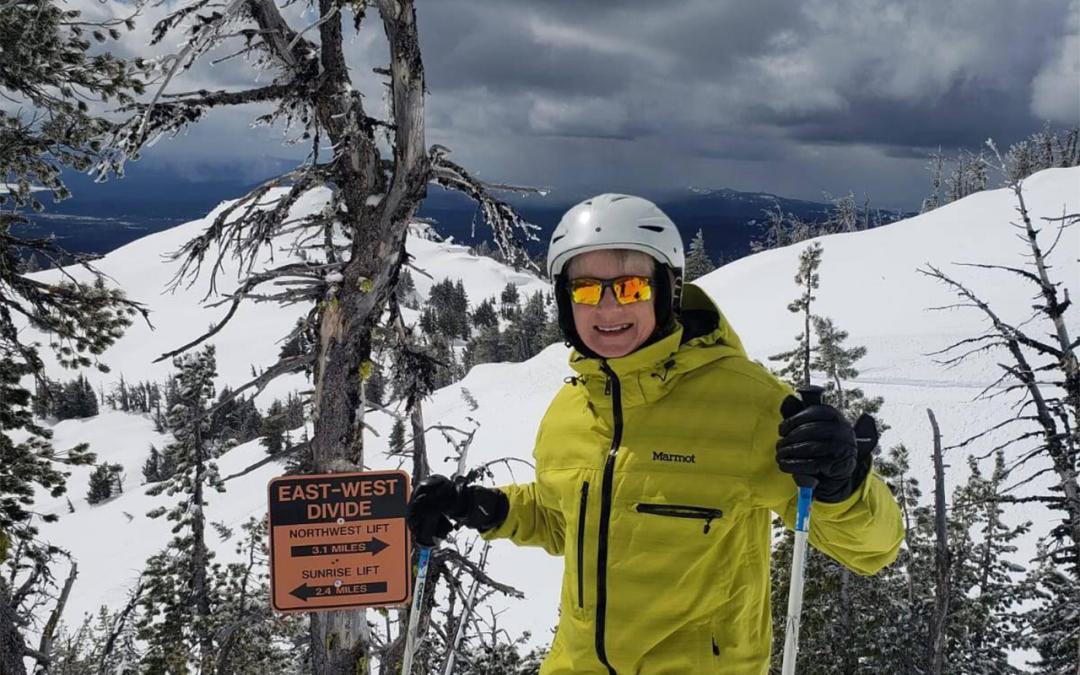
A woman in a skiing outfit stands next to a sign read "East, West."

Malgorzata Peszynska on the southeast side of Mt. Bachelor, Oregon, where two trails meet at the East West Divide. Peszynska's journey has also taken her on trails from East to West, over 5,000 miles from Poland to Oregon.

From Warsaw to worldwide impact: A wholehearted journey

Born and raised in Warsaw, Poland, Peszynska discovered her passion for mathematics at a young age. Encouraged by her family, she cultivated that passion alongside her love for the natural world, leading her to study mathematics in the context of physical phenomena and ultimately specialize in mathematical modeling and computational solution of flows through porous media and their geological applications.

She earned a master’s degree in applied mathematics from the Warsaw University of Technology and a Ph.D. in mathematics from the University of Augsburg in Germany. She also holds a habilitation degree from the Warsaw University of Technology.

Her interest in real-life applications is driven, in part, by a personal passion for the natural environment and outdoor activities. And she commits fully to her pursuits, whether tackling complex equations, building interdisciplinary teams, or enjoying leisure activities like skiing and sailing. Embracing her mantra to "Make your own kind of music," she consistently tries to choose the complex and challenging path over the simple and easy.

Reflecting on the most meaningful milestones and accomplishments that led to this recognition, Peszynska shared that it's not about one single thing but rather a tapestry of efforts woven from countless interesting problems and diverse potential directions.

“At every fork in the road, we are choosing a path and sometimes we succeed in making progress,” she said. “At times, the most cited papers are the easiest for us, and sometimes those least noticed are the hardest but might make an impact much later. This may be scary when looking ahead, but it gets easier over time.”

She likens her role as a mathematician to that of a translator, bridging gaps between disciplines and applying mathematical rigor. Collaborating with colleagues from within mathematics and across other fields has empowered her to tackle real-world modeling projects with significant practical implications, even in the absence of a clear existing mathematical framework for analysis. From exploring multi-scale modeling techniques to navigating complex algorithms, these partnerships have broadened her perspective and fueled innovation.

As a mentor, she encourages students to discover their passions and gently nudges them to work diligently towards their goals, knowing they might change their minds along the way. But, she said, “There's no substitute for hard work. Sometimes, it's not just about assignments or tasks; it's about doing repetitive steps and finding the discipline to keep going. One of my past mentors said, ‘All you can do is work.’ And that's true. It means showing up every day, putting in your hours, and eventually, things will click. In turn, mentoring isn't easy. You offer advice, but ultimately, it's up to them to decide what works best for them. It's not unique—I don't have all the answers. Live and let live, I suppose—that's another principle I try to uphold.”

One of her former students, Scott Clark ('08), listed in Forbes Magazine’s 30 under 30, shared, “Dr. Peszyńska’s guidance led me down the interdisciplinary path that would become the foundation of my later graduate and professional work. ... She had a direct, positive impact on my career trajectory, and I would not be where I am today without her.”

At that, she humbly replied, “We have a lot of brilliant undergraduate students, and they just need an opportunity to fly. And so we should be accommodating them, I think. Yeah, let them fly."

She has also found leading the community in various professional circumstances gratifying—“building one connection at a time and not letting go.” Peszyńska has served as a program director for computational mathematics for the NSF and in multiple roles for the Society for Industrial and Applied Mathematics. Additionally, she organizes conferences, serves on editorial boards, and participates in review panels for prestigious institutions.

A group of people stand on a deck celebrating the graduation of a postdoc.

Malgorzata Peszyńska and her students and postdocs celebrating the graduation of Lisa Bigler (Ph.D. 2022).

Challenges and rewards: Bridging disciplinary divides

Peszynska’s success in bridging complex mathematics and diverse real world disciplines has much to do with her independent and joyful spirit.

She describes her atypical view of computational and applied math as an "attitude," rather than a discipline. “My work leans closer to art in its abstract form, or closer to science and engineering in its useful side. This dichotomy is not always understood or appreciated, and it feels funny and sometimes tedious that we may have to prove ourselves over and over. Doesn't everyone want to have clean air, enough food, exciting and intellectually stimulating complex work and stability of life? Live and let live!

“But my strategy is to not try to win anyone over to interdisciplinary work but rather to enjoy the intellectual and emotional joy of learning the new language while appreciating the cultural differences. The reward is that you build the bridges rather than straddle the fence.”

To apply her discipline and contribute wholly to critical concerns is very hard work, and she competes mostly with herself, harnessing discipline if ever enthusiasm wanes. Just as she advises her students: Do the work.

“On the lighter side, most days I wake up happy in the morning to continue doing this work,” she said. “It's fun, more fun than video games because I can make my own with the simulations. So that's exactly what I hope for others, especially students, that they will find fun in it—potentially even more, making a difference, one step closer to a better world.”

Curious minds may explore Peszyńska’s website for its challenges and interactive learning. Exploring innovative solutions can feel akin to solving puzzles, but even more rewarding.

The lasting impact of her work that she will hold most dear is the enduring value of lifelong learning and the significance of interdisciplinary collaboration—with its potential to shape the future. And she truly hopes that students will experience and appreciate the intrinsic joy and real-world impact that computational and applied mathematics have to offer.

“I am thrilled to see Malgo Peszyńska get this well-deserved recognition,” said Eleanor Feingold, dean of the College of Science. “Her world-class work in mathematical and computational modeling, coupled with her dedication to interdisciplinary collaboration, are instrumental in shaping the future of environmental science.”

Along her journey, Peszyńska has had to choose between many forks in the road. With too many options to follow in one lifetime, she acknowledges the opportunities left behind for future lives.

What might she pursue in her next life? Well, she might need two (or more). “Right now, my count goes into the upper teens.”

Megan Tucker smiles widely, her scarlet beanie a striking contrast to the snow-covered mountaintops that rise behind her.

What do mathematicians do? This mathematics grad began a technical writing career at Amazon

By Elana Roldan

In science, ‘new’ is a constant. Novel research techniques propel studies forward. Updated software creates ripples across technology. But as fields evolve at a breakneck pace, leaving the rest of the world to play catch-up, there is a subset of communicators helping us along — technical writers.

Technical writing breaks down complex scientific jargon into easily understood information. Those who pursue the niche are much like Swiss Army knives, able to learn and explain a variety of specializations. Alumna Megan Tucker, ‘20, is one such knife.

After completing a double major in Mathematics and Liberal Studies with a focus on writing, Tucker worked as a technical writer for Amazon Web Services for three years. She is currently completing her master’s degree abroad. Using the breadth of knowledge and professional skills she naturally gained as a College of Science undergraduate, she has found the sweet spot between her two passions in a truly rewarding career.

“It felt great to graduate knowing I could continue to learn and write about science and become an expert in fields I wouldn’t have known existed until someone said, ‘We need a tech writer.’”

Doing the math

The perfect set of degrees for Tucker wasn’t immediately obvious. While she always had an additional writing-focused major, her first major in STEM was nuclear engineering. It was short-lived as she felt drawn to the deeper discussions about quantum mechanics available to physics undergraduates. But physics still wasn’t quite right, and she finally turned to the major that had run through each of the others: mathematics.

Having academic advisors dedicated to each major ready to help made for a smooth transition into mathematics. It turned out to be an excellent fit, even as the content became increasingly difficult. Triumphing over challenges with the help of her mentors was one of the best learning experiences the major had to offer.

“I was really struggling with some proofs in an abstract algebra course and Professor Schmidt told me, ‘You can do this proof. You’re doubting yourself. Stop doubting yourself and you’ll be able to solve anything you put your mind to.’ That was such a game changer for me, to realize that yeah, I can do this,” she said.

“That’s really what I went to college for, to talk to experts in their field ... Having the opportunity to work with those people and learn from them is probably the best thing that I got out of OSU and the College of Science.”

The switch was especially validated at the end of her junior year when she was accepted into an internship for the Department of Energy, which she found through attending a College of Science research seminar. She flew to Pittsburgh and Washington, D.C. to study data sets that could prove useful for carbon sequestration.

Surrounded by Ph.D. candidates of many specializations, Tucker appreciated the experience for its challenging environment.

“In college especially, people should really push themselves. That’s their opportunity to learn and try things and fail. I don’t even think you should stop doing that after college, but college is a really nice place where you can do it a lot,” she said.

This style of learning led by knowledgeable guides was a highlight of her time as an undergraduate, and she cherishes the lessons it taught her.

“That’s really what I went to college for, to talk to experts in their field,” she said. “Learning not just about the class, but about what it means to get your Ph.D., what it means to get your master’s and what it means to be a mathematician. Having the opportunity to work with those people and learn from them is probably the best thing that I got out of OSU and the College of Science.”

The unspoken questions

When technical writing was first introduced to her through her coursework, Tucker had no intention of pursuing it further. A career in the niche hardly crossed her mind.

“I was like, ‘It’s a course I took in school, no one actually does that for work, right?’” she recalled ironically.

But when she later accepted a grant writing internship on campus while searching for more work opportunities, her perspective shifted. She began to see the world of possibilities that lived at the intersection of writing and science. Her two passions that once seemed completely disparate merged into her dream job. By the time senior year rolled around, she was applying for as many technical writing positions as she could.

A job offer from Amazon Web Services came back in March and she began working for them in Seattle soon after graduation. AWS is the most widely adopted global cloud provider, boasting millions of users who rely on its services. Much of Tucker’s work involved creating user and application programming interface guides for each software release. Her writing boiled down imposing cloud architecture setup into step-by-step instructions, guiding customers out of a computer deep end and into smooth sailing.

“There's an endless amount of things I could write about. You’re answering the unspoken questions that need to be answered.”

The skills she learned from both of her degrees played prominent roles in her daily work. Being able to absorb the ins and outs of feature releases and discuss science-heavy content with software developers both stemmed from her mathematics major. These then pooled into planning, writing and editing technical documentation for the company, allowing her to thrive in her position.

Along with the skills she purposefully developed, Tucker found that the ones she gained naturally as a science student were critical to her success.

“It’s very much like university with different clothing,” she explained. “Ultimately, I really had to keep up with my courses and be organized and punctual. That’s pretty invaluable to me working, staying on top of my tasks and being able to communicate these topics with people who have a varying level of knowledge about them.”

After three years at AWS, Tucker resigned to work toward her master’s in writing at Queen’s University in the U.K., which she plans to earn later this year. The degree will be another step higher for her into the world of technical writing, one full of possibilities.

“I love the field because of that conversation between STEM and writing,” she said. “I could write for chip manufacturing, I could write for a university, I could write for medical tech. There's an endless amount of things I could write about. You’re answering the unspoken questions that need to be answered.”

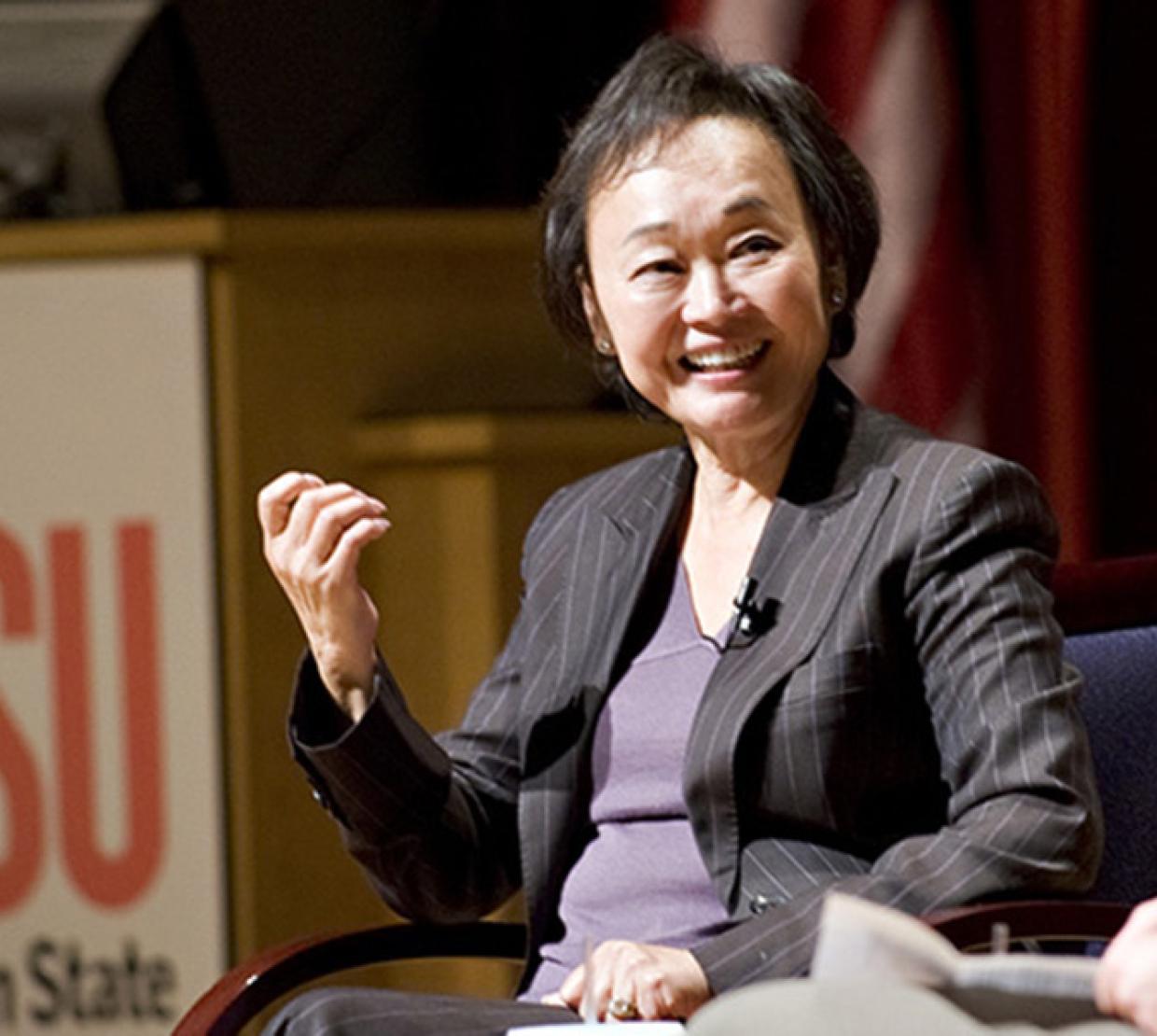
Peggy Cherng sits in a suit on stage giving a talk at an OSU event.

How Peggy Cherng used her analytical know-how to help build a restaurant empire

By Kevin Miller, ’78 for the Oregon Stater

The three years Peggy Cherng, ’71, spent in Corvallis powering through a four-year program in applied mathematics are a bit of a blur. A rainy, green blur.

“Mostly I remember rain, green and studying. It was raining a lot in Oregon. And Oregon was very green. And I believe one time I got poison oak,” said Cherng, the co-CEO of Panda Express. The company operates more than 2,300 restaurants and brings in $3 billion in annual sales. “But it is important to me that you know that I am grateful for the education I got at Oregon State.

“I did have fun sometimes. But I was working on my studies.”

Cherng has been twice honored as an alumna — in 2000 as an Alumni Fellow of the College of Science and in 2012 by being invited to give the College of Business Dean’s Distinguished Lecture.

Born Peggy Tsiang in Burma (now Myanmar), she moved with her family to China as a child. They eventually settled in Hong Kong. She did well in school, especially in math, and was eager to go to college.

“Most of the people in Hong Kong get their higher education overseas,” she said.

She ended up enrolling at tiny Baker University in Kansas in 1967. It didn’t take long for her and fellow Chinese student Andrew Cherng to notice one another.

The two became friends and fell in love. They planned to finish their undergraduate work as quickly as possible so they could go to graduate school together and get married. In the meantime, she decided to transfer to Oregon State for her bachelor’s degree in math.

Why?

“I didn’t have any friends there, so that wasn’t why,” she said. “It was a scholarship. I just went.”

At Oregon State, she loaded up on challenging classes. And for the next three years, the couple maintained their Kansas-to-Oregon relationship in an era with no Facetime, no email and no free calling plans.

“I don’t think we could afford to talk much,” she said. “At that time a long- distance call was quite expensive.”

Once she got her OSU degree, Peggy and Andrew reunited at the University of Missouri, where he earned a master’s degree in applied mathematics in 1972 before moving to the Los Angeles area to help his cousin run a Chinese restaurant. In 1973 Andrew and his father, a chef, opened a full-service Chinese restaurant of their own, Panda Inn, in Pasadena.

Peggy, meanwhile, quickly finished a master’s degree in computer science at University of Missouri and stayed on to earn a doctorate in electrical engineering in late 1974. She was a rising star, specializing in complex pattern recognition and predictive analytics programming. Her projects included making CAT scans more useful and developing complex battle simulators for the Navy.

The Cherngs married in 1975 and soon started a family, which grew to include three daughters — Andrea, Nicole and Michelle. While Peggy did cutting-edge programming and engineering for McDonnell Douglas and other companies, Andrew and his father worked against fierce competition to make Panda Inn the best Chinese restaurant in the area. Though weekdays saw her doing demanding work in the defense industry, Peggy worked at the restaurant on weekends.

“I was there in a limited capacity at first,” she said, laughing at the memory. “I could only do hosting, and I was not a good hostess. Not very efficient. I couldn’t make cocktail drinks.”

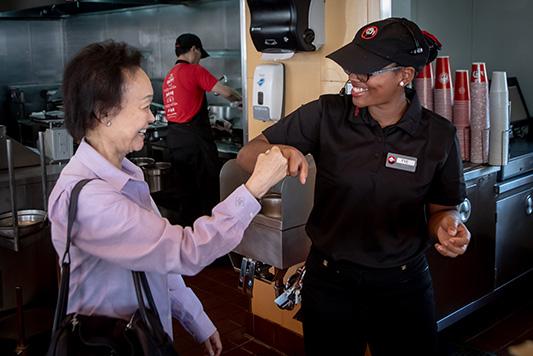
Peggy Cherng with a Panda Express employee.

By 1982, Panda Inn had a strong enough local following that the Cherngs decided to launch a fast-food spinoff, Panda Express, in a local mall the next year. Cherng greets an associate in Tampa, Florida. Today her company is the largest family- owned and operated Asian restaurant chain in the U.S., with more than 2,300 restaurants, 47,000 employees and $3 billion in sales. (Photo courtesy of Panda Restaurant Group.)

Peggy left her engineering career to handle the business and personnel aspects of the company, with Andrew focusing on growth and strategy.

Peggy is credited with creating one of the first purpose-built point-of-sale systems in the fast-food industry, as well as with many continuing innovations in personnel recruiting, training and motivation, including offering profit-sharing to the restaurant’s employees and promoting from within as much as possible.

In 1987, Panda’s chef, Andrew Kao, invented an orange chicken dish, and its popularity helped fuel rapid growth for the company. (The company sells a whopping 110 million pounds of orange chicken each year.)

It’s still Panda’s signature item, and among the places where it is consistently ordered is a Panda Express in the Memorial Union Commons at Oregon State.

What is Peggy’s favorite?

“Well,” she said, “I eat light. Some of the things I like to eat are tofu and eggplant, which are not exactly embraced by everybody who eats at Panda.”

What about orange chicken? She smiled.

“Of course. I do eat orange chicken because it’s our signature dish.”

Really? Like one bite per meal?

“No,” she said, laughing. “Two bites!”

The Cherngs continue to work as co-CEOs and remain active in the business in their mid-70s. Asked how they’ve maintained a successful marriage and a successful business together for so many years, Peggy said it hasn’t always been easy.

“We experience the same challenges as anybody else. You have to learn how to leverage each other’s strengths,” she said.

Part of what held them together during the early days, she said, was their common awareness that they were onto something new and different.

“No one else had a Chinese fast-food restaurant chain,” she said. “So it was all new. We were learning how to do it.”

When she’s not working, her favorite activity is to spend time with her family, especially her five (soon to be six) grandchildren. But work remains central.

Why not retire and kick back? She seems puzzled by the question because she continues to find joy in her job.

“Every single new step the company takes brings new things we must learn: more structures, more challenges, more organization to develop, something new to implement.”

For example, she’s working with others on the Panda team to use data analytics to help improve service and give local Panda managers clearer information on how they might support excellence among the associates (Panda’s term for employees) who work for them.

The Panda organization and the Cherngs as a family are active philanthropists, both through major gifts and via their Panda Cares foundation, which offers help ranging from food donations to college scholarships.

“The mission of the Panda Cares foundation is to support health and education of underserved children,” Peggy said. “To really make a difference, you need a focus.”

Among the Cherngs’ many gifts are support for the Cherng Family West Tower at Huntington Hospital in Pasadena and for OSU’s work promoting healthy children and families.

In addition to the challenges faced across the restaurant industry during the COVID-19 pandemic, Panda Express managers and associates were also subjected to incidents of racism fueled by a rise in anti-Asian sentiment.

“You cannot control other people,” Peggy said. “So, we focus on how we position ourselves. We are productive citizens in the communities we serve. You need a positive approach to hatred.”

No alumni magazine profile of a successful graduate would be complete without advice for those beginning their careers.

“I always say at the start that you have to believe in yourself,” Cherng said. “Also, you need to be curious, because only with curiosity can you learn and elevate and be better.”

She added: “And I believe engineering training and math training help the mind to think, especially when we face something uncertain and unknown to us.”

As for her own continuing education, it seems some friends have been taking her to school as she masters a new pastime.

“Recently I’m learning how to play mahjong,” she said. “But I’m a beginner, and sometimes as a beginner you have to pay what I call tuition. My biggest win is maybe $20, but my biggest loss is $40.”

Probably she can afford it, right?

“Yes,” she said, and then laughed. “I can.”

This story originally appeared in the spring issue of the Oregon Stater.

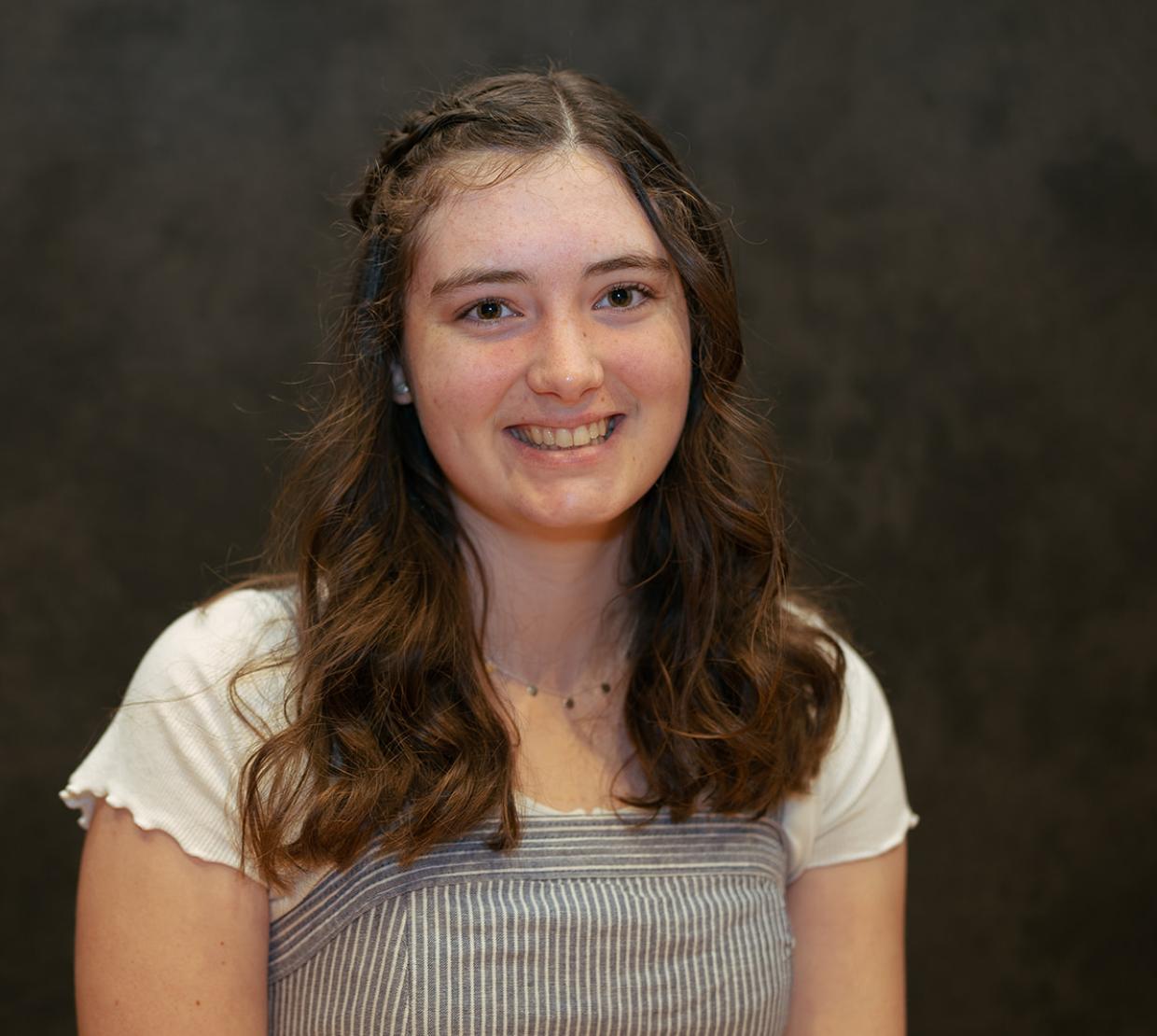
Madison Collins smiles in front of a grey background.

Mathematics senior finds effective teaching strategies on her path to a graduate degree

By Kaitlyn Hornbuckle

Mathematics homework in 2023 often has parents scratching their heads and admitting defeat. Oregon State University senior Madison Collins knows that feeling all too well.

At the dinner table growing up she disagreed with her parents on how to break up numbers for addition and multiplication problems. “My mother had different methods of math that she learned,” she said. “I went, ‘Mom, that’s not how my teacher told me to do it.’” Luckily for Collins, math came naturally, and her parents tried to keep her on her toes with new academic topics.

Until one day, she surpassed her father, an important figure in her life who encourages and challenges her academically.

“It was fun when I was talking to him about math content and he said, ‘I have no idea what you’re talking about.’” That’s when Collins realized, after all these years, she finally surpassed her father at a higher level of mathematics.

Modernizing the education process

A third-year student graduating with a bachelor's degree in mathematics with the mathematical biology option and a minor in chemistry, Collins plans to hit the ground running by starting her master's degree in math education at Oregon State in fall 2023. Even though 1+2 will always be equal to 3, Collins strives to teach math differently so that students can learn better and discover something new along the way.

“I want to help students from multiple backgrounds see that learning math and succeeding in a college math course is possible for them. I want to be able to communicate math well to students so they can learn the content and gain confidence in their mathematical abilities,” she said. “In college, a lot more students don’t feel like they can connect to the teachers personally, so I definitely want to try to build up the community in that way while teaching.”

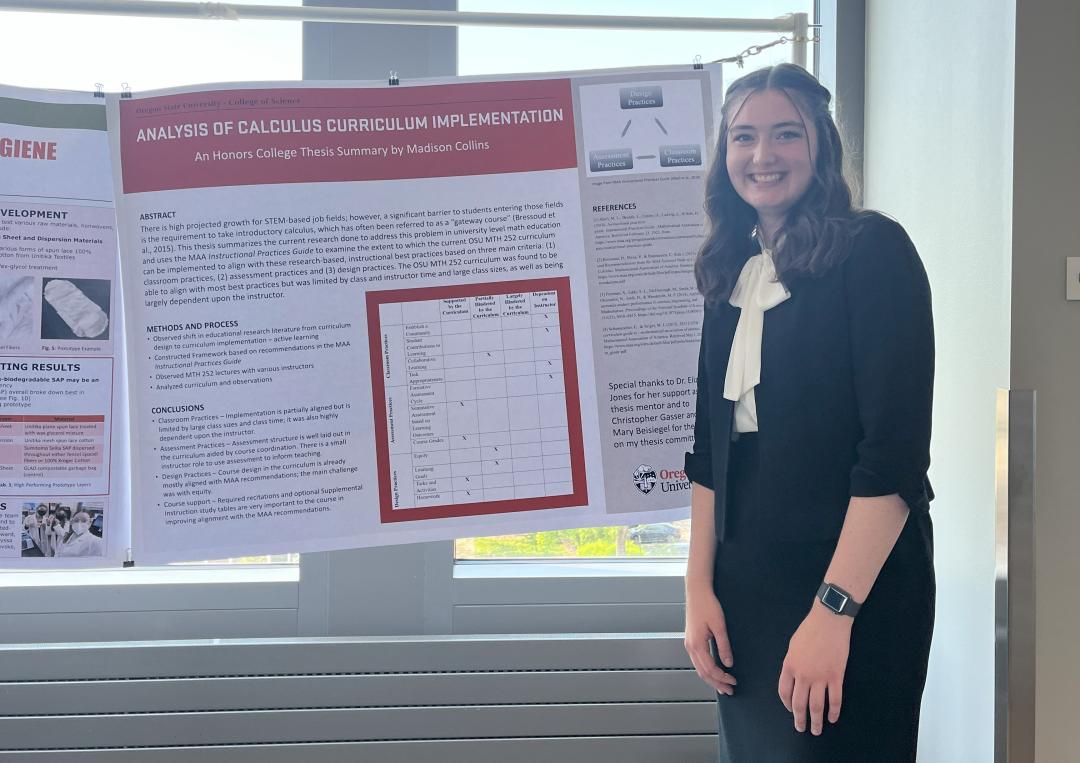
Collins has already started analyzing how the college-level calculus curriculum is being taught in the classroom for her honors thesis. Her curriculum curiosity dates back to the table in her childhood kitchen.

Whenever she and her sister got stuck on a math problem, her parents paused dinner to get them back on track. Sometimes, this meant her parents teaching them ‘weird’ and ‘wacky’ methods that aren’t taught in school anymore. To Collins, this is a typical part of the education process.

“While parents being able to help kids with homework is really important, a lot of research has gone into improving education with new teaching strategies and ways of communicating certain ideas,” she said. “New advances are being made in math education theory all the time so the content delivery is changing. It is unrealistic not to change math to keep up with new understandings of concepts. With that said, many math curricula, especially calculus, have remained largely unchanged for decades.”

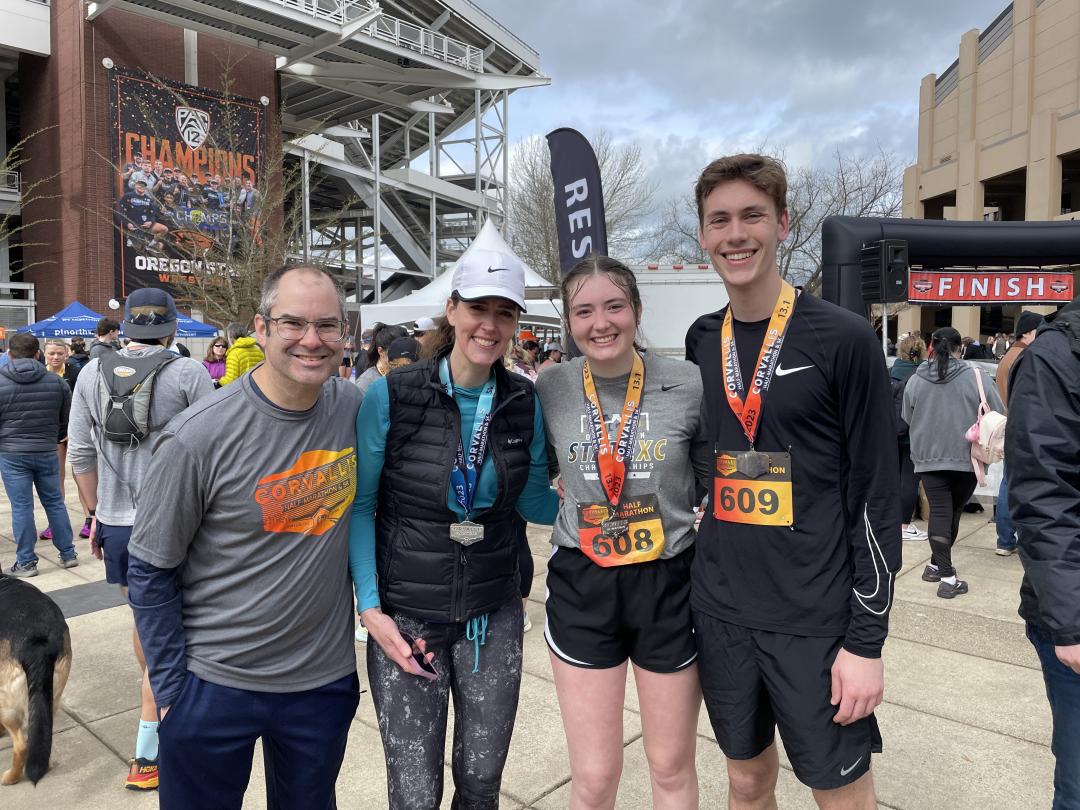
When Collins entered high school, she loved to ‘move pieces around’ to solve puzzle-like math problems in her calculus courses. Outside of the classroom, she chose to do sports instead of working a job, a choice that greatly impacts how she views the education experience. Joining the cross country, swimming and track teams helped her grow and prepare for the rigor of college courses early on.

Even though she didn’t continue sports at Oregon State, Collins kept running on her own during college. She competed in the April 2023 half marathon in Corvallis alongside her boyfriend while her uncle and mother ran the 5k.

Training for 13.1 miles, spending time with her family and developing a thesis in the same term required a work-hard-play-hard attitude. Especially when that workload also included tutoring.

Four people stand with running bibs in front of the OSU football stadium.

Madison Collins (#608) spent time with her uncle, mother and boyfriend after completing the April 2023 half marathon in Corvallis.

Building new communities with math

Sometimes, student-athletes struggle with maintaining satisfactory grades while trying to maintain a busy schedule, so Oregon State Athletics has a special tutoring program designed for them. As a tutor, she got these students back on track when they struggled with their college courses.

After a year, she switched to the Supplemental Instruction (SI) program. The program is a free resource that students at Oregon State utilize to learn key concepts in a group environment. Leaders come prepared with a lesson plan full of practice problems and interactive activities and implemented them in peer-led, group study tables.

This was her chance to practice shaking up the curriculum. Collins designed a BINGO activity that aided students with reviewing vocabulary. She also put together problem sets that they solved together at the study table. This way, she was able to not only host student-led lessons but encourage collaboration.

While an employee, she started chatting about what she wanted to research for her honors thesis with SI Coordinator ​​Chris Gasser. He acted as a mentor by encouraging Collins to be resilient while taking tough academic courses. Before long, she stumbled upon her honors topic of choice - analyzing curriculum implementation.

Uncovering how calculus is taught

At the end of her third year, Collins devoted the majority of her time to developing her honors thesis with Oregon State Mathematics Instructor Elizabeth Jones. Collins visited different sections of MTH 252 Integral Calculus at Oregon State and recorded observations.

She sat with the students and jotted down different teaching strategies she saw implemented by a variety of instructors. Using her observations, she developed a framework for analysis in order to find the most effective ways to continue implementing the calculus curriculum in college-level courses.

Madison Collins standing in front of a poster presenting her honors thesis.

Madison Collins presented her honors thesis on how the calculus curriculum is implemented in the college classroom.

She enjoyed chatting with Jones about the different classroom, assessment, design and course support strategies she chose to analyze. But occasionally, their math education preferences diverged.

While talking about trigonometry substitution, they discussed different mathematical notations and the confusion that comes with non-standard notations. Variables are written with alphabetical characters. For instance, pertaining to trigonometric substitution, Collins prefers to use a ‘u’ whereas Jones prefers to use an ‘x’.

Sometimes, the same symbol can have different meanings in various areas of math. For example, absolute value bars, IVI, can denote other operations including vector magnitude, IVI. It’s a subtle detail, but can have a major impact on how variables are communicated to the students.

"I hope that by going into teaching, I can help people get through a typically difficult subject and make it more enjoyable for them."

Now that her first thesis is complete, Collins wants to put what she learned into practice by teaching in a college setting that is approachable for students. When students walk into her future office, she wants to address the little questions and not have students be hesitant to ask a question that is ‘too simple’ to answer.

“I get really excited when I am helping someone and can see them putting the pieces together in their head. When they reach the final answer in a ‘lightbulb moment,’ they get super excited,” she said. “I don’t just want to lecture students. I want to teach them how to approach math and build confidence in their skills.”

Being able to learn how to be the teacher she wants to be came at a cost. Luckily, when her academic experience got a little bumpy, she wasn’t alone.

Persevering in the face of failure

For Collins, being a Beaver at Oregon State came with the pressure to succeed. “The biggest challenge I've had growing up through school was that I put a lot of academic pressure on myself,” she said.

Madison Collins standing in front of a white board.

Madison Collins demonstrates how to solve a problem using calculus at the front of the classroom.

After her official advisor left the university, she met Oregon State Mathematics Professor Nathan Gibson who became her advisor, professor and mentor. He taught MTH 323 Mathematical Modeling, which turned out to be a tough class for Collins. She wrote a 10-page report talking about the errors that happen when modeling basic electrical circuits and how the different components differed from each other.

“I ended up using a little bit of electrical engineering from that one class I took in my first year. I’m pretty sure my simulation failed, but I still got an A on the paper,” she said. It takes encouragement to agree to finish a difficult course, especially when it comes to learning how to use differential equation systems in the real world. This was the type of mentorship Gibson provided when Collins needed it most. Now, she can apply what she learned in a classroom setting.

“A lot of people are told they aren’t a math person,” she said. “I totally agree that math is not something many people want to study, but I really enjoy it and the problem-solving aspect of it. I hope that by going into teaching, I can help people get through a typically difficult subject and make it more enjoyable for them.”

Collins is now able to teach others in a way she wishes she was taught – and it all started with math homework at the dinner table.

Subscribe to Women in Science