Mathematics Major

Mathematics Major

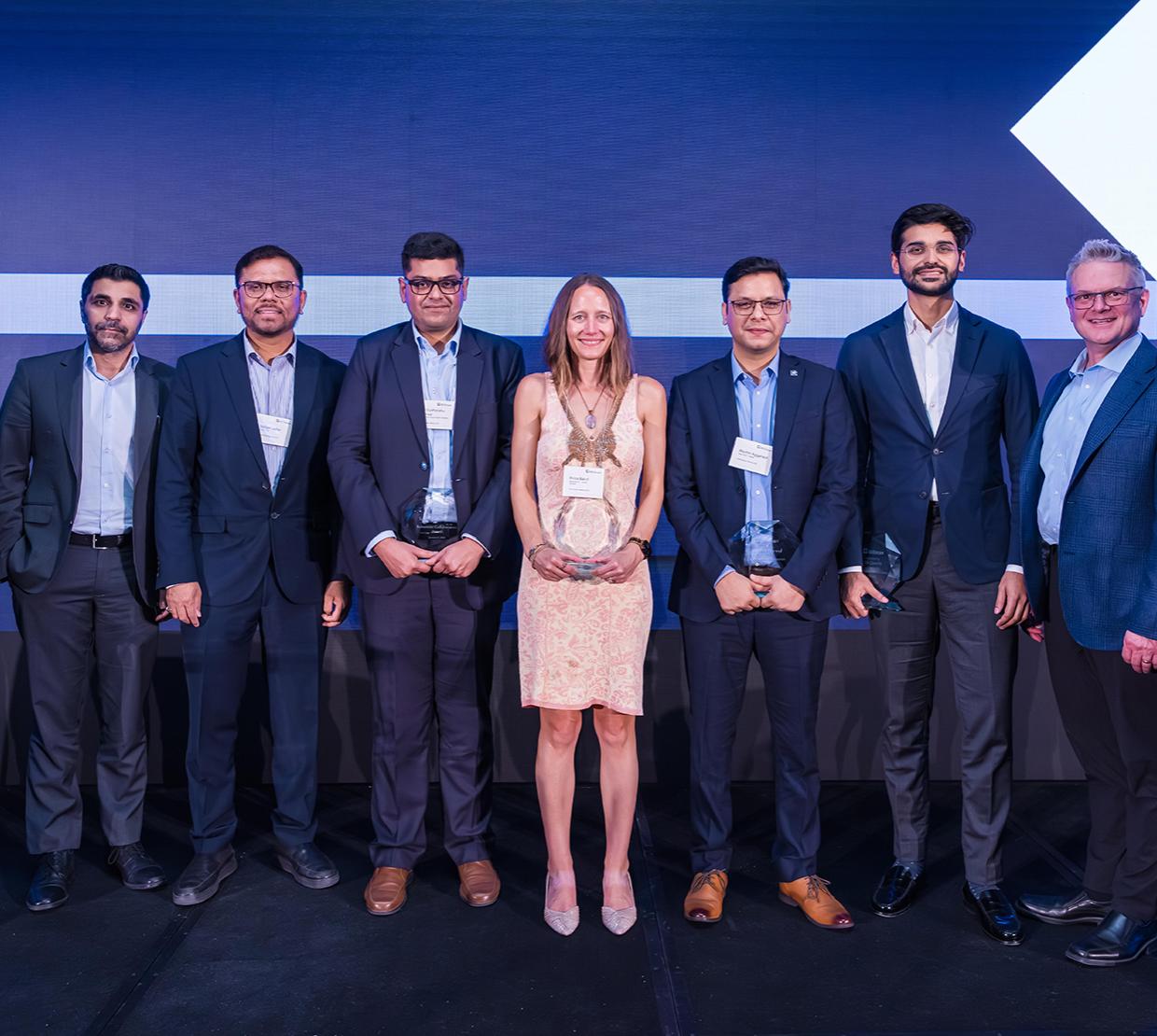
A group of people at a conference.

What does an actuary do? Erica Baird’s path from math student to industry leader

By Hannah Ashton

Erica Baird and her coworkers at a shareholders meeting in Phoenix in 2026, along with the chairman of the board and CEO of Milliman.

Erica Baird (’05, M.A. mathematics ’09, Ph.D. mathematics and statistics ’13) didn’t set out to become an actuary. In fact, when she first heard about the career as an undergraduate mathematics student at Oregon State University, she was skeptical.

“I thought it was a scam,” she said. “You go and take all of these exams and then you get this great high-paying job and all you need is a bachelor’s degree.”

That skepticism didn’t last. As Baird learned more about the profession and the rigor behind its credentialing process, she began to see actuarial science as a disciplined field grounded in mathematics, data and real-world impact.

Today, Baird is a principal and consulting actuary at Milliman, where she leads research and development for a risk-adjustment software product while advising clients across the health care industry. Her path from southern Oregon to a leadership role in a global consulting firm was driven by a desire to use mathematics to tackle complex challenges that affect patients and health care systems.

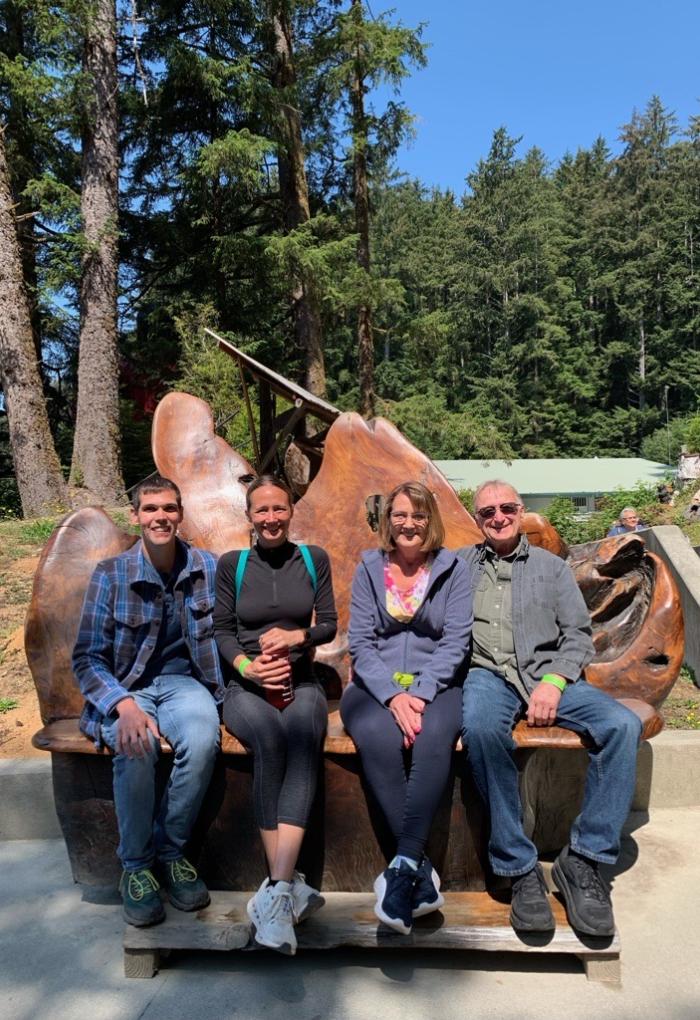
Four people sit and pose for a photo in front of trees.

Baird and her husband Kyle pose for a photo with Baird's parents at the Trees of Mystery in California.

What is an actuary?

At its core, actuarial science uses mathematics, statistics and financial theory to manage risk and inform decision-making. While the work is rooted in numbers, it is ultimately about helping institutions understand what could happen in the future — and how to plan for it.

The profession is structured around four main practice areas: health, life, property and casualty, and pensions. Each track focuses on a different kind of risk and requires specialized knowledge of industries, regulations and financial systems.

Health actuaries, like Baird, work with hospitals, insurance companies and government programs to analyze medical costs, design insurance pricing and evaluate how healthcare services are funded and delivered.

“We’re trying to make sure that their prices are fair, and that they are financially stable,” she said.

Baird started at Milliman as an actuarial analyst, supporting a software product designed to predict individual health care costs using past claims data. She trained predictive models, validated them and answered client questions.

Over time, her role expanded. Baird discovered she excelled in consulting, working directly with clients to solve unique problems. She now leads research and development for the software product and holds a senior-level position on the consulting side. Her work ranges from pricing Medicare plans to helping hospitals understand payment models to evaluating how successful medical interventions are at improving patient outcomes.

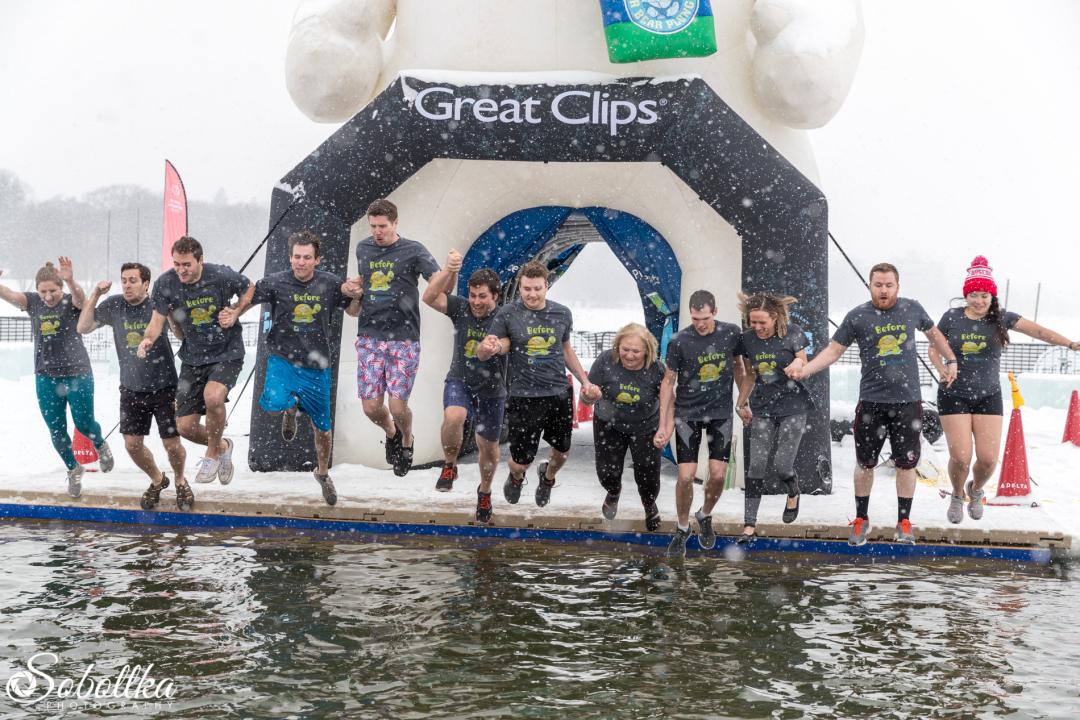
A group of people hold hands and jump into a lake for a polar plunge.

Baird and her coworkers jump into a frozen lake for a polar plunge to benefit Minnesota Special Olympics (Baird is third from the right and her husband, Kyle, is fourth from the right).

“My days are never boring," she said. “Clients bring us hard problems and we get to design studies, build models and really dig into whether something is working.”

No two assignments look the same, she said, because no two clients are trying to solve identical problems. That variability is part of what keeps the work engaging: each project requires adapting models, interpreting data in context and explaining results to non-technical audiences.

While insurance can be a complex and sometimes frustrating system for consumers, Baird emphasizes the broader mission behind the work.

“It can be tricky, but it can also save lives,” she said. “We aren’t just there to help insurance companies make more money. We’re there to help them serve the people that need health care.”

In January 2026, Baird joined the Actuarial Standards Board, which sets standards that actuaries in the U.S. must follow in their work. It also oversees updates to those standards through volunteer expert task forces and public comment, helping ensure consistency and professionalism across the field.

“It's been a great experience because they’re all people who are really passionate and excited. We spend a lot of time in passionate discussions and debates, making sure we think through all the implications of the guidance that we’re creating. Am I setting the bar too high for actuaries? Or am I not setting it high enough?”

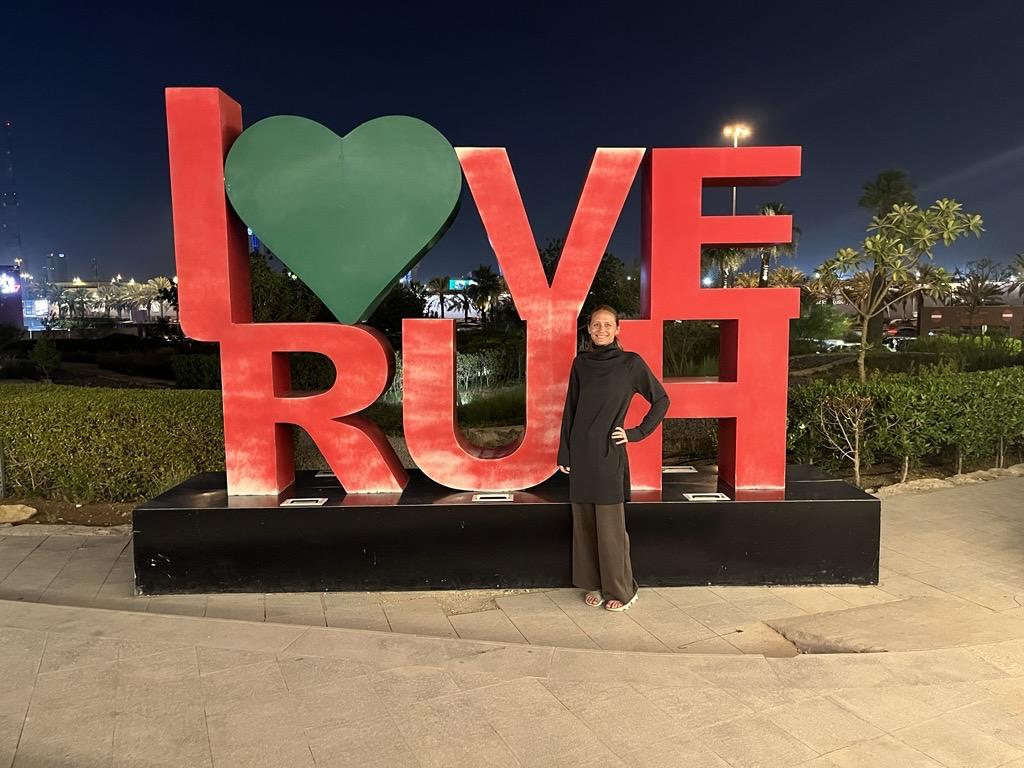
A woman poses with a giant sign that says "Love RUH."

Baird poses with the Love RUH sign in Riyadh, Saudi Arabia during a work trip.

Baird’s take on how to become an actuary

Baird grew up in Central Point, Oregon, and was interested in pursuing a degree in education, but a high school calculus class shifted her trajectory.

“I really enjoyed the problem-solving aspect of it,” she said. “It felt like the first time you moved beyond mechanics and got to how we use math to solve problems.”

That realization led her to pursue mathematics at Oregon State, where she eventually completed her undergraduate degree, master’s degree in mathematics and a dual Ph.D. in mathematics and statistics.

Her interest in actuarial science didn’t take hold until graduate school. After taking her first probability course, she began to see new possibilities, deciding to take her first actuarial exam while she was still in school.

Becoming an actuary requires a series of rigorous professional exams that unfold over several years. Candidates complete seven exams and a series of modules and other courses to reach Associate status, with several additional exams and modules needed to be fully credentialed as a Fellow. Most candidates study while working full-time, turning the exam process into a parallel track of education and career experience.

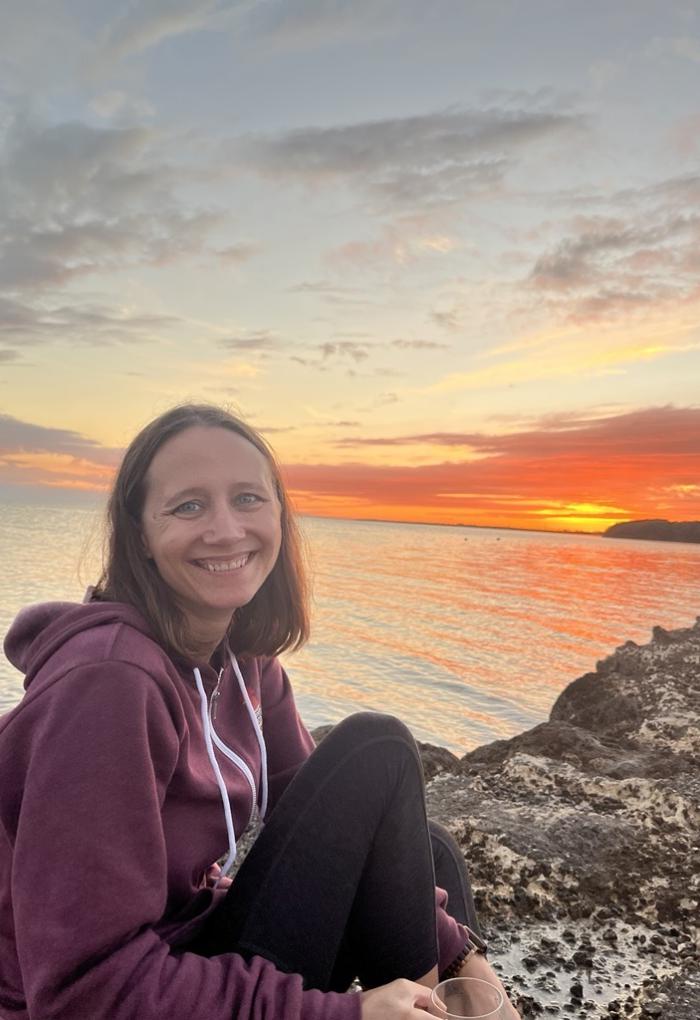
A woman poses for a photo in front of an orange sunset over water.

Baird poses for a photo during sunset in Key West during a work trip.

Always being open to learning benefited Baird when she started at Milliman. New terminology, processes and expectations felt overwhelming. Although she credits her graduate training for helping her develop critical skills like note-taking and technical writing, it took her time to adjust.

“For the first six to eight months, I felt completely out of my element,” she said.

Doubting yourself in a new role is a normal experience, Baird said, but those feelings won’t last forever. Over time, that uncertainty gave way to confidence and she took on leadership roles.

For students interested in actuarial careers, Baird recommends gaining early exposure to the field by taking exams and pursuing internships. Equally important are soft skills.

“We’re a very collaborative group,” she said. “Making sure that you can show that you have successfully worked as part of a team or led a team is helpful.”

Actuarial work goes beyond spreadsheets and equations; it’s about using math to guide decisions that affect people’s lives. From shaping how healthcare is delivered to ensuring organizations can meet their financial commitments, that work carries real consequences. For Baird, it’s a job that lets her use mathematical skills in ways that have real-world impact.

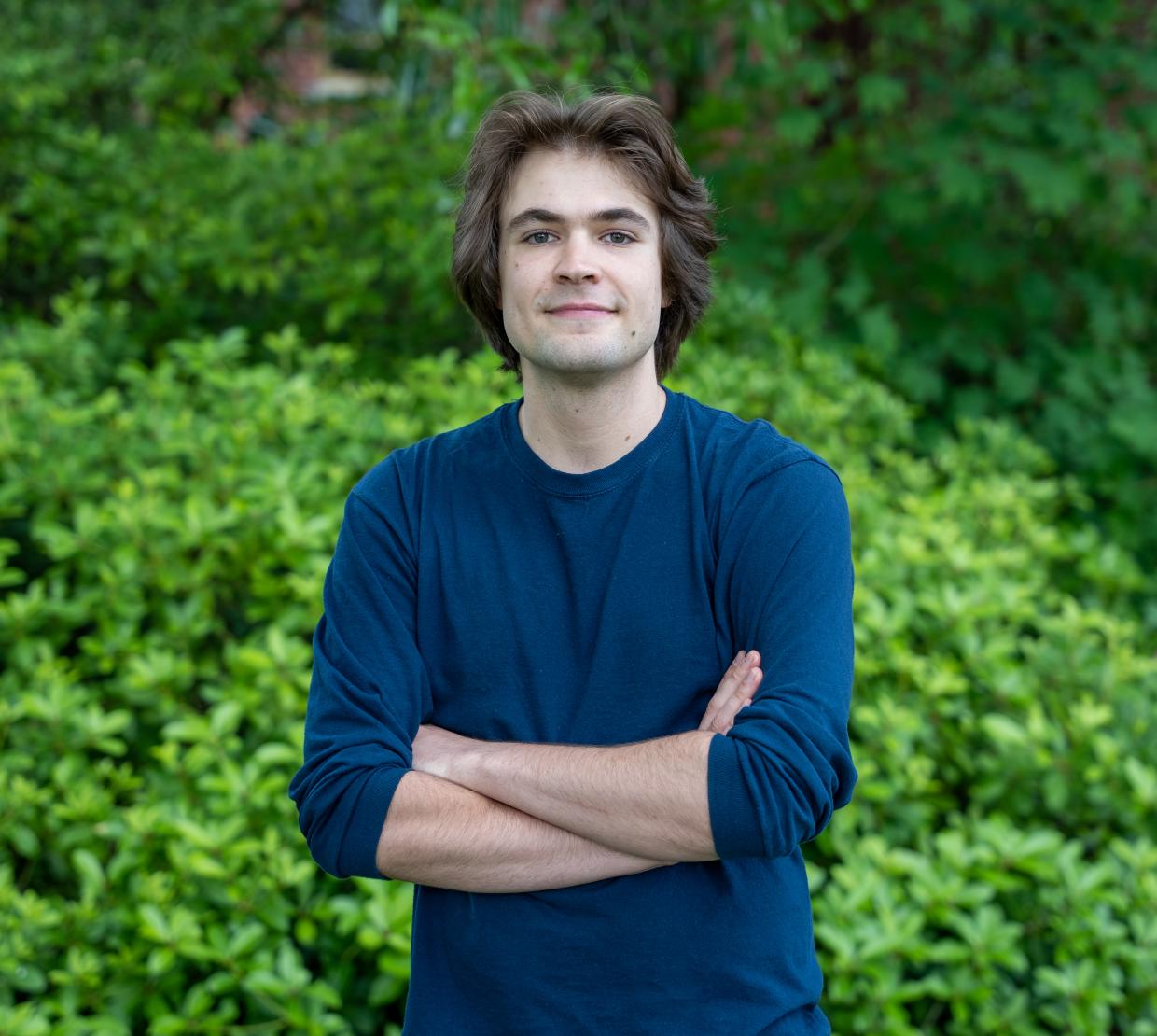
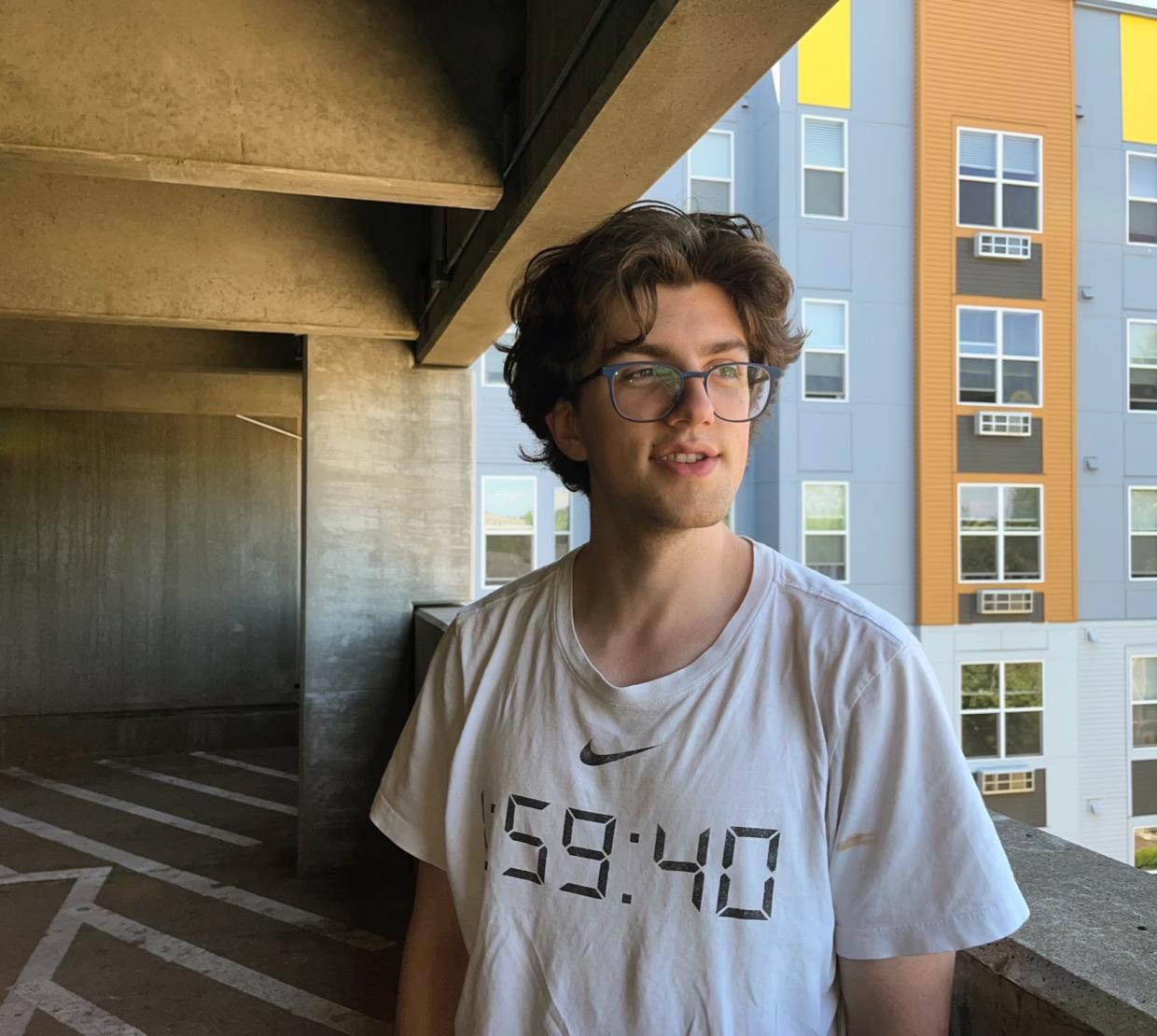
A man in a black shirt stands in front of a white background.

Roan Luikart, Class of ’25: Mathematics major finds the equation for success

By Hannah Ashton

Roan Luikart is quick to admit that he knows math isn’t everyone's favorite subject — and he’s had his fair share of surprised reactions when he tells people he loves it. But for him, the appeal is clear.

“There’s a logical rigor and clarity in mathematics that is comforting,” Luikart said. “It’s not subjective. Either something is logically consistent or it isn’t. In a world with a lot of uncertainty, mathematics is grounding.”

He also sees the beauty in the discipline, from fractals to Lorenz attractors, a set of chaotic solutions that resembles a butterfly. For Luikart, math is more than equations and proofs. It’s a way of thinking, creating and understanding the world.

At Oregon State, he was able to bring his passion to life. He studied abroad in England, conducted two undergraduate research projects, served as a resident assistant and helped grow the Math Club.

This June, Luikart will graduate as an Honors double major in mathematics and physics before preparing for his next adventure: pursuing a Ph.D. in mathematics at the University of Virginia. He hopes to become a professor of mathematics and carry forward the mentorship and discovery that have defined his academic career.

The Math Club poses for a photo during the first meeting of Fall term 24-25.

The Math Club poses for a photo during the first meeting of Fall term 24-25.

How he got involved with undergraduate research

Luikart’s passion for math didn’t begin in a classroom. In eighth grade, after transferring schools and being placed in the wrong math track, he found himself catching up over winter break with a thick packet of make-up work. He was unmotivated — until his father brought him along to work and left him with nothing else to do but finish the assignments.

“Through that experience, I formed a greater appreciation for it and fell in love with math,” he said. “I found out how fun it can be especially when you have a higher level of understanding.”

By high school, he was even more enthusiastic about math. And once he discovered he could make a career out of it, he was sold.

Raised between Oregon and New Hampshire, Luikart chose Oregon State in part for in-state tuition and its strong research focus. He capitalized on this strength and completed two major research projects, one on campus and the other as a part of an NSF funded summer research opportunity.

Asking his favorite professor if he could do research with him snowballed into his Honors thesis project and a mentor for life.

Luikart approached assistant professor Nick Marshall, who is interested in mathematics problems that involve interactions between analysis, geometry and probability, especially such problems motivated by applications to data science.

“He is a fantastic teacher, and past that, a great research mentor. He’s given me a lot of advice, and I don’t know where I would be without it,” Luikart said.

Together with Marshall and a graduate student, Luikart co-authored a paper published in the SIAM Journal On Matrix Analysis and Applications. Their work focused on improving a numerical algorithm, relevant to fields like medical imaging and computer tomography (CT, also known as CAT scans), by adding a method known as “momentum” to speed the algorithm.

“We need algorithms that can quickly solve these linear systems of equations. We added a term that incorporates past movement of the algorithm so it can speed up,” he said.

Equipped with knowledge from multiple terms working with Marshall, Luikart applied for multiple REUs (competitive summer National Science Foundation Research Experience for Undergraduates programs), covering all sides of mathematics research.

Luikart presents his REU research at the end of the program.

Luikart presents his REU research at the end of the program.

He was accepted and spent three months in Illinois working on mathematical biology at Northwestern University.

His research mentor was studying circannual rhythms, a biological rhythm that happens annually in different species like birds or bears. While many of the models assume this behavior is intrinsic and doesn’t take into account environmental influences, his mentor theorized differently.

Luikart worked on the early development of a new mathematical model that incorporates external factors like temperature or duration of daylight.

“I improved my independent problem solving and learned how mathematical modeling works. I did most of it on my own and it was interesting because I could mathematically model the same biological observation in different ways,” he said.

Undergraduate research has not been the only way Luikart has gotten involved on campus.

He joined the Math Club as a first-year student and became president in his senior year, helping revive the organization after it dwindled during the pandemic.

“It has been a huge part of my time here,” he said.

Today, the club hosts weekly meetings and game nights for all students who love math or are interested in it. Luikart’s energy and passion for connecting with students led to him becoming a resident assistant in the dormitories for three years.

Luikart and his friend Nick pose for a photo during the Math4All conference in 2024.

Luikart and his friend Nick pose for a photo during the Math4All conference in 2024.

Studying abroad

Second to meeting Nick Marshall, studying abroad was a top transformative experience for Luikart. Similar to knowing he wanted a Ph.D., studying abroad was a no-brainer. Travel has been a huge part of his life, with his mother taking him to a new country almost every year since he was a young child. At last count, he has been to about 20 countries.

Working with OSU Go, he was able to tailor his experience and enroll in Lancaster University in the United Kingdom. Often ranked in the top 15 mathematics programs in the UK, Lancaster fit everything he was looking for.

His favorite detail was one he almost didn’t notice. On an evening walk home, he noticed covered walkways along campus buildings, designed to shelter from frequent rain. Between the supporting pillars were carefully tended flower planters. Careful not to damage them, gardeners were taking each planter down to water. This small attention to detail left a lasting impression.

“I really liked the university, and the campus turned out to be the biggest highlight for me. It is incredibly beautiful. I was already loving the campus, but as I was nearing the end of my time there, I started to take more time to appreciate things. I could go on and on,” he said.

A thirst for more math

This July, Luikart will head to Charlottesville to begin his Ph.D. at the University of Virginia. While professorship remains his goal, the draw of graduate school goes further than fulfilling a career path.

“Even if I don’t end up becoming a professor, having that further mathematical understanding is something I desire. Right now, I know just the tip of the iceberg,” he said.

For Luikart, math is a subject to explore. And thanks to the community, opportunities and mentorship he found at Oregon State, he’s ready for whatever comes next.

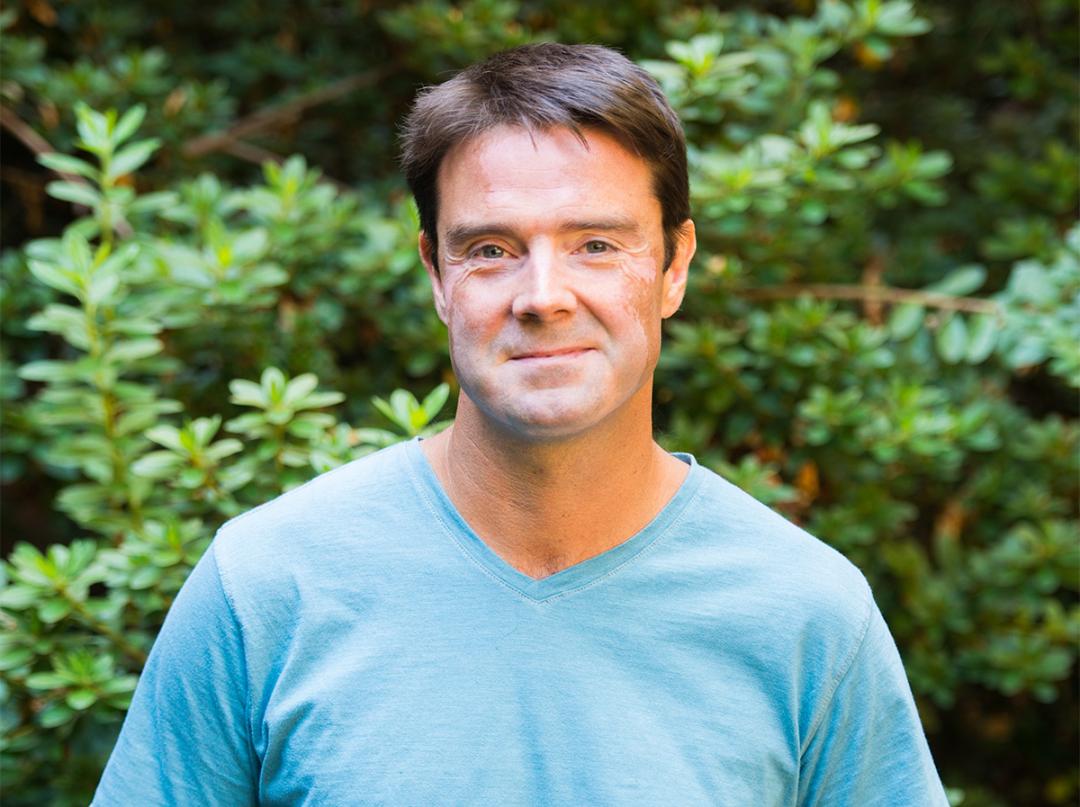
Joey Takach posing with a smile in front of leafy green bushes.

Edtech-inspired physics and mathematics senior lands a spot at top-tier university

By Kaitlyn Hornbuckle

A long time ago in a galaxy not so far away — in Lake Oswego, Oregon — Joey Takach ordered a bunch of soundboards, accelerometers and other metal parts online. This aspiring Jedi was determined to build his own model lightsabers that hummed and glowed just like the Star Wars movies.

"When I was really young, I wanted to be an astrophysicist, but I didn't really know what that meant. I’ve always been a huge Star Wars fan, so fantasizing about creating technology that might resemble something from that played a significant role in what I chose to study,” he said.

Building lightsabers while in high school wasn’t out of the ordinary for Takach. He loved putting together different types of gadgets for fun, and drew inspiration from the type of work his mother did in the engineering field.

When it was time to decide his next steps in his academic career, he applied to Oregon State University to study electrical engineering. The presidential scholarship helped him avoid student debt and made studying at Oregon State especially appealing.

But then his trajectory changed entirely. Instead of focusing on the mechanics of building lightsabers, he became fascinated by something bigger: getting closer to objective reality itself. And being able to model what happens in real life using mathematical equations to make sense of everyday experiences was just as captivating.

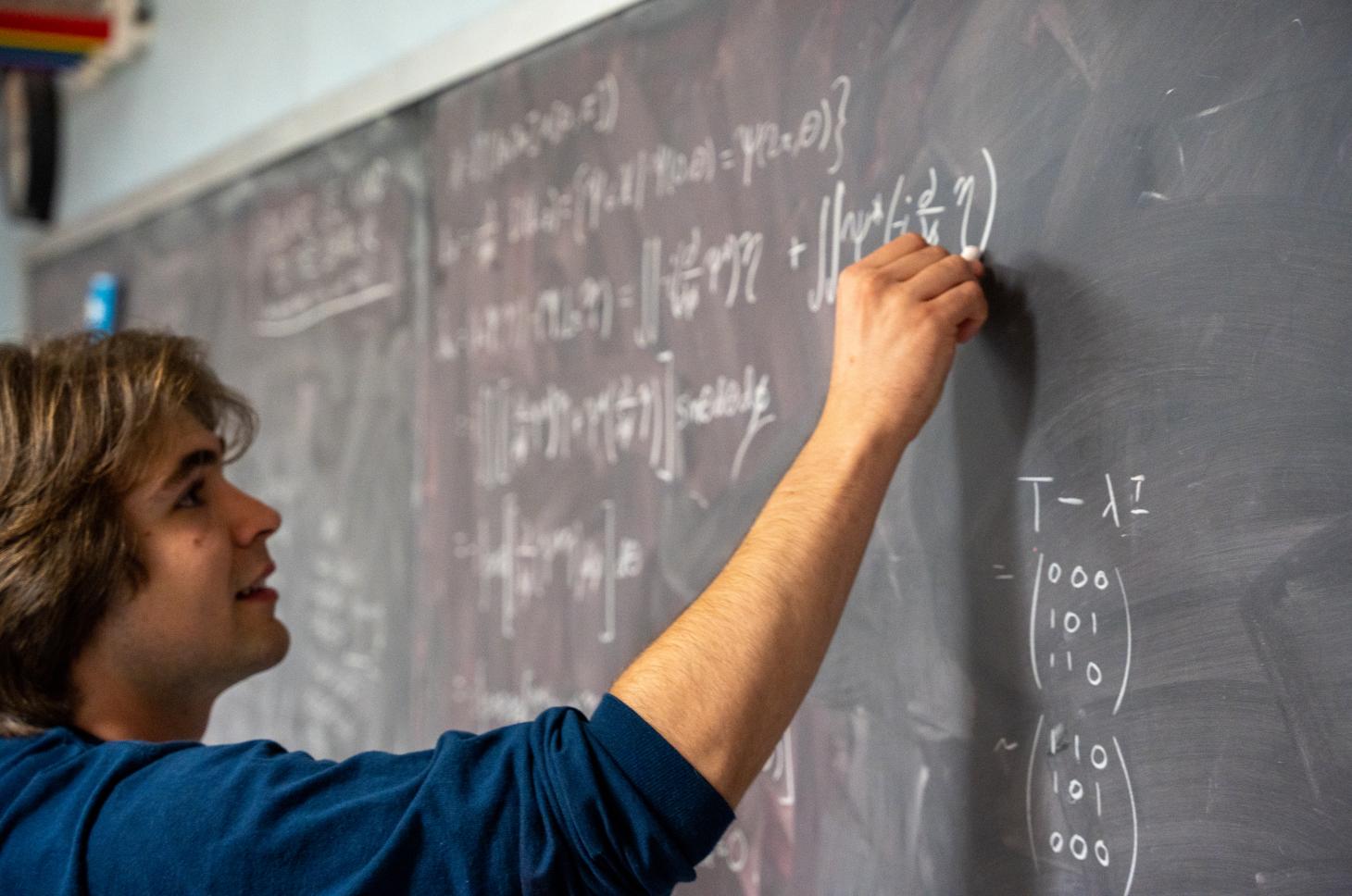
Joey Takach grinning while writing equations on a chalkboard.

Takach plays with some of his favorite equations.

"When I started to take more physics classes, I thought, 'Wow, this physics stuff is really cool,' and it just clicked,” Takach said. One thing led to another, his passion grew and he pivoted entirely.

"Not to say that math isn’t beautiful, but I think that applying math to something real is what is most important."

Takach is graduating this summer with a double major in physics and mathematics. "The coolest thing about the math department is how flexible it is. And in the physics department, everyone's really friendly and there's lots of interaction between students," he said.

In the fall, Takach is moving forward with a Ph.D. program at University of California, Berkeley, focusing on particle physics and phenomenology. This involves looking for things that can be observed and may not be obvious experimentally. Instead of testing a hypothesis, phenomenologists choose a mathematical theory and try to “tease out” observations. After they decide what the observable effects are, they tell experimentalists to go looking for them in real life applications.

By chance, physics meets education technology

Takach found a lot of faculty support that allowed him to make an impact early on in his academic career. In his first year, one of his main advisors, Associate Department Head David Craig became his go-to resource for knowledge.

“I did the naive freshman thing and went to Craig because he was one of the resident theoretical physicists here. He directed me to a bunch of stuff to study in my free time and what books to read. He also motivated me to start learning on my own, and helped me learn how to attack those high-level concepts early without waiting to be in a class.”

Takach’s journey didn’t stop there. Last summer, he landed an internship at University of California, Davis, where he gained experience working with computational physics and quantum field theories in the realm of particle physics.

At Oregon State, he worked on campus as a peer advisor for the Science Success Center and as a learning assistant for the Techniques of Theoretical Mechanics course in the physics department.

His passion blossomed when he learned how to utilize the power of Python, a computer programming language, to create educational videos about high-level physics concepts and make the content more accessible to students who haven’t learned it.

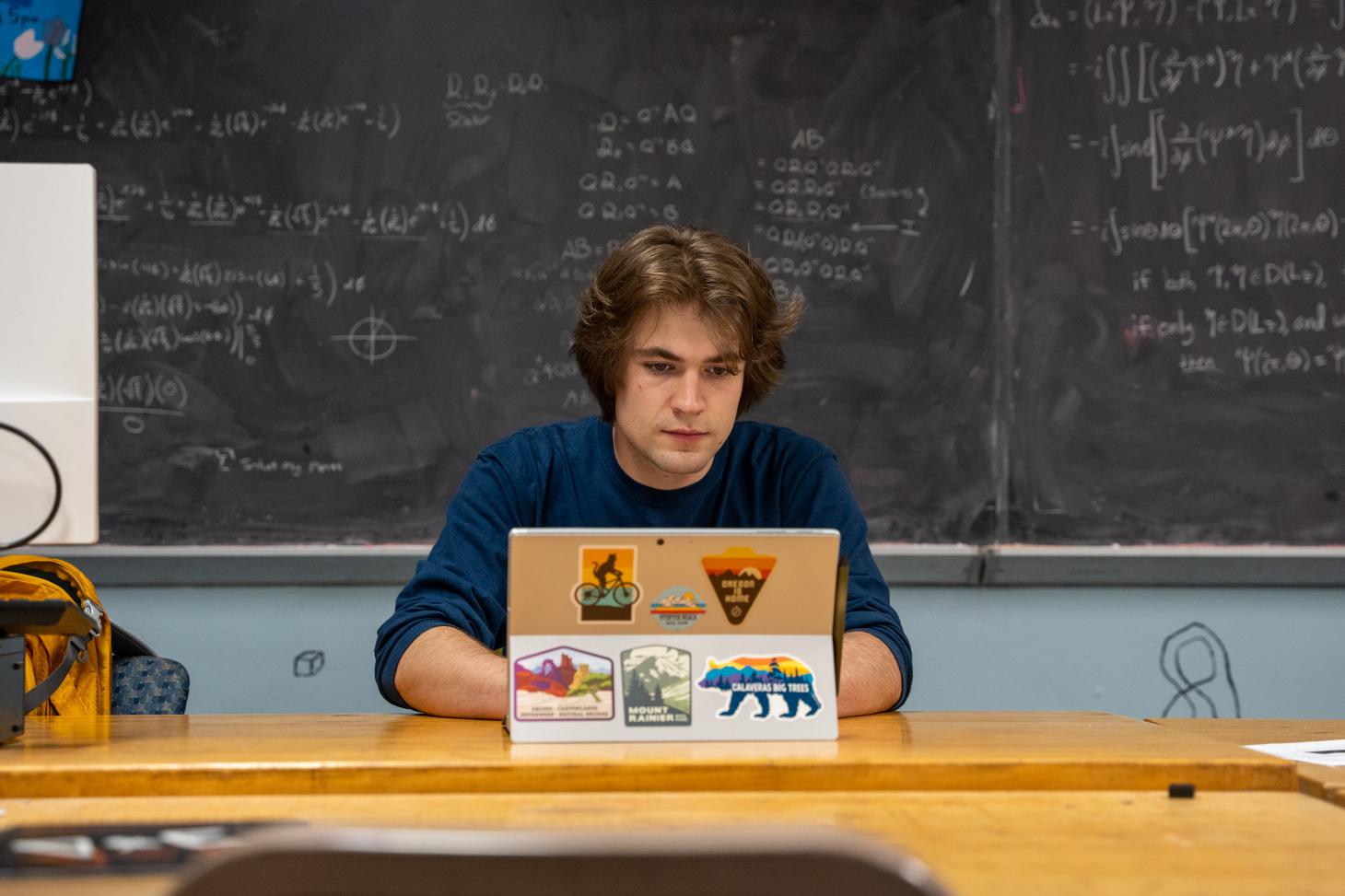
Takach is busy typing behind his laptop. A chalkboard full of mathematical equations stands behind him.
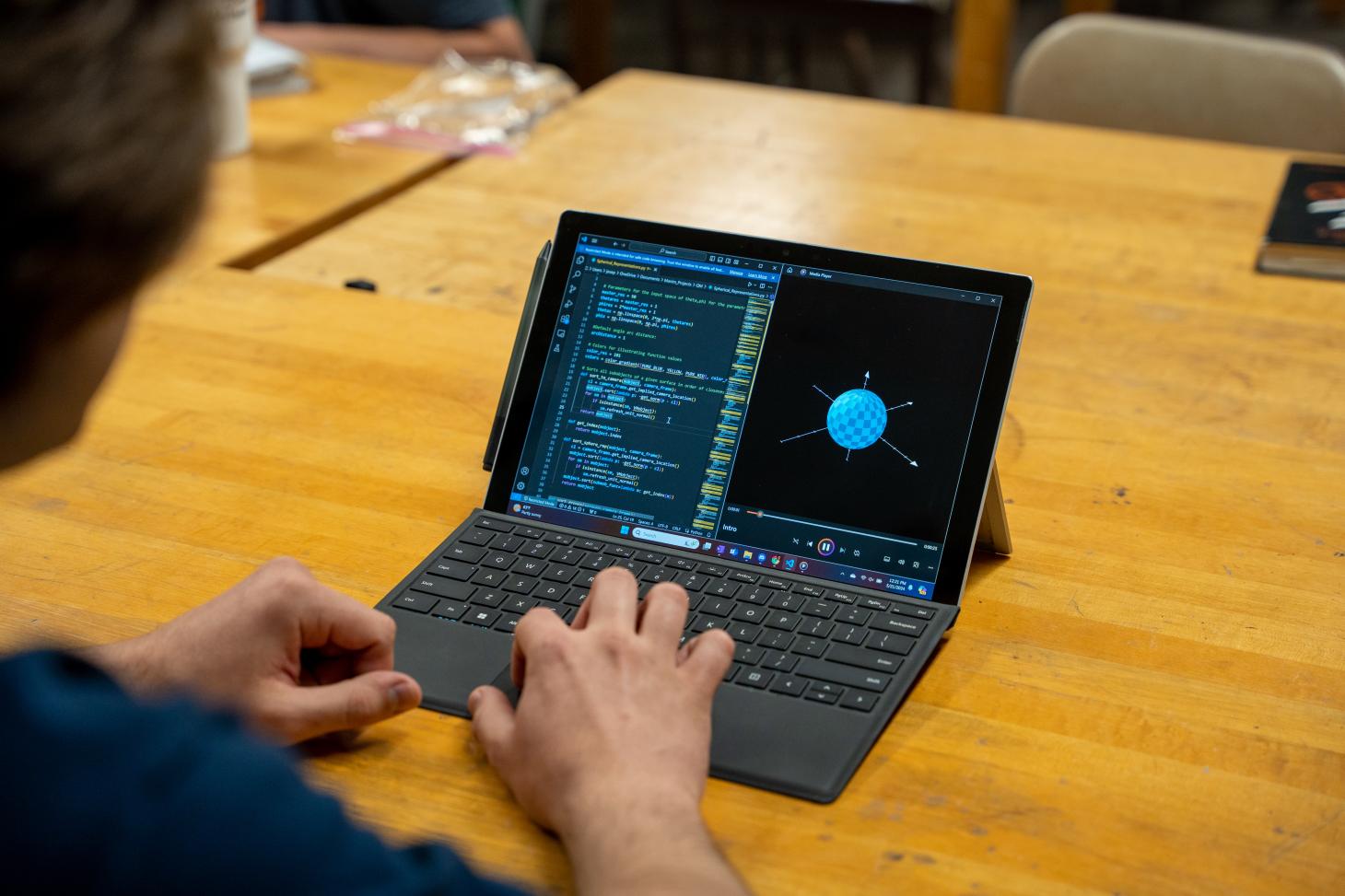
Takach steps through a Python program that runs a video simulation. A blue sphere with arrows pointing out of it is displayed on the computer screen.

Takach presents a vector video simulation using the Python programming language.

“Getting an early start and giving kids the opportunities to learn more as early as they can is so important. It becomes second-nature if they start early enough,” he said.

Inspired by YouTuber 3Blue1Brown, who made animated mathematics content, Takach created his own video to help more students have access to an engaging, easier-to-grasp learning experience. His goal was to teach about an advanced mathematics topic: curl.

In vector mathematics, curl is a concept that involves measuring the rotational or swirling behavior of a vector field. A vector is a direction with a specified measurement, such as how fast a golf ball moves forward when hit with a golf club. Imagine a bunch of arrows pointing in the direction that the ball is moving – the longer the arrows, the stronger the force in that direction.

“There are tons of people online that make these kinds of videos. Making this content accessible to younger people is essential because the amount of science you need to know in order to advance in a field is very daunting,” Takach said.

He sent his video to Physics Professor Emeritus Corinne Manogue, the leader behind the Paradigms in Physics project funded by the National Science Foundation. This physics education project led to the creation of 19 new physics courses and focused on shifting the curricula from traditional lectures to active engagement for students at Oregon State.

She hired Takach to make more educational videos that were aligned with the physics curriculum, including quantum mechanics. The videos were intended to improve the learning experience for future physics students.

“The most concrete thing that I want to have an impact on is teaching. I love sharing the experience of learning something for the first time. It happens so frequently – it's the weirdest experience and when you share that with someone, It’s motivating, fulfilling and fun,” he said.

Physics Associate Professor Elizabeth Gire also had a positive influence on his academic career. After she taught one of his first upper-division physics courses, he left feeling inspired. "She really, really cares about the students and how much everyone's learning. I think that rubbed off on me. The way she goes about teaching and encouraging people to work together is definitely something to look up to and had a big impression on me.”

Looking back, one of Takach’s favorite memories at Oregon State is living with his friends for three years. "Two of my best friends from high school are still my roommates now. They’ve been a great support system.”

During his free time, Joey loves to dive into music and plays several instruments, including guitar, bass, viola and violin. When the sun comes out, he enjoys hiking, backpacking and traveling.

After completing his Ph.D. in California, Takach dreams of becoming a physics professor. “Learning and teaching for as long as possible is the most ideal for me. I need the connection to what is actually real. Not to say that math isn’t beautiful, but I think that applying math to something real is what is most important.”

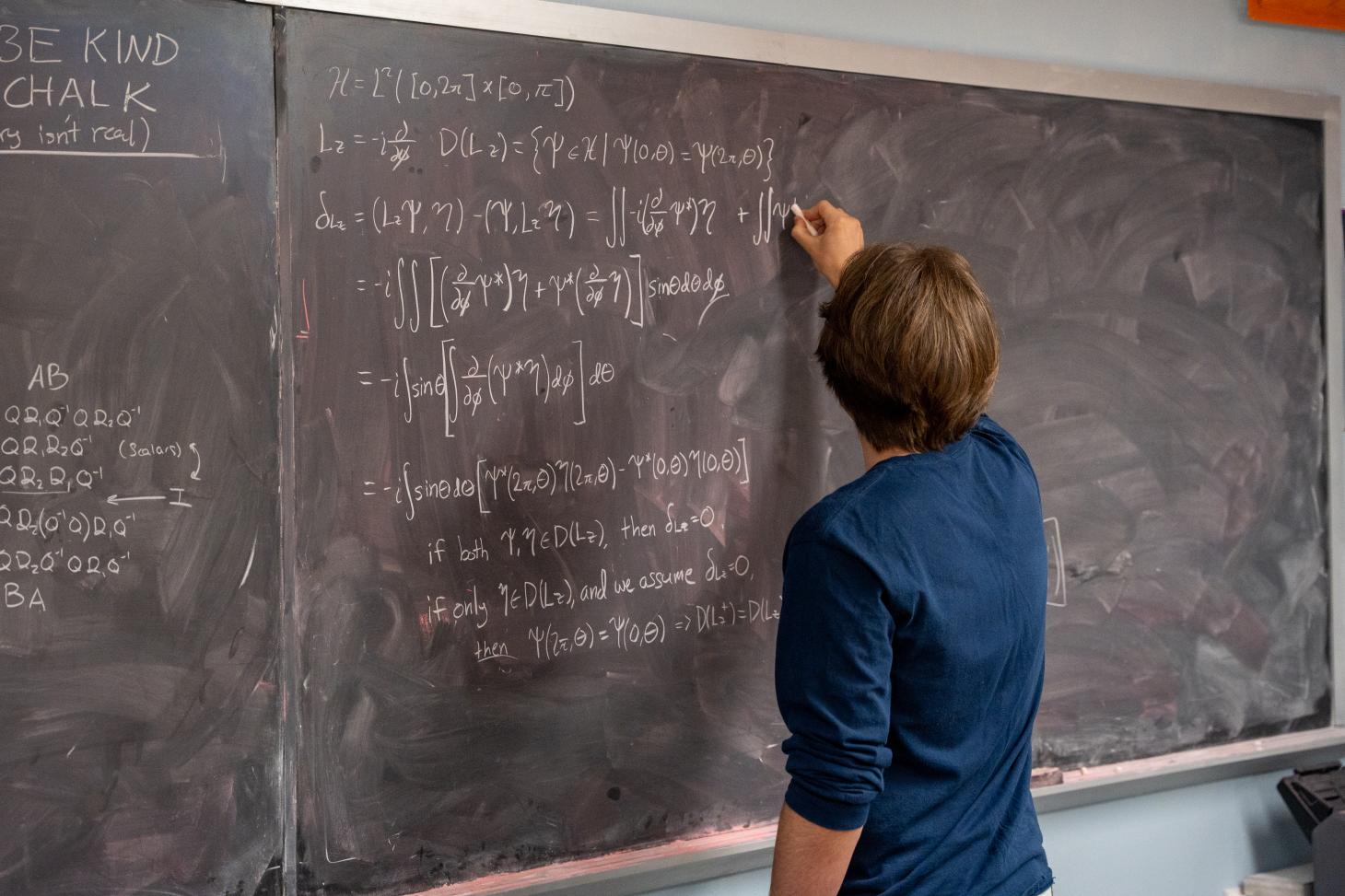
Takach fills a chalkboard with mathematical equations, with his back faced to the camera.

Takach contributes to the beauty of mathematics and reality of physics on a chalkboard.

Michael Waterman teaching

College of Science alumnus to be presented with honorary doctorate

By Hannah Ashton

Courtesy of USC, by Leah Lee

College of Science alumnus Michael S. Waterman (Mathematics '64, '66) will be presented with an honorary doctorate at this year's university-wide commencement ceremony in Corvallis.

Waterman is an internationally celebrated mathematician and biologist known for his extraordinary contributions to science, dedication to education and impact on multiple disciplines. He is an eminent figure in bioinformatics and globally recognized as a trailblazer in computational biology.

He is considered the architect of the groundbreaking Human Genome Project which advanced genomics and deepened the world's understanding of life's genetic foundations. He is also known for his collaborative innovation in developing the Smith-Waterman algorithm, a monumental breakthrough. This algorithm revolutionized sequence alignment and is described as the "gold standard for gene and protein sequence analysis." It has become an indispensable tool in bioinformatics, molecular biology, and genetics, and has profoundly impacted molecular biology, medicine, cancer treatment and biofuel development.

"Dr. Waterman's dedication to pushing the frontier of knowledge and his commitment to education are extraordinary," wrote Oregon State University President Jayathi Murthy and Provost and Executive Vice President Edward Feser.

Waterman received the college's Lifetime Achievement in Science Award in 2021. Serving on the College of Science Board of Advisors, he also created a scholarship that supports College of Science students who are historically underserved, Oregon residents.

His list of awards and honors includes the Guggenheim Fellowship and professorships at the University of Southern California and the University of Virginia. He is an elected member of the American Academy of Arts and Sciences, the National Academy of Sciences, and the National Academy of Engineering, and a fellow of several scientific organizations including the American Association for the Advancement of Science and the Institute of Mathematical Statistics.

He has received the Gairdner Foundation International Award, the Dan David Prize, the Walter Benter Prize in Applied Mathematics, and the Friendship Award from the Chinese government. Additionally, he is a founding editor of the Journal of Computational Biology and serves on the editorial boards of various journals.

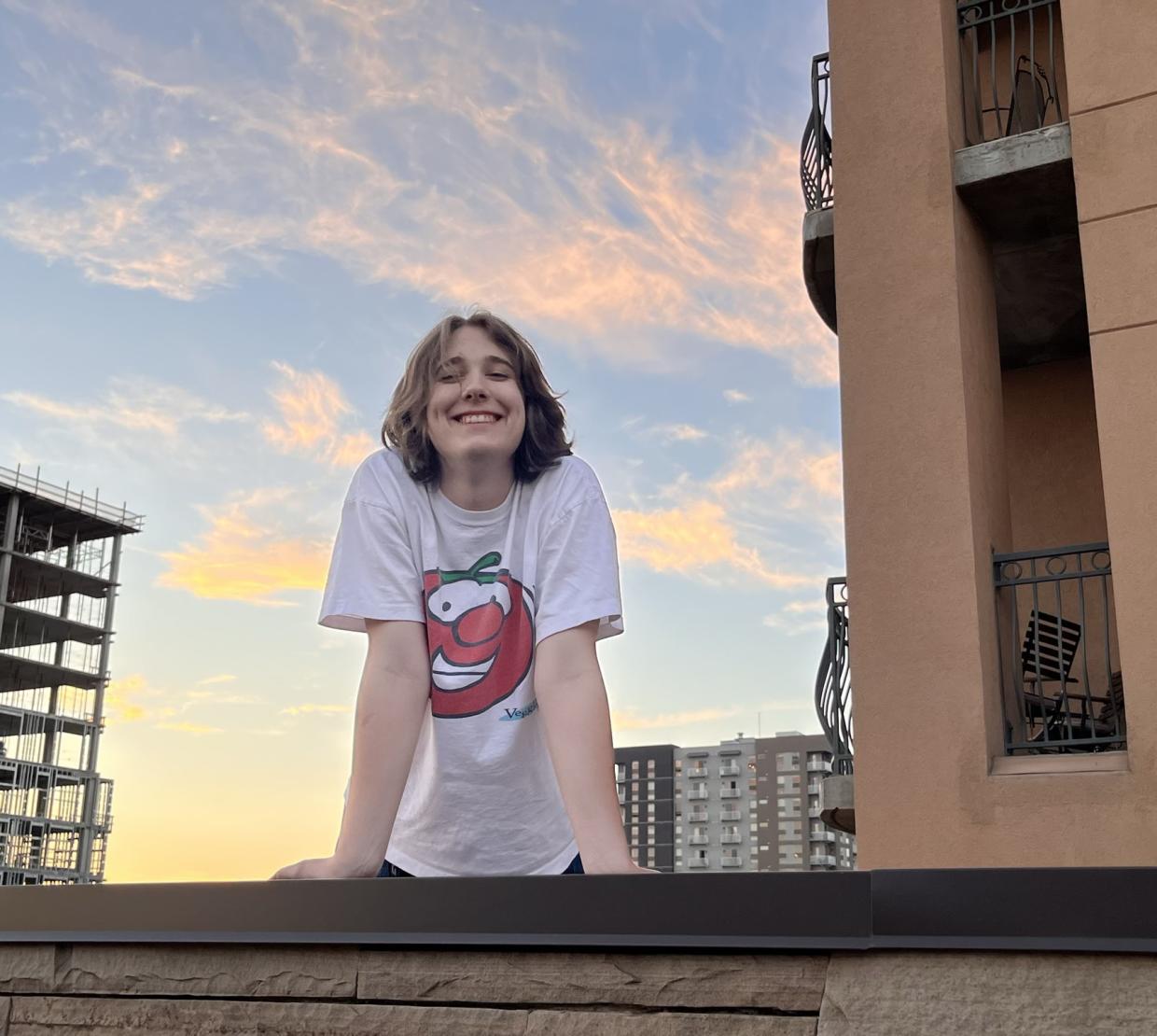
A man in a white t shirt with shoulder length hair poses for a photo with a sunset in the background.

Turning a talent for numbers into a career in finance

By Tom Henderson

Ryan Holzschuh liked math as a teenager.

He was even one of the top mathematics students at Cleveland High School in inner southeast Portland and took a year's worth of college-level math classes during his senior year in 2022.

However, it took going to Oregon State University for Holzschuh to truly fall in love with numbers.

“When I was in high school, I was just good at math," he said. "I didn't really know what to enjoy about it. Coming here really helped. A lot of the professors helped me learn to love it."

One such professor was Dr. Axel Saenz Rodriguez, who specializes in algebra and number theory, analysis and applied mathematics as well as probability.

"He was my probability professor," Holzschuh said. I "had him for a whole year. He has really taught me to love proofs. I was terrible at proofs early in the year. Now I've gotten good at them."

One area of math was a bit of a harder sell for Holzschuh.

"Algebra was not my favorite, but I had Dr. Clayton Petsche as a professor," he said. "He is such a good teacher and really helped me love algebra, even though I will probably never do it again because it is very complicated."

Holzschuh is graduating from Oregon State this spring with a mathematics degree with a focus in statistics as well as a minor in actuarial science.

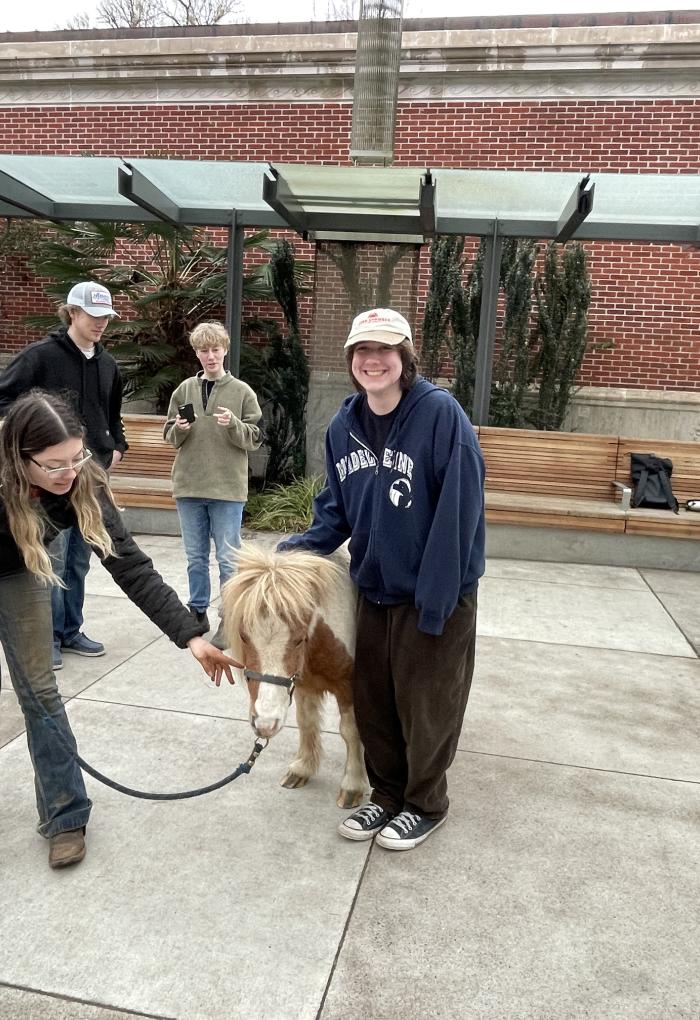
A man stands on the Oregon State University campus and pets a miniature horse.

Ryan Holzschuh pets a miniature horse in front of the Memorial Union.

His road to graduation started with his father.

"I was very good at math when I was a kid, and my dad tried to hone in on that," he said. "He always told me how when he learned math, he memorized formulas and that got him through math even when he didn't always understand it."

Even if math didn’t rise to the level of a passion quite yet in Holzschuh's young life, he spent a lot of time crunching numbers. "I would always spend hours learning to understand the math I was doing," he said.

All that time paid off when he arrived at Cleveland High School. "I quickly picked up on math because I had such a strong foundation that I could easily build on," he said.

"That led to being very good at math and very good at physics," he added. "I didn't pursue physics because there are just a couple of concepts I really didn't understand, like when I started learning about Feynman diagrams."

Feynman diagrams are pictorial representations of mathematical expressions describing the behavior and interaction of subatomic particles.

Physicist Richard Feynman used wavy lines to represent photons. In physics as well as mathematics, a wave is a propagating dynamic disturbance of one or more quantities. "Waves are pretty weird," Holzschuh said. "Waves always tripped me up, so I decided to focus on math."

Oregon State was a fairly straight-forward choice for college, he said. Other colleges and universities in Oregon don't offer as many classes in statistics, and Holzschuh also wanted to stay close to home.

"I came to Oregon State mostly because I'm from Portland, and it was pretty easy," he said. "I wasn't moving too far, and I still had a little bit of freedom. I also knew a lot of people here, so it would be an easy transition into college."

Once in Corvallis, Holzschuh said he was impressed with the university's world-class faculty, and his love of math flourished.

"I love the theory behind math," he said. "It's super interesting to me how you predict outcomes."

He added he also loves how math is so unambiguous.

"I like how math has one answer," he said. "When you're doing calculus, there's one answer. Now that I'm in more proof-based analysis level math, I like how you go from Point A to Point B, and there are different ways to go, but you're always going to get to Point B."

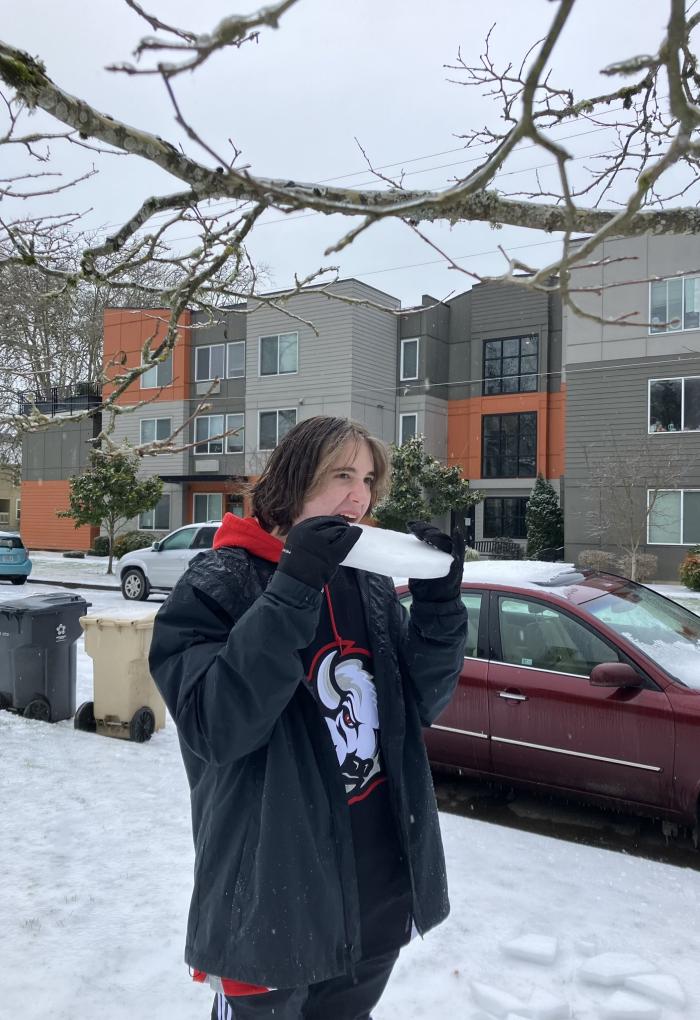
A man holds a piece of ice and attempts to eat it.

Ryan Holzschuh pretends to eat a piece of ice during an ice storm in January 2024.

His other academic passion is not known for its lack of ambiguity.

"Math and science were my big subjects in high school, but I also had a small interest in philosophy," Holzschuh said. "I really do still love philosophy."

He just doesn't have a lot of time to hang out with Plato, Descartes and their 21st-century counterparts as a mathematics major.

"Because I spend most of my time studying math, I don't have the reading comprehension level to truly understand a lot of the current philosophy papers," he said. "They're just so heavy and dense."

Still, he has friends ready to help. "One of my best friends is a philosophy major in Belgium, and he will talk to me about philosophy for hours," he said. "I really love it."

"Being able to go on the scheduling website and just take a bunch of math classes, it makes me pretty happy."

Being a math major has not kept him socially isolated, he added.

"I've met so many different people from so many different majors," Holzschuh said. "One of my best friends is a mechanical engineer. My two roommates are botany and English majors."

Students recognized for expertise in certain subjects in high school are often humbled when they arrive at college and are no longer the big fish in a small pond.

Even if he was no longer one of a handful of math stars, Holzschuh said he found coming to the mathematics community at Oregon State exhilarating.

"I actually liked it," he said. "For one, college allowed me take the classes I wanted to take. I went from high school, where I took one math class a year and seven other random classes, to where I'm taking 20 hours of math and statistics this semester."

He added, "Being able to go on the scheduling website and just take a bunch of math classes, it makes me pretty happy."

Undergraduate students usually spend much of their freshman and sophomore years taking required lower-division classes, regardless of their majors.

"Once you get past your second year in mathematics, it really opens up," Holzschuh said. "I came in a year ahead on my math track, so once I got to my second year, I could take linear algebra, and once you've taken that, basically everything opens up. You can pretty much take any math class in any field."

He has taken such general elective classes as differential equations, complex variables ("which is really interesting"), math models and math biology.

"I never thought I would take anything related to biology because I hated biology in high school, but that was an interesting class," Holzschuh said.

After graduation, he intends to move from Corvallis in August to start graduate school at Boston University.

"I selected Boston University because it's on the East Coast," he said. "I really want to go there, especially because of math and finance. The East Coast is a great place to be for that. Also, Boston seems beautiful, and it's close to New York."

After grad school, Holzschuh said he hopes to remain on the East Coast and pursue his love of numbers as a quantitative analyst -- designing, developing and implementing algorithms and mathematical or statistical models to solve complex financial problems.

"It's a very challenging career path, and I really like being challenged," he said.

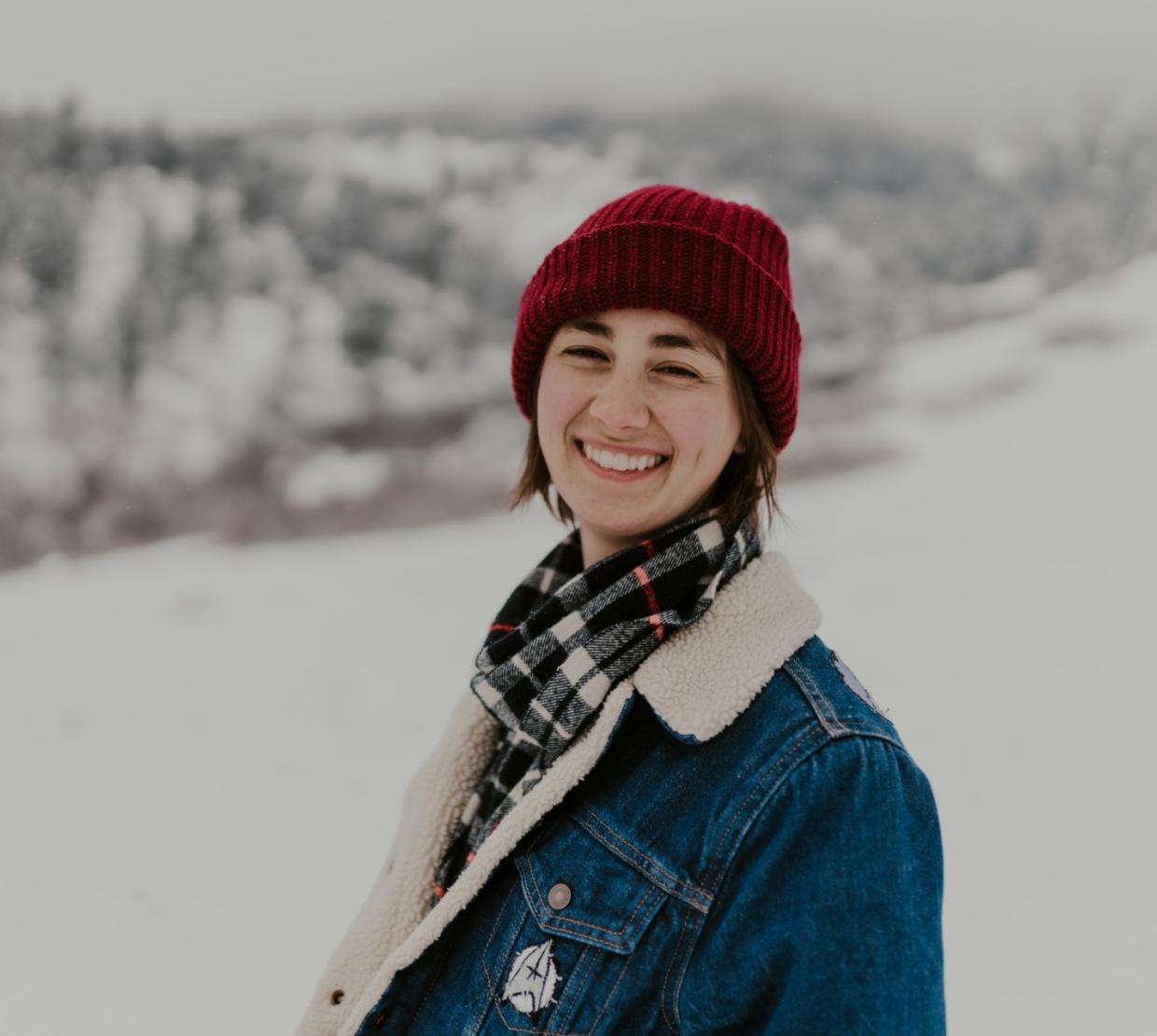
Megan Tucker smiles widely, her scarlet beanie a striking contrast to the snow-covered mountaintops that rise behind her.

What do mathematicians do? This mathematics grad began a technical writing career at Amazon

By Elana Roldan

In science, ‘new’ is a constant. Novel research techniques propel studies forward. Updated software creates ripples across technology. But as fields evolve at a breakneck pace, leaving the rest of the world to play catch-up, there is a subset of communicators helping us along — technical writers.

Technical writing breaks down complex scientific jargon into easily understood information. Those who pursue the niche are much like Swiss Army knives, able to learn and explain a variety of specializations. Alumna Megan Tucker, ‘20, is one such knife.

After completing a double major in Mathematics and Liberal Studies with a focus on writing, Tucker worked as a technical writer for Amazon Web Services for three years. She is currently completing her master’s degree abroad. Using the breadth of knowledge and professional skills she naturally gained as a College of Science undergraduate, she has found the sweet spot between her two passions in a truly rewarding career.

“It felt great to graduate knowing I could continue to learn and write about science and become an expert in fields I wouldn’t have known existed until someone said, ‘We need a tech writer.’”

Doing the math

The perfect set of degrees for Tucker wasn’t immediately obvious. While she always had an additional writing-focused major, her first major in STEM was nuclear engineering. It was short-lived as she felt drawn to the deeper discussions about quantum mechanics available to physics undergraduates. But physics still wasn’t quite right, and she finally turned to the major that had run through each of the others: mathematics.

Having academic advisors dedicated to each major ready to help made for a smooth transition into mathematics. It turned out to be an excellent fit, even as the content became increasingly difficult. Triumphing over challenges with the help of her mentors was one of the best learning experiences the major had to offer.

“I was really struggling with some proofs in an abstract algebra course and Professor Schmidt told me, ‘You can do this proof. You’re doubting yourself. Stop doubting yourself and you’ll be able to solve anything you put your mind to.’ That was such a game changer for me, to realize that yeah, I can do this,” she said.

“That’s really what I went to college for, to talk to experts in their field ... Having the opportunity to work with those people and learn from them is probably the best thing that I got out of OSU and the College of Science.”

The switch was especially validated at the end of her junior year when she was accepted into an internship for the Department of Energy, which she found through attending a College of Science research seminar. She flew to Pittsburgh and Washington, D.C. to study data sets that could prove useful for carbon sequestration.

Surrounded by Ph.D. candidates of many specializations, Tucker appreciated the experience for its challenging environment.

“In college especially, people should really push themselves. That’s their opportunity to learn and try things and fail. I don’t even think you should stop doing that after college, but college is a really nice place where you can do it a lot,” she said.

This style of learning led by knowledgeable guides was a highlight of her time as an undergraduate, and she cherishes the lessons it taught her.

“That’s really what I went to college for, to talk to experts in their field,” she said. “Learning not just about the class, but about what it means to get your Ph.D., what it means to get your master’s and what it means to be a mathematician. Having the opportunity to work with those people and learn from them is probably the best thing that I got out of OSU and the College of Science.”

The unspoken questions

When technical writing was first introduced to her through her coursework, Tucker had no intention of pursuing it further. A career in the niche hardly crossed her mind.

“I was like, ‘It’s a course I took in school, no one actually does that for work, right?’” she recalled ironically.

But when she later accepted a grant writing internship on campus while searching for more work opportunities, her perspective shifted. She began to see the world of possibilities that lived at the intersection of writing and science. Her two passions that once seemed completely disparate merged into her dream job. By the time senior year rolled around, she was applying for as many technical writing positions as she could.

A job offer from Amazon Web Services came back in March and she began working for them in Seattle soon after graduation. AWS is the most widely adopted global cloud provider, boasting millions of users who rely on its services. Much of Tucker’s work involved creating user and application programming interface guides for each software release. Her writing boiled down imposing cloud architecture setup into step-by-step instructions, guiding customers out of a computer deep end and into smooth sailing.

“There's an endless amount of things I could write about. You’re answering the unspoken questions that need to be answered.”
The skills she learned from both of her degrees played prominent roles in her daily work. Being able to absorb the ins and outs of feature releases and discuss science-heavy content with software developers both stemmed from her mathematics major. These then pooled into planning, writing and editing technical documentation for the company, allowing her to thrive in her position.

Along with the skills she purposefully developed, Tucker found that the ones she gained naturally as a science student were critical to her success.

“It’s very much like university with different clothing,” she explained. “Ultimately, I really had to keep up with my courses and be organized and punctual. That’s pretty invaluable to me working, staying on top of my tasks and being able to communicate these topics with people who have a varying level of knowledge about them.”

After three years at AWS, Tucker resigned to work toward her master’s in writing at Queen’s University in the U.K., which she plans to earn later this year. The degree will be another step higher for her into the world of technical writing, one full of possibilities.

“I love the field because of that conversation between STEM and writing,” she said. “I could write for chip manufacturing, I could write for a university, I could write for medical tech. There's an endless amount of things I could write about. You’re answering the unspoken questions that need to be answered.”

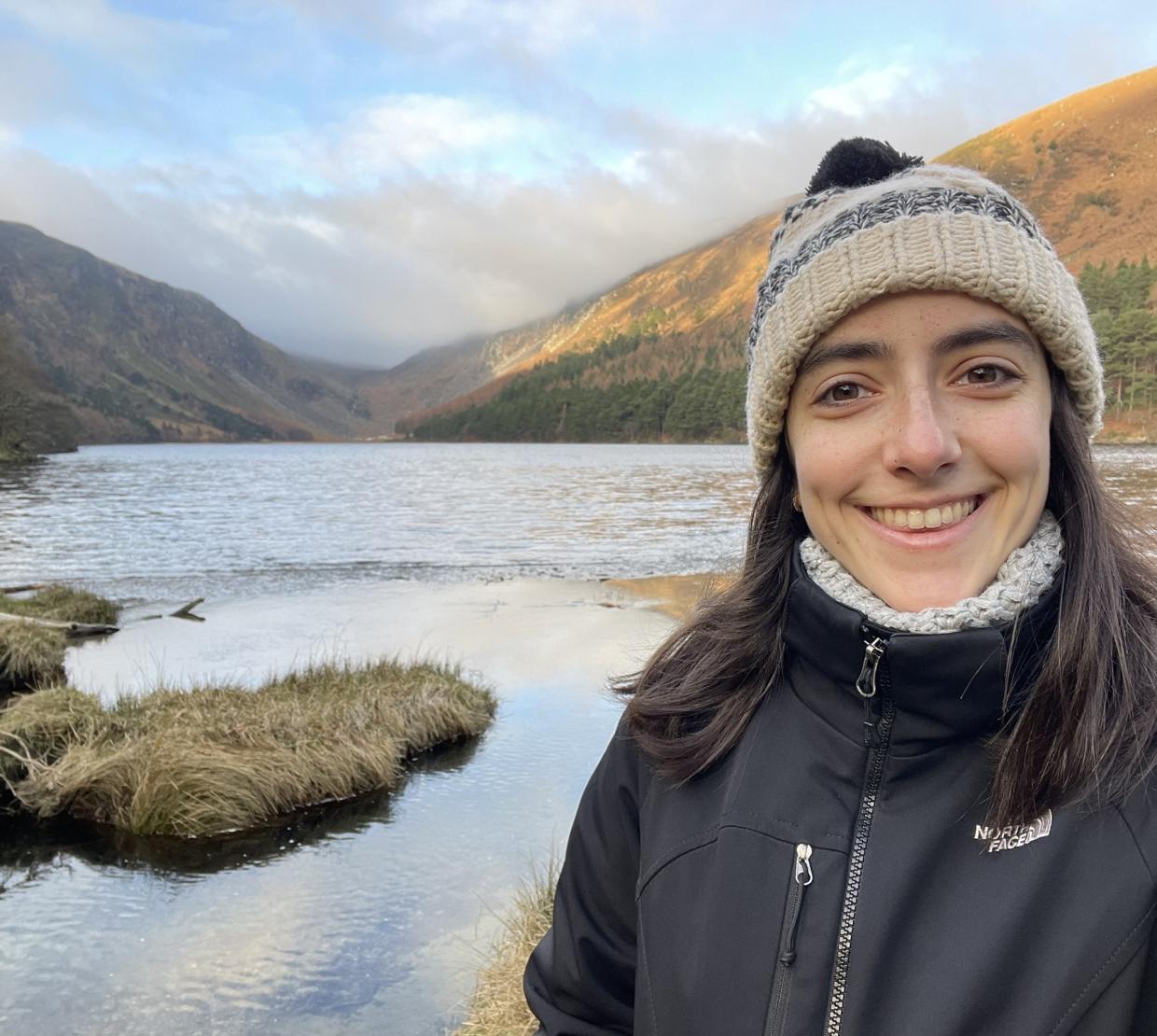
Rachel Sousa stands before a vast body of water at the base of tall, sweeping mountains in Ireland.

Mathematics graduate thrives with simple philosophy: ‘Why not?’

By Elana Roldan

In the intricate languages of mathematics and biology, alumna Rachel Sousa, ‘20, is multilingual.

Instead of translating words, she transforms data. Instead of immersion in a foreign country, she interns at eminent research facilities. Calling her field the Rosetta Stone of mathematics and biology isn’t much of a stretch.

“Collaboration is key in progressing research forward,” she says. “It’s hard for mathematicians to just think about the math and not have any access to data, whereas the experimentalists can do all of these experiments, but some of them are very time-consuming or impossible. If you can bring the two worlds together, they synergize very well.”
The path Sousa took from Oregon State to being a Ph.D. candidate at the University of California, Irvine was paved with risk. With many of the opportunities that came her way, the chance of rejection seemed too large to overcome. But by putting herself out there, she has gone on to attend prestigious international events and earn highly competitive internships before setting foot outside academia.

Bolstered by her undergraduate experiences in the College of Science, she has reached higher and higher ever since.

Finding the best fit

While she always had mathematics at the forefront, Sousa wasn’t introduced to its application in biology until beginning at Oregon State. A panel with upper-division students during an introductory course for mathematics majors was the first time she’d seen the fields merge. Instantly, she became hooked. The final push she needed came from her advisor as she discussed changing to the mathematical biology option. He excitedly showed her his own research which integrated the disciplines, and she made the switch that same day.

“The College of Science was really good at bringing people of different backgrounds together so that you could hear different experiences and life journeys, whether they were similar to yours or not,” she said, which helped her discover her new passion.
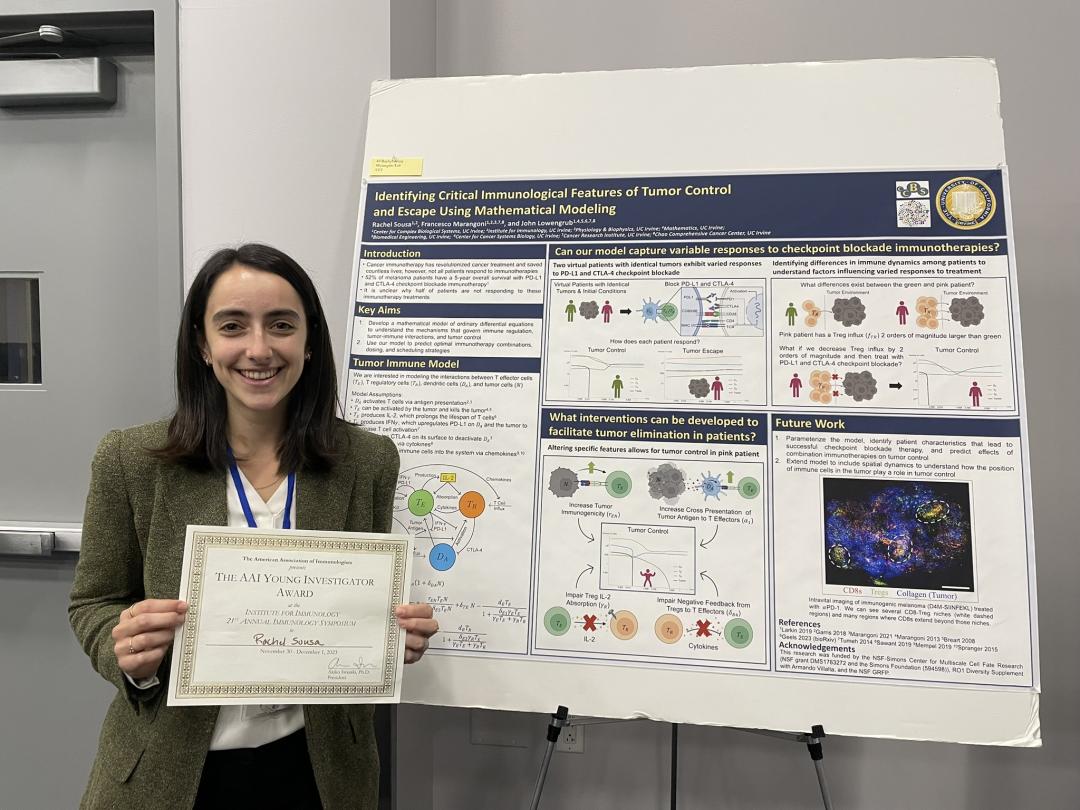
Sousa holds up a certificate for the American Association of Immunologists Young Investigator Award while standing in front of her research poster.

Sousa wins the American Association of Immunologists Young Investigator Award for her poster presentation at the 2023 UC Irvine Immunology Symposium.

Sousa didn’t slow down from there. She soon met Associate Professor Cory Simon at a student-faculty mixer hosted by the College of Science. His work, which used mathematical modeling to predict specific grass formations in Africa and Australia, fascinated her, and she joined his lab soon after.

Two years later, she received an email from the College about an internship opportunity with the National Cancer Institute. It seemed like a stretch that she would get it, but with a few years of research under her belt and a solid support system encouraging her to try, she sent in her application and hoped for the best. What she hadn’t expected was for them to say yes.

Sousa spent the summer at the University of Utah using mathematical modeling to study breast cancer, loving every minute of it.

“That was the key moment I decided that I really enjoyed this type of work and that I wanted to pursue it moving forward,” she said.

The right mindset

After graduating from Oregon State in 2020, Sousa went to UCI to work toward her Ph.D. in Mathematical, Computational and Systems Biology. More than her GPA, she credits her acceptance into the program to her undergraduate experience at OSU.

“Doing research during undergrad was a huge part of it. Showing I had the interest and the skills to do research really helped,” she said. “Good or good enough grades, doing some sort of research in undergrad, and getting an internship will help to boost your skills.”

The inherent collaboration in mathematical biology led her to join two labs at UCI, one led by a mathematician and the other by an immunologist. She works with both to create models of the immune system and its interactions with cancer, which they ultimately want to use to predict the most effective therapy choices in eliminating the disease. Much of what she learned at Oregon State applies to what she now does daily as a professional researcher. From building models to working with ordinary differential equations, the foundations she laid as an OSU student continue to support her current work.

While studying at UCI, Sousa has not rested on her laurels. In her second year, she applied for the notoriously competitive National Science Foundation Graduate Research Fellowship Program and earned the impressive award. She also put her skills to the test in an industry setting during an internship with pharmaceutical company Pfizer, where she built models for anti-cancer small-molecule drug development.

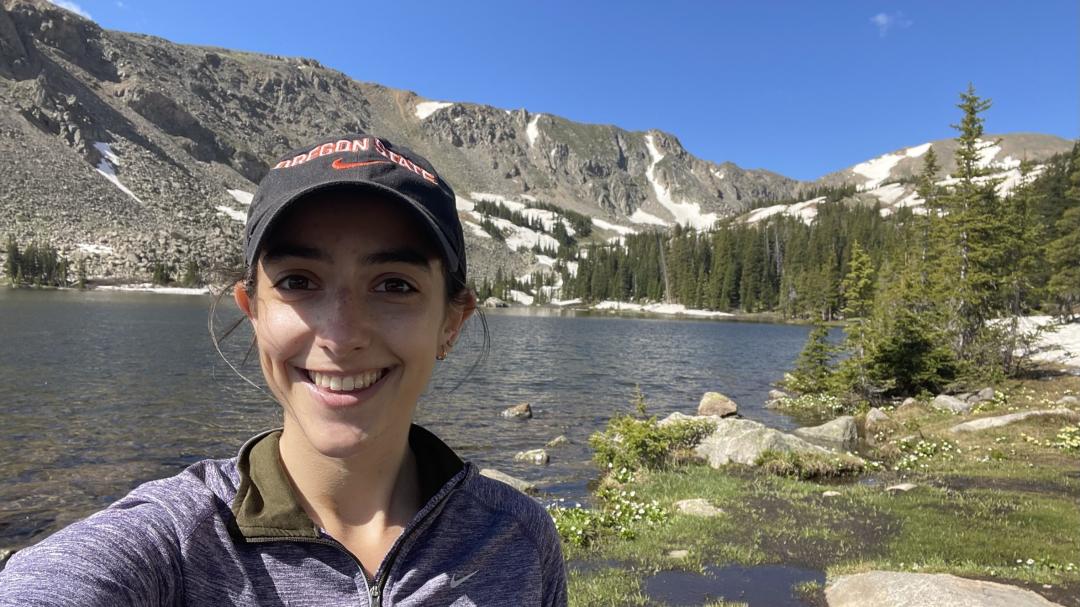
Sousa smiles in front of a crystal clear lake bordered by craggy mountainsides and pines.

Sousa hikes to Diamond Lake during her internship with Pfizer in Colorado.

One of her proudest achievements was being selected to attend the 72nd Lindau Nobel Laureate Meeting. The meetings are annual forums that bring together Nobel Laureates and 600 emerging young scientists from around the world in Lindau, Germany. It left a lasting impression on Sousa and was another reminder to pursue any opportunity that came her way.

“I applied to attend and again was sort of like, ‘It seems like a big opportunity, I don’t know if I’ll be selected but the worst they could tell me is no.’ Except they told me yes,” she said.

“That’s such a good mindset to have in life. If you don’t try, you’re not going to get it. If the worst-case scenario is somebody telling you ‘no,’ then why not at least try? That’s sort of what’s gotten me where I am today.”

In the years since Sousa began pursuing mathematical biology at OSU, she has developed a philosophy toward her work and career. Whether applying for her undergraduate internship at the National Cancer Institute, her fellowship from the National Science Foundation or a spot at the Lindau Nobel Laureate Meeting, there was always an initial doubt about if she should even take the chance. What has become clear to her after all of these experiences is that without trying to seize an opportunity, the possibility of getting it becomes zero.

“I see all of these opportunities and they all seem like such prestigious things that I feel not good enough for, but then I apply and I get them. So I am good enough,” she said. “That's such a good mindset to have in life. If you don’t try, you’re not going to get it. If the worst-case scenario is somebody telling you ‘no,’ then why not at least try? That’s sort of what’s gotten me where I am today.”

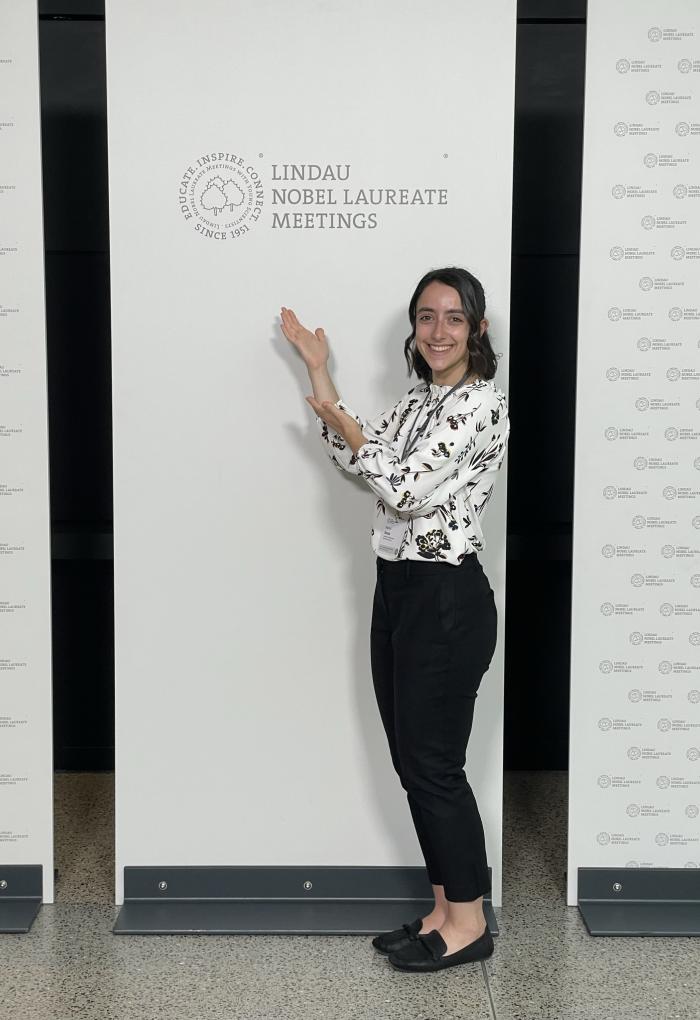
Sousa points to the sign for the Nobel Laureate Meeting.

Sousa attends the 72nd Lindau Nobel Laureate Meeting.

A series of colored circles on a blue background.

Classroom puzzles to cosmic insights: Students and professor demystify mathematical theorem

By Hannah Ashton

Central forces that decay as 1/r² are special, as they guarantee that all bound orbits are going to be closed (Bertrand's theorem). Small changes in the power will lead to significantly different kinds of orbits.

More than 150 years ago, Joseph Bertrand stated a mathematical theorem. Proving why this theorem is true hasn’t been a simple endeavor.

Two College of Science alumni, along with professor Patrick De Leenheer, recently published a paper in the SIAM Review pulling back the curtain on Bertrand’s Theorem. Together, they wrote a proof that is accessible to undergraduate mathematics or physics students.

Bertrand’s Theorem states that among all possible gravitational laws, there are only two exhibiting the property that all bounded orbits are closed, Newtonian and Hookean gravitation.

“If we didn’t live in a gravitational field governed by Newtonian gravitation, the world would be very different and far more unpredictable. For example, we would probably not have seasons,” De Leenheer said. “It’s kind of remarkable that gravity operates in this way. Among all the possibilities, truly infinite, this is the one that we live in and that’s just astounding.”

In the simplest terms, the group started by using a process of elimination, by first showing that gravitation must follow a power law. Next, they narrowed down the power laws until only two of them remained. And finally, they checked that both of these had the property they were looking for.

De Leenheer remembers taking his first physics class in high school and questioning the formula, R: F = G(m1m2)/R2. De Leenheer wanted to know why it was R-squared. Why not R cubed or something different? This led him to Bertrand’s Theorem. He couldn’t find a proof of it, leaving him to wonder why it was true.

Headshot of Patrick De Leenheer on campus

Patrick De Leenheer

John Musgrove, ‘20, and Tyler Schimleck, ‘21, heard about the theorem in De Leenheer’s Vector Calculus 2 course and approached him after class. He enthusiastically brought them on board what turned into a five-year project.

“For me, it was my first time jumping into real mathematical literature. Reading papers by other mathematicians working on the same problem and diving into their research was super exciting for me,” Musgrove said.

Having access to undergraduate research helped both of them successfully pursue a postgraduate degree.

Musgrove graduated from Columbia University with his MS in Operations Research and Schimleck is currently a graduate student at UC Santa Barbara in the Department of Mathematics. Schimleck is interested in differential geometry and mathematical physics.

“It can be so scary at first if you try to read mathematical literature. There is a huge gap between a lot of high-level research and what you learn in undergrad,” Schimleck said. “Doing undergraduate research was a massive confidence boost that helps me say, ‘No, it’s okay, I can do this. I may not understand it at first but eventually, I’ll figure it out and it’ll be okay.’”

Working with a faculty member can be equally terrifying but Musgrove and Schimleck said De Lehneer helped every step of the way.

“One of my favorite things about working with Patrick, would be sitting there in the room and we’re staring at equations on the blackboard in silence for a few minutes and then we will have an “Aha” moment and Patrick will actually say “Aha” and go run to the blackboard with the solution,” Musgrove said. “It's labor. Math doesn’t look appetizing but once you are in it, the energy and emotions sustain the whole thing.”

He said that in a typical undergraduate classroom, students don’t get to experience facing a wall because everything is set up with an answer already.

“That’s the difference with doing research, there is nobody who will tell you the answer. You just have to keep looking at it and thinking about it. There are no shortcuts,” he said.

De Leenheer said it feels like serendipity that a question he had as a young adult, he was able to answer years later.

“I got to know two guys here in class and they showed excitement and they had the dedication, they never quit. Even today I am still thinking about it and it baffles me when I talk to people about this result. All together it was very rewarding,” he said.

Sullivan Bailey-Darland in front of an urban backdrop.

A ‘limitless degree’: Physics senior pushes the boundaries of his field

By Elana Roldan

How does DNA move? How do cells communicate with each other? When it comes to these questions, it’s easy to think of molecular biologists behind the words. But as physics and mathematics senior Sullivan “Sully” Bailey-Darland knows, there are many more voices asking.

“My biggest worry for physics was that I would just be doing stuff about energy and electrons, and those are interesting, but they’ve been studied so much and involve a lot of the research I wasn’t as interested in,” he said. “My lab advisor has made me aware that physics is not a limiting degree. From what I can tell, it’s the most limitless degree.”

Bailey-Darland has found a full range of research opportunities from his time pursuing physics, mathematics and even chemistry at Oregon State. A future of discovery and experimentation has already begun for him as he forges ahead to graduate school at Cornell University.

Expanding the possibilities

During his first year, Bailey-Darland took part in the Undergraduate Research, Scholarship, & the Arts (URSA) Engage program. URSA Engage gives research opportunities to first- and second-years, as well as transfer students. As part of the program, students choose a faculty mentor to work with on their research projects. While searching through faculty mentor summaries for a project that interested him, Bailey-Darland saw a familiar name — Assistant Professor Kevin Brown.

Bailey-Darland had previously attended several seminars within the department of physics and recalled seeing Brown give a distinct presentation at one on linguistics, an uncommon topic for the field.

“He gave a seminar on modeling a language network and comparing it to different types of gases, and I thought that was really crazy,” Bailey-Darland said. Intrigued by Brown’s research, he decided to seek him out and landed a position doing computational programming in his laboratory group.

What he didn’t expect from the experience was a broader perspective of his major. Brown, who holds a doctorate in theoretical physics from Cornell University, studied biological systems for his Ph.D. His work as a physicist shattered the predetermined niche of the field Bailey-Darland had painted in his mind.

“Working at Oregon State made me want to do more interdisciplinary things…It made me aware that if you learn tools or skills from physics or math, you don’t have to necessarily be stuck only applying them to that field. And that’s exactly what biophysics is.”

“Dr. Brown made me aware of the possibilities for physics,” he said. “He introduced me to the idea that the field can be for any interesting problem, not just a physics problem.”

Biophysics, the field Brown based his doctorate on, appealed to Bailey-Darland through its interdisciplinary nature, a quality he values highly ever since beginning his research career.

“Working at Oregon State made me want to do more interdisciplinary things,” he said. “It made me aware that if you learn tools or skills from physics or math, you don’t have to necessarily be stuck only applying them to that field. And that’s exactly what biophysics is.”

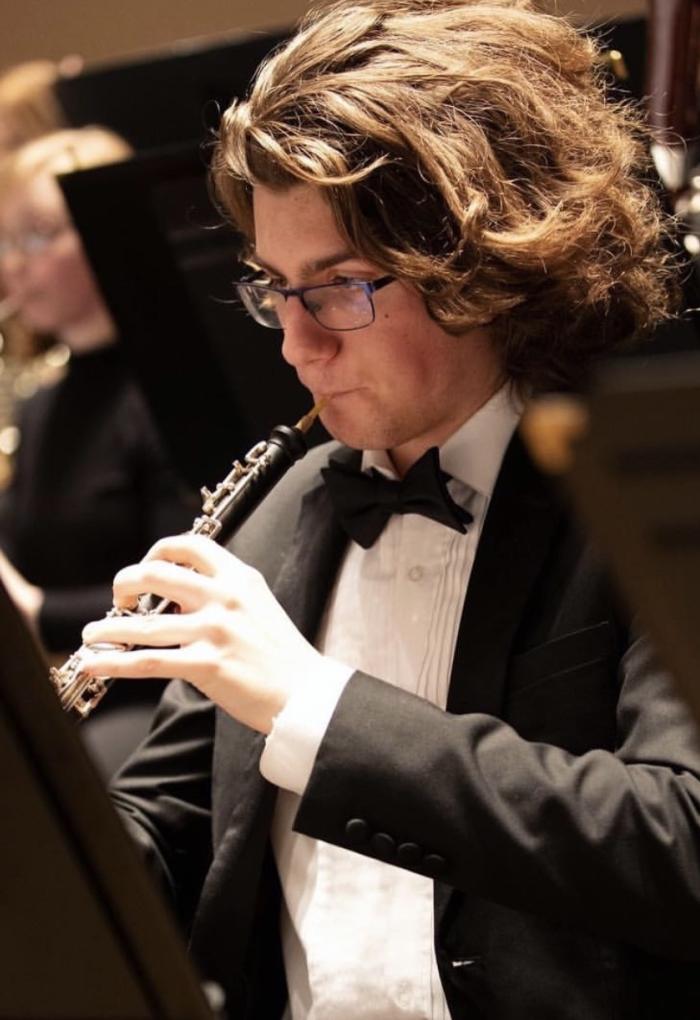
Bailey-Darland plays the oboe during an orchestra performance.

Bailey-Darland plays the oboe in a Portland Youth Philharmonic ensemble concert.

Biophysics remains a relatively new branch that tries approaching biology through a less traditional lens. As Bailey-Darland puts it, there is an innate difficulty to the study of biology because of its complexity. Even the most basic level of life, a cell, bursts with intricate processes and structures. Because of this, applying the methods of physics to biology can help dissect it into more palatable pieces.

“Most of physics is looking at a really simple system and understanding it completely, like seeing what happens if a block slides down a ramp, and building on that to more complicated things,” he explained. “So to me, it seems like biophysics is trying to start saying, ‘How can we look at simplified systems in biology and understand them?’”

In addition to his passion for physics, Bailey-Darland would discover another field that held his interest. In fact, he found two.

Simple and elegant

Deciding on a major is a notoriously daunting task, but deciding on a second major may be even more so.

This was the challenge Bailey-Darland found himself faced with. Having skipped general chemistry thanks to credits he earned in high school, he began the organic chemistry sequence in his first year. This set him on an accelerated path toward getting all of the chemistry credits he needed, and he realized he would be able to have an additional major in chemistry if he took a few more courses. Already enjoying the subject, he went through with it and became a double-major.

Yet, a different topic called to him more.

Amidst his several chemistry lectures and laboratories, he felt that he was being pulled away from the mathematics classes he loved. Part of his initial reasoning in getting a chemistry major was that he would still have time outside of it to dedicate to mathematics. When that was no longer the case, he switched his second major for one in the subject he was more passionate about.

“Much of math, at least to me, can be simple and elegant in a lot of ways.”

“Math is another framework to look at different ideas,” he said. “Much of math, at least to me, can be simple and elegant in a lot of ways. There’s a lot of aspects of it that are translatable to other things, and it’s a way to make talking about certain ideas very rigorous and logical.”

The chemistry classes he took were not in vain, however. He continued to get a minor in the subject and even found a new opportunity through his courses. While in physical chemistry his sophomore year he met Professor Chong Fang, whose ultrafast spectroscopy laboratory not only adds to the field of chemistry but also those of physics, biology and bioengineering, among others. Fang discussed his research briefly in the class, and Bailey-Darland decided to approach him about it during his office hours.

As a physics major in need of an advisor for his required thesis, Bailey-Darland also took the opportunity to ask the professor to help guide him through his project. With that, he became not only a double-major but also a member of two separate research groups pursuing science as an interdisciplinary researcher. What he couldn’t have expected from any of these experiences would be a senior year spent programming.

The tools for the job

Bailey-Darland never took a programming class in high school. The extent of his experience came from free tutorials online, ones where he would compute mathematics problems with large datasets using relatively simple programming. So it became ironic that the culminating thesis for his physics major relied entirely on the skill.

Moving back and forth between his two research groups, he realized that they both encountered a similar problem in different contexts called “sloppy models.” In a lab, models can be used to illustrate data gathered throughout an experiment. Fitting the models allows researchers to analyze and predict data, and the better the fit, the more accurate the analysis. But with sloppy models, the data can become considerably harder to study.

“Basically you can move around the parameters of your model and still get a good fit,” Bailey-Darland explained. “That’s an inherent problem in this type of model compared to fitting a line, where it’s a lot easier to figure out the slope or the y-intercept.” In short, the flexibility of these models made them more inaccurate predictors of data and resulted in less concrete conclusions.

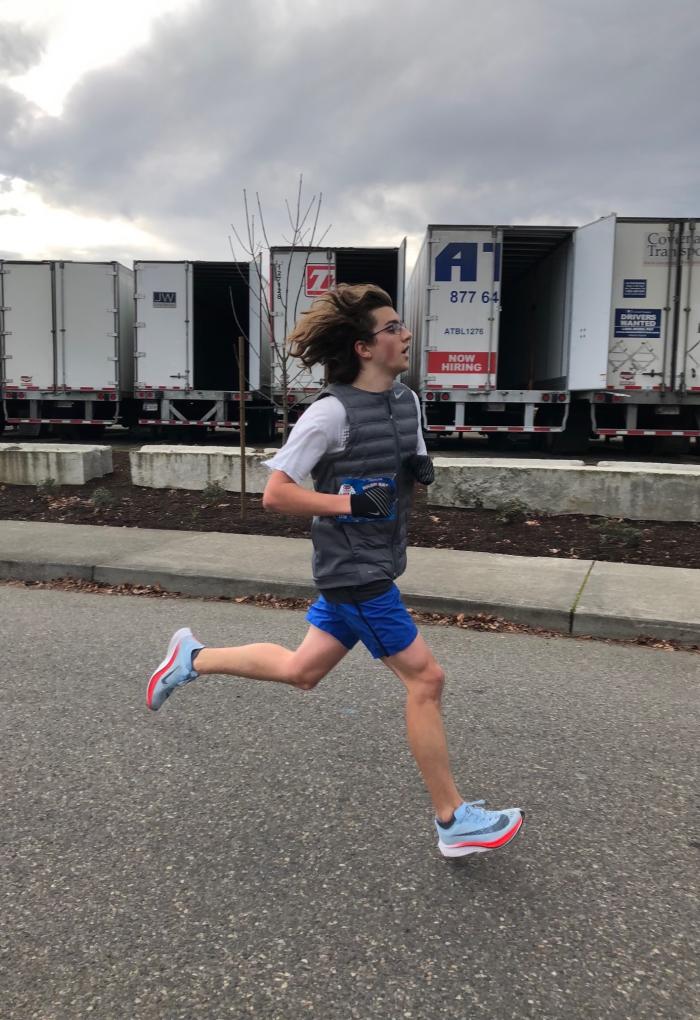
Bailey-Darland running in a half-marathon during an overcast day.

Bailey-Darland participating in a half-marathon, which he completes once a year in Portland, OR during the winter.

After deciding he would make fixing the problem his thesis, he came across a new challenge he hadn’t experienced before. “When you initially do research you’re given a project and don’t really have to think about whether it’s valid or not. If someone asks why you’re doing it, your advisor usually steps in and explains why it’s important,” he said. “But my thesis was the first time where I was the one who had to explain the importance to both of my advisors. That was a really good opportunity to grow.”

He had planned on using an already created Python library, a programming language, in order to conduct his work, but found that it wouldn’t function the way he needed it to. Not wanting to give up, he resolved to do something he had no intention of at the start of the project: create entirely new programming tools.

“I originally planned to not make anything new,” he said. “I started by assuming I’d use someone else’s work, but at a point I realized I could just make it myself. That ended up happening for all of the stages of this process.”

The work wound up being so significant that, despite again not planning for it, Bailey-Darland received the sole Physics Undergraduate Thesis award for his research.

“I wasn’t aiming for the award, but I definitely put a lot of work into it,” he said. The experience illustrated a vital idea for him. “Some of the most fun research projects I’ve worked on have been when I had an idea and wasn’t sure if it was good or not. If you’re interested in it, it’s worth pursuing.”

“That’s kind of how it was with OSU — there are lots of opportunities to do interesting things if you’re looking for them. I’m hoping to do that again; show up and do stuff that seems interesting to me.”

Now at the end of his time at Oregon State, he will continue doing interdisciplinary work with a biophysics research group at Cornell University, much like his advisor Kevin Brown. While he may not have specific goals laid out for himself, he enjoys having room to grow. “That’s kind of how it was with OSU — there are lots of opportunities to do interesting things if you’re looking for them. I’m hoping to do that again; show up and do stuff that seems interesting to me.”

To read more about being a physics major, visit their department website here.

Madison Collins smiles in front of a grey background.

Mathematics senior finds effective teaching strategies on her path to a graduate degree

By Kaitlyn Hornbuckle

Mathematics homework in 2023 often has parents scratching their heads and admitting defeat. Oregon State University senior Madison Collins knows that feeling all too well.

At the dinner table growing up she disagreed with her parents on how to break up numbers for addition and multiplication problems. “My mother had different methods of math that she learned,” she said. “I went, ‘Mom, that’s not how my teacher told me to do it.’” Luckily for Collins, math came naturally, and her parents tried to keep her on her toes with new academic topics.

Until one day, she surpassed her father, an important figure in her life who encourages and challenges her academically.

“It was fun when I was talking to him about math content and he said, ‘I have no idea what you’re talking about.’” That’s when Collins realized, after all these years, she finally surpassed her father at a higher level of mathematics.

Modernizing the education process

A third-year student graduating with a bachelor's degree in mathematics with the mathematical biology option and a minor in chemistry, Collins plans to hit the ground running by starting her master's degree in math education at Oregon State in fall 2023. Even though 1+2 will always be equal to 3, Collins strives to teach math differently so that students can learn better and discover something new along the way.

“I want to help students from multiple backgrounds see that learning math and succeeding in a college math course is possible for them. I want to be able to communicate math well to students so they can learn the content and gain confidence in their mathematical abilities,” she said. “In college, a lot more students don’t feel like they can connect to the teachers personally, so I definitely want to try to build up the community in that way while teaching.”

Collins has already started analyzing how the college-level calculus curriculum is being taught in the classroom for her honors thesis. Her curriculum curiosity dates back to the table in her childhood kitchen.

Whenever she and her sister got stuck on a math problem, her parents paused dinner to get them back on track. Sometimes, this meant her parents teaching them ‘weird’ and ‘wacky’ methods that aren’t taught in school anymore. To Collins, this is a typical part of the education process.

“While parents being able to help kids with homework is really important, a lot of research has gone into improving education with new teaching strategies and ways of communicating certain ideas,” she said. “New advances are being made in math education theory all the time so the content delivery is changing. It is unrealistic not to change math to keep up with new understandings of concepts. With that said, many math curricula, especially calculus, have remained largely unchanged for decades.”

When Collins entered high school, she loved to ‘move pieces around’ to solve puzzle-like math problems in her calculus courses. Outside of the classroom, she chose to do sports instead of working a job, a choice that greatly impacts how she views the education experience. Joining the cross country, swimming and track teams helped her grow and prepare for the rigor of college courses early on.

Even though she didn’t continue sports at Oregon State, Collins kept running on her own during college. She competed in the April 2023 half marathon in Corvallis alongside her boyfriend while her uncle and mother ran the 5k.

Training for 13.1 miles, spending time with her family and developing a thesis in the same term required a work-hard-play-hard attitude. Especially when that workload also included tutoring.

Four people stand with running bibs in front of the OSU football stadium.

Madison Collins (#608) spent time with her uncle, mother and boyfriend after completing the April 2023 half marathon in Corvallis.

Building new communities with math

Sometimes, student-athletes struggle with maintaining satisfactory grades while trying to maintain a busy schedule, so Oregon State Athletics has a special tutoring program designed for them. As a tutor, she got these students back on track when they struggled with their college courses.

After a year, she switched to the Supplemental Instruction (SI) program. The program is a free resource that students at Oregon State utilize to learn key concepts in a group environment. Leaders come prepared with a lesson plan full of practice problems and interactive activities and implemented them in peer-led, group study tables.

This was her chance to practice shaking up the curriculum. Collins designed a BINGO activity that aided students with reviewing vocabulary. She also put together problem sets that they solved together at the study table. This way, she was able to not only host student-led lessons but encourage collaboration.

While an employee, she started chatting about what she wanted to research for her honors thesis with SI Coordinator ​​Chris Gasser. He acted as a mentor by encouraging Collins to be resilient while taking tough academic courses. Before long, she stumbled upon her honors topic of choice - analyzing curriculum implementation.

Uncovering how calculus is taught

At the end of her third year, Collins devoted the majority of her time to developing her honors thesis with Oregon State Mathematics Instructor Elizabeth Jones. Collins visited different sections of MTH 252 Integral Calculus at Oregon State and recorded observations.

She sat with the students and jotted down different teaching strategies she saw implemented by a variety of instructors. Using her observations, she developed a framework for analysis in order to find the most effective ways to continue implementing the calculus curriculum in college-level courses.

Madison Collins standing in front of a poster presenting her honors thesis.

Madison Collins presented her honors thesis on how the calculus curriculum is implemented in the college classroom.

She enjoyed chatting with Jones about the different classroom, assessment, design and course support strategies she chose to analyze. But occasionally, their math education preferences diverged.

While talking about trigonometry substitution, they discussed different mathematical notations and the confusion that comes with non-standard notations. Variables are written with alphabetical characters. For instance, pertaining to trigonometric substitution, Collins prefers to use a ‘u’ whereas Jones prefers to use an ‘x’.

Sometimes, the same symbol can have different meanings in various areas of math. For example, absolute value bars, IVI, can denote other operations including vector magnitude, IVI. It’s a subtle detail, but can have a major impact on how variables are communicated to the students.

"I hope that by going into teaching, I can help people get through a typically difficult subject and make it more enjoyable for them."

Now that her first thesis is complete, Collins wants to put what she learned into practice by teaching in a college setting that is approachable for students. When students walk into her future office, she wants to address the little questions and not have students be hesitant to ask a question that is ‘too simple’ to answer.

“I get really excited when I am helping someone and can see them putting the pieces together in their head. When they reach the final answer in a ‘lightbulb moment,’ they get super excited,” she said. “I don’t just want to lecture students. I want to teach them how to approach math and build confidence in their skills.”

Being able to learn how to be the teacher she wants to be came at a cost. Luckily, when her academic experience got a little bumpy, she wasn’t alone.

Persevering in the face of failure

For Collins, being a Beaver at Oregon State came with the pressure to succeed. “The biggest challenge I've had growing up through school was that I put a lot of academic pressure on myself,” she said.

Madison Collins standing in front of a white board.

Madison Collins demonstrates how to solve a problem using calculus at the front of the classroom.

After her official advisor left the university, she met Oregon State Mathematics Professor Nathan Gibson who became her advisor, professor and mentor. He taught MTH 323 Mathematical Modeling, which turned out to be a tough class for Collins. She wrote a 10-page report talking about the errors that happen when modeling basic electrical circuits and how the different components differed from each other.

“I ended up using a little bit of electrical engineering from that one class I took in my first year. I’m pretty sure my simulation failed, but I still got an A on the paper,” she said. It takes encouragement to agree to finish a difficult course, especially when it comes to learning how to use differential equation systems in the real world. This was the type of mentorship Gibson provided when Collins needed it most. Now, she can apply what she learned in a classroom setting.

“A lot of people are told they aren’t a math person,” she said. “I totally agree that math is not something many people want to study, but I really enjoy it and the problem-solving aspect of it. I hope that by going into teaching, I can help people get through a typically difficult subject and make it more enjoyable for them.”

Collins is now able to teach others in a way she wishes she was taught – and it all started with math homework at the dinner table.

Subscribe to Mathematics Major