Study Abroad

Study Abroad

A man in a black shirt stands in front of a white background.

Roan Luikart, Class of ’25: Mathematics major finds the equation for success

By Hannah Ashton

Roan Luikart is quick to admit that he knows math isn’t everyone's favorite subject — and he’s had his fair share of surprised reactions when he tells people he loves it. But for him, the appeal is clear.

“There’s a logical rigor and clarity in mathematics that is comforting,” Luikart said. “It’s not subjective. Either something is logically consistent or it isn’t. In a world with a lot of uncertainty, mathematics is grounding.”

He also sees the beauty in the discipline, from fractals to Lorenz attractors, a set of chaotic solutions that resembles a butterfly. For Luikart, math is more than equations and proofs. It’s a way of thinking, creating and understanding the world.

At Oregon State, he was able to bring his passion to life. He studied abroad in England, conducted two undergraduate research projects, served as a resident assistant and helped grow the Math Club.

This June, Luikart will graduate as an Honors double major in mathematics and physics before preparing for his next adventure: pursuing a Ph.D. in mathematics at the University of Virginia. He hopes to become a professor of mathematics and carry forward the mentorship and discovery that have defined his academic career.

The Math Club poses for a photo during the first meeting of Fall term 24-25.

The Math Club poses for a photo during the first meeting of Fall term 24-25.

How he got involved with undergraduate research

Luikart’s passion for math didn’t begin in a classroom. In eighth grade, after transferring schools and being placed in the wrong math track, he found himself catching up over winter break with a thick packet of make-up work. He was unmotivated — until his father brought him along to work and left him with nothing else to do but finish the assignments.

“Through that experience, I formed a greater appreciation for it and fell in love with math,” he said. “I found out how fun it can be especially when you have a higher level of understanding.”

By high school, he was even more enthusiastic about math. And once he discovered he could make a career out of it, he was sold.

Raised between Oregon and New Hampshire, Luikart chose Oregon State in part for in-state tuition and its strong research focus. He capitalized on this strength and completed two major research projects, one on campus and the other as a part of an NSF funded summer research opportunity.

Asking his favorite professor if he could do research with him snowballed into his Honors thesis project and a mentor for life.

Luikart approached assistant professor Nick Marshall, who is interested in mathematics problems that involve interactions between analysis, geometry and probability, especially such problems motivated by applications to data science.

“He is a fantastic teacher, and past that, a great research mentor. He’s given me a lot of advice, and I don’t know where I would be without it,” Luikart said.

Together with Marshall and a graduate student, Luikart co-authored a paper published in the SIAM Journal On Matrix Analysis and Applications. Their work focused on improving a numerical algorithm, relevant to fields like medical imaging and computer tomography (CT, also known as CAT scans), by adding a method known as “momentum” to speed the algorithm.

“We need algorithms that can quickly solve these linear systems of equations. We added a term that incorporates past movement of the algorithm so it can speed up,” he said.

Equipped with knowledge from multiple terms working with Marshall, Luikart applied for multiple REUs (competitive summer National Science Foundation Research Experience for Undergraduates programs), covering all sides of mathematics research.

Luikart presents his REU research at the end of the program.

Luikart presents his REU research at the end of the program.

He was accepted and spent three months in Illinois working on mathematical biology at Northwestern University.

His research mentor was studying circannual rhythms, a biological rhythm that happens annually in different species like birds or bears. While many of the models assume this behavior is intrinsic and doesn’t take into account environmental influences, his mentor theorized differently.

Luikart worked on the early development of a new mathematical model that incorporates external factors like temperature or duration of daylight.

“I improved my independent problem solving and learned how mathematical modeling works. I did most of it on my own and it was interesting because I could mathematically model the same biological observation in different ways,” he said.

Undergraduate research has not been the only way Luikart has gotten involved on campus.

He joined the Math Club as a first-year student and became president in his senior year, helping revive the organization after it dwindled during the pandemic.

“It has been a huge part of my time here,” he said.

Today, the club hosts weekly meetings and game nights for all students who love math or are interested in it. Luikart’s energy and passion for connecting with students led to him becoming a resident assistant in the dormitories for three years.

Luikart and his friend Nick pose for a photo during the Math4All conference in 2024.

Luikart and his friend Nick pose for a photo during the Math4All conference in 2024.

Studying abroad

Second to meeting Nick Marshall, studying abroad was a top transformative experience for Luikart. Similar to knowing he wanted a Ph.D., studying abroad was a no-brainer. Travel has been a huge part of his life, with his mother taking him to a new country almost every year since he was a young child. At last count, he has been to about 20 countries.

Working with OSU Go, he was able to tailor his experience and enroll in Lancaster University in the United Kingdom. Often ranked in the top 15 mathematics programs in the UK, Lancaster fit everything he was looking for.

His favorite detail was one he almost didn’t notice. On an evening walk home, he noticed covered walkways along campus buildings, designed to shelter from frequent rain. Between the supporting pillars were carefully tended flower planters. Careful not to damage them, gardeners were taking each planter down to water. This small attention to detail left a lasting impression.

“I really liked the university, and the campus turned out to be the biggest highlight for me. It is incredibly beautiful. I was already loving the campus, but as I was nearing the end of my time there, I started to take more time to appreciate things. I could go on and on,” he said.

A thirst for more math

This July, Luikart will head to Charlottesville to begin his Ph.D. at the University of Virginia. While professorship remains his goal, the draw of graduate school goes further than fulfilling a career path.

“Even if I don’t end up becoming a professor, having that further mathematical understanding is something I desire. Right now, I know just the tip of the iceberg,” he said.

For Luikart, math is a subject to explore. And thanks to the community, opportunities and mentorship he found at Oregon State, he’s ready for whatever comes next.

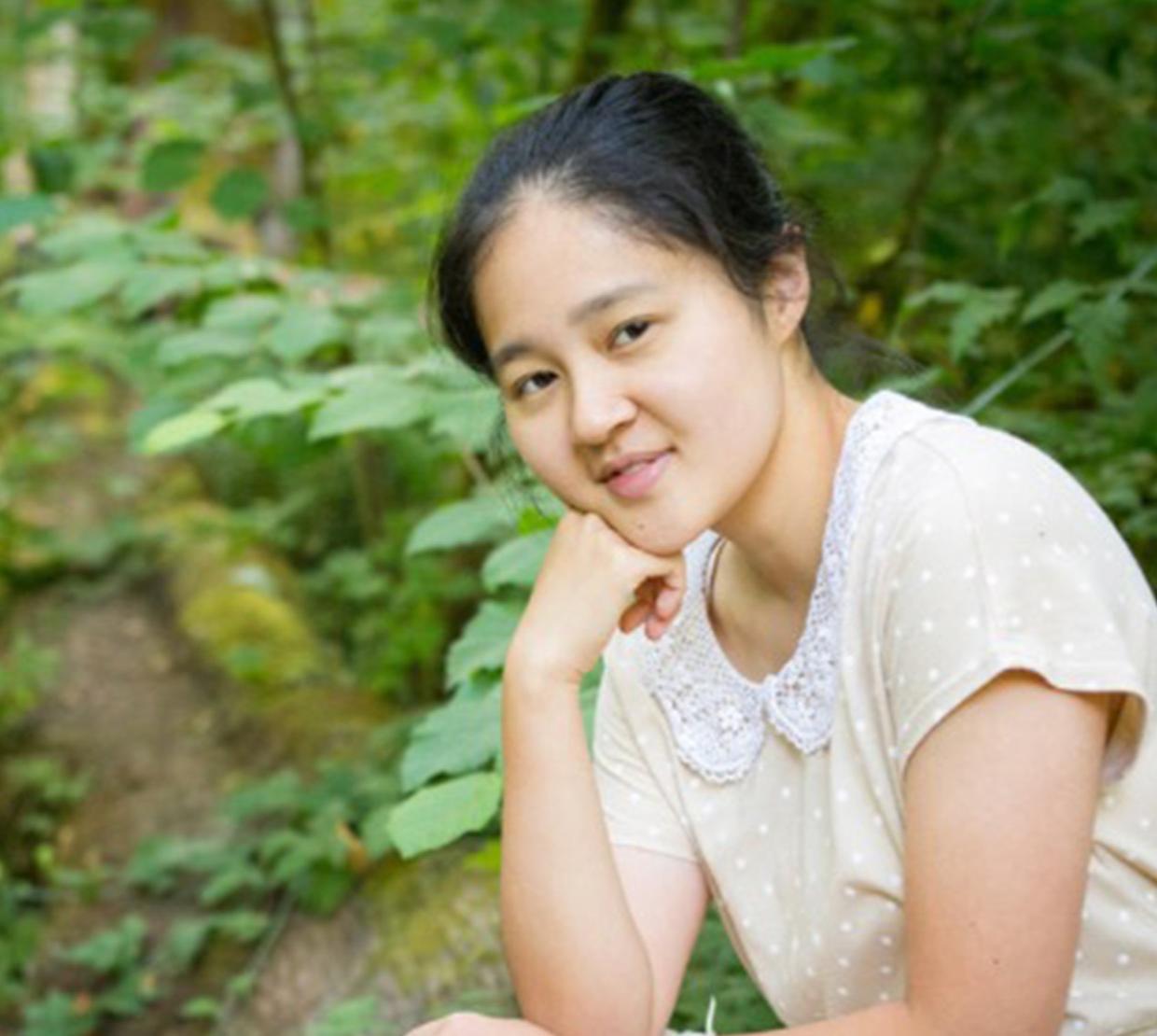
Saki Nakai sitting outside in a forest.

Mathematics graduate to research cross-cultural psychology for Fulbright

By Grace Peterman

France, Japan and Luxembourg: international experiences give Saki Nakai a rich, interdisciplinary perspective.

Saki Nakai is not your average pre-med student. The graduating senior double majored in mathematics and psychology at OSU and has spent the last two terms studying abroad in France to complete a French minor. She is also one of two College of Science students and alumni to receive the 2022 Fulbright Student Award. This award will support Nakai for one year of independent study in cultural psychology at the University of Luxembourg.

Nakai was drawn to OSU for its Honors College and the opportunity to weave her diverse research interests into a thesis project. She started as a psychology major, but she became really interested in how math could be used to answer questions relevant to medicine and psychology.

Using math to support mental health

Completing the math major on top of her pre-med courses was a challenge, but Nakai is glad she did. “Sticking with the math major gave me a more enriching college experience,” she said. “The nature of the subject requires you to take time to do the homework, so people just naturally come together and collaborate in the Math and Statistics Learning Center (MSLC).”

Embracing teamwork and collaboration paid off for Nakai during the pandemic, when she took one of her hardest courses, MTH 343 Introduction to Modern Algebra, over Zoom.

“The entire class time is spent doing math problems, and the instructor Filix Maisch would hop around between Zoom rooms to help us,” she said. “I did struggle with it a lot, but the challenge really brings students together. I made some of my best math friends in that class.”

“Sticking with the math major gave me a more enriching college experience.”

Growing in confidence as a mathematician, Nakai took on research that combined her two majors, math and psychology, through the Summer Undergraduate Research Experience (SURE) Science program. Exclusive to the College of Science, SURE Science allows students of any year to get paid to do 11 weeks of full-time research over the summer with faculty from any college. Nakai completed a project using ordinary differential equations and dynamical systems theory to model bipolar disorder, under the mentorship of Vrushali Bokil, professor of mathematics and College of Science associate dean of graduate studies and research.

“SURE was a completely new perspective on medicine,” said Nakai. “The project was important to me because it was the first time I saw how I can use mathematics to actually answer questions in psychology and medicine, and that’s my ultimate career goal.”

Nakai also used applied math in her research project for the NSF-funded Research Experiences for Undergraduates program, a fully funded research experience which she completed at the University of Nebraska-Lincoln summer of 2019. Nakai’s project investigated reciprocal and non-reciprocal support in an Inuit community in Labrador, Canada using social network analysis. “My poster won first place in sociology at the REU program, and I got to go to the Emerging Researchers National Conference in STEM in Washington, D.C. to present it,” she said.

Cultural identities at home and abroad

Both of these projects were meaningful to Nakai because her motivation for pursing medicine is to help vulnerable populations and expand acceptance of diversity. Nakai was born in the U.S. to Japanese parents, so cross-cultural competence deeply informs her perspective. “That aspect of my personal experience has been a big part of the research I’ve done,” she said.

After high school, Nakai took a gap year to work in an international primary care clinic in Japan. “Since it was an international clinic, we had both Japanese- and English-speaking patients. The doctor spoke English, but some of the nurses didn’t,” she said. Nakai worked as both receptionist and translator wherever she was needed in the clinic.

Being immersed in both Japanese and U.S. cultures, Nakai researched some of their differences in her psychology coursework. She did a statistical analysis comparing the manifestation of shyness in Japan and the U.S. “Rates of shyness are higher in Japan, but a lot of it comes from cultural differences,” she said. Japanese culture is more collectivist, while the U.S. is more individualistic. How self-expressive or reserved people are is influenced by these cultural mindsets. Thus, we cannot apply the same scale to measure shyness in Japan that we would in the U.S.

“Doing that kind of research is empowering because it gives a voice to people who might not otherwise be heard,” Nakai said.

An internationally-informed physician

For the last six months, Nakai has been studying abroad at the University of Poitiers in west-central France. Living with a host family and studying exclusively French for six months has brought a new dimension to Nakai’s multicultural awareness.

Inspired by the experience, she will use her Fulbright award to complete a research project on cross-cultural psychology in Luxembourg, a small country that borders France, Germany, and Belgium. The project will explore identity construal and acculturation in American and Japanese expatriates living in Luxembourg’s unique multicultural and multilingual setting.

Nakai will use hybrid images and visual primes to analyze how people respond to cultural mixing. “I might show American participants a picture of a hamburger, a picture of a typical Luxembourgish lunch, and also a hybrid image, for example, a lunchbox with both. I can then ask them what they feel about these images, and with the hybrid image, do they think it’s the best of both worlds, or do they react to it with disgust?”

“Doing that kind of research is empowering because it gives a voice to people who might not otherwise be heard.”

Nakai has embraced living in the best of both worlds during her time in France. She and her host family have traded off cooking Japanese and French foods for each other. “I made sushi for them, and they were pretty fascinated by the whole process,” Nakai said. In return, they introduced her to delicious raclette and boeuf bourguignon.

Ultimately, Nakai wants to be a physician, and she anticipates that all of her multicultural experiences will enable her to be a dynamic, effective communicator with many different types of patients. She sees herself eventually serving Japanese-American communities in the U.S. “Multicultural Luxembourg will serve as a blueprint for the multicultural U.S. I want to make a society that would really value diversity,” she said.

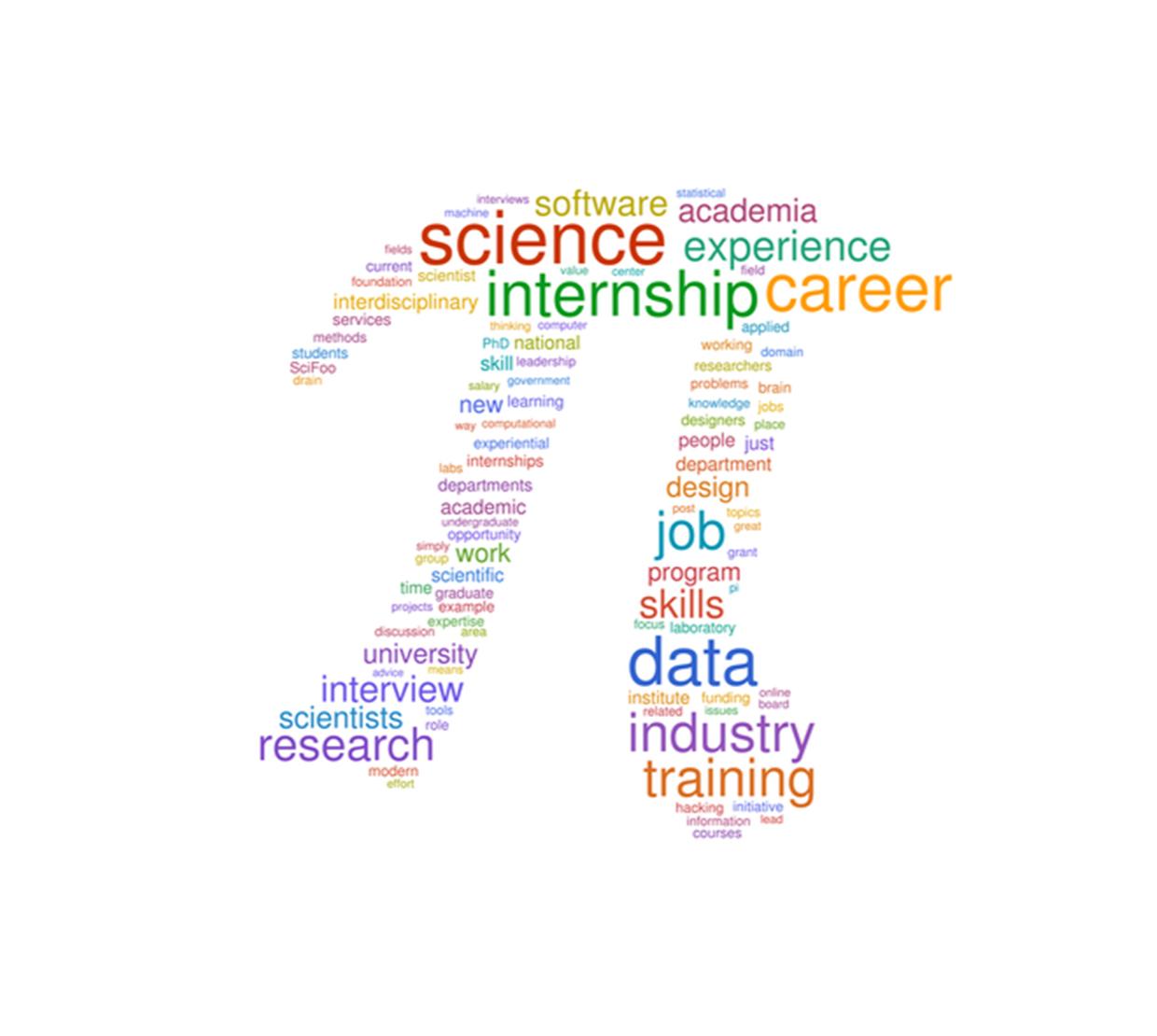
Word cloud in the shape of Pi

Summer Graduate Internships and Research Experiences

Word cloud of common terms used in describing STEM internships arranged in a pi shape to highlight the notion of a so-called Pi-Shaped Researcher (with both quantitative and disciplinary depth), see Informatics in the Future, Chapter 2, October 2015, Springer. Credit: Vrushali Bokil & Nathan Gibson. Text editing done by Joy King.

Think BIG! Jobs in Business (B), Industry (I) and Government (G) are consistently rated among the highest areas for job satisfaction [BIG Jobs Guide, SIAM 2018, Internships-SIAM], and mathematicians are in demand for their skills. For many students a summer internship can be their first and formative experience in a BIG job. An internship can also help students get a leg in the BIG firm creating an opportunity for a future position in the place of the internship.

Why Should you do an Internship? [see BIG Math Network] Read on for the experiences that Oregon State mathematics graduate students had during the summer of 2018. It was an exciting and fruitful time for many of the Department’s Graduate Students who gained research experiences in internships or workshops.

Joseph Umhoefer’s summer internship was a return trip to Lawrence Berkeley National Lab (LBL) for him. Working with LBL researchers, he wrote a flow solver for anisotropic porous media. This work is relevant to flows through the subsurface, fuel cells, wood, etc. Umhoefer found working for the lab provided experience learning a variety of tools that are valued on the job market.

Choah Shin had an exciting and intense internship experience in the STOMP group of the Energy and Environment Department at Pacific Northwest National Laboratory (PNNL). STOMP was originally designed to simulate subsurface flow and transport and had been extended to investigate gas hydrate productions, a topic closely related to Shin’s thesis on methane hydrate basin modeling. The learning curve on the new subject was steep, but she found herself enjoying the challenges. Through this experience, she gained technical skills that she would not have learned in school and more expertise for her goal as a researcher.

Alex Putman began his internship at Maiden Reinsurance by building statistical models for a large data set (over 250,000 entries) to calculate an expected cost per year for each of the customers in order to better inform an insurance company how to price customers based on many different factors. He learned and used a variety of models and methods specific to insurance problems and was given the opportunity to search for new models, learn about them, and try to implement them into their work. Finally, Putnam worked on building programs to automate a search for optimal parameters for different functions pertaining to modeling. For example, he wrote a code that took a set of data, and found an optimal distance to cluster points in the set to automatically cluster the data in ways that could not be done by hand.

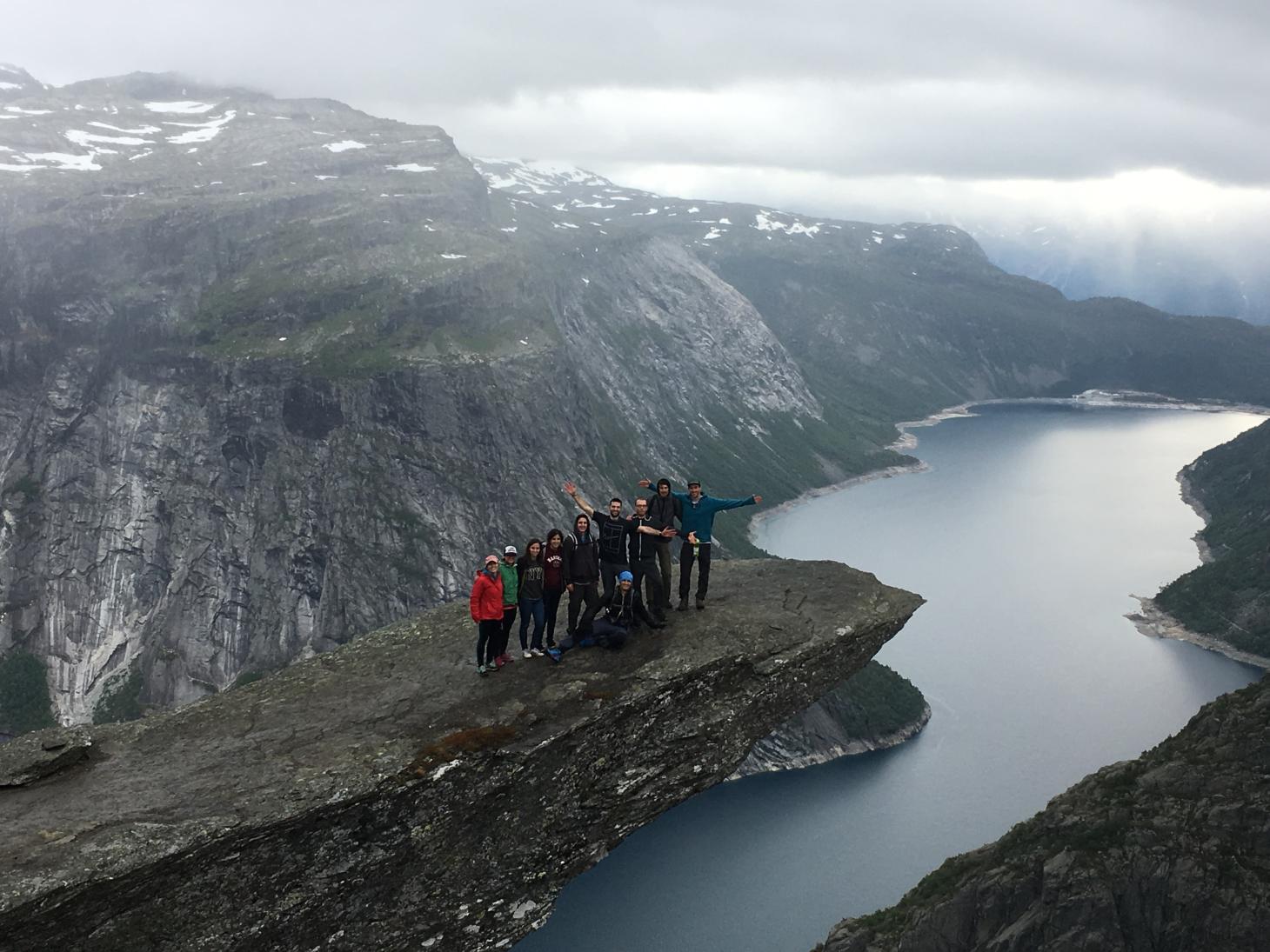
Lisa Bigler participated in two summer schools. The first half of the Summer School on Computational Physiology(SSCP2018) was in June and took place in Oslo, Norway. This part was dedicated to lectures and gave all the participants some common background knowledge on computing and physiology. The second half was focused on small group work, concluding with 15 minute presentations, and was held in San Diego, California. Bigler attended a second summer school at the Mathematical Sciences Research Institute on Representation of High Dimensional Data. The first of two weeks consisted of lectures and exercises on data mining. The second week was focused on career development and research in industry, with lectures from both academics and industry professionals.

A group of people standing on a cliffside overlooking a river.

Lisa Bigler (in green) with her summer school cohort in Oslo, Norway.

Sebastian Naranjo’s work at Los Alamos National Laboratory (LANL) was a challenge, as well as, a rewarding experience. Two to three times per week Naranjo would meet with his supervisor in the T5 research group in Applied mathematics and plasma physics. Together they developed a novel discretization for the evolution of the electric and magnetic fields in an ionized gas. Sebastian feels very fortunate to have received training at LANL. His officemates became his unofficial mentors. They were engineers and computer scientists, so the conversations about academic topics revolved around fluid flow and high performance computing.

“I feel very privileged to have had this opportunity. I am very thankful for the support of my advisor and funding from the National Research Training (NRT) program in Risk and Uncertainty Quantification in Marine Science at Oregon State University.” -Sebastian

How to get Started: To get started planning a summer internship or other research we recommend that students start by seeking guidance from their advisors. Also, see a review in SIAM News of a professional development event for graduate and postdoc students at the annual SIAM meeting in summer 2018. The event highlights the importance of an honest "inside-out" self-analysis of one's strengths, weaknesses and passions in addition to building strong professional soft skills such as communicating and networking. A useful read for all job-seekers and career-builders! Lastly, a great resource to help plan your internship is the BIG Math Network Site. Below are some tips from this site to get started.

  • Who am I? identify your goals and personal values.
  • What should I do? plan classes to take, craft a great résumé, and try out an internship.
  • What will I learn? learn about career options, and research and apply for full-time jobs.
  • Will I be successful? interview with confidence; you know the job matches your skills and values.
  • What is important to keep doing? Network, network, network.

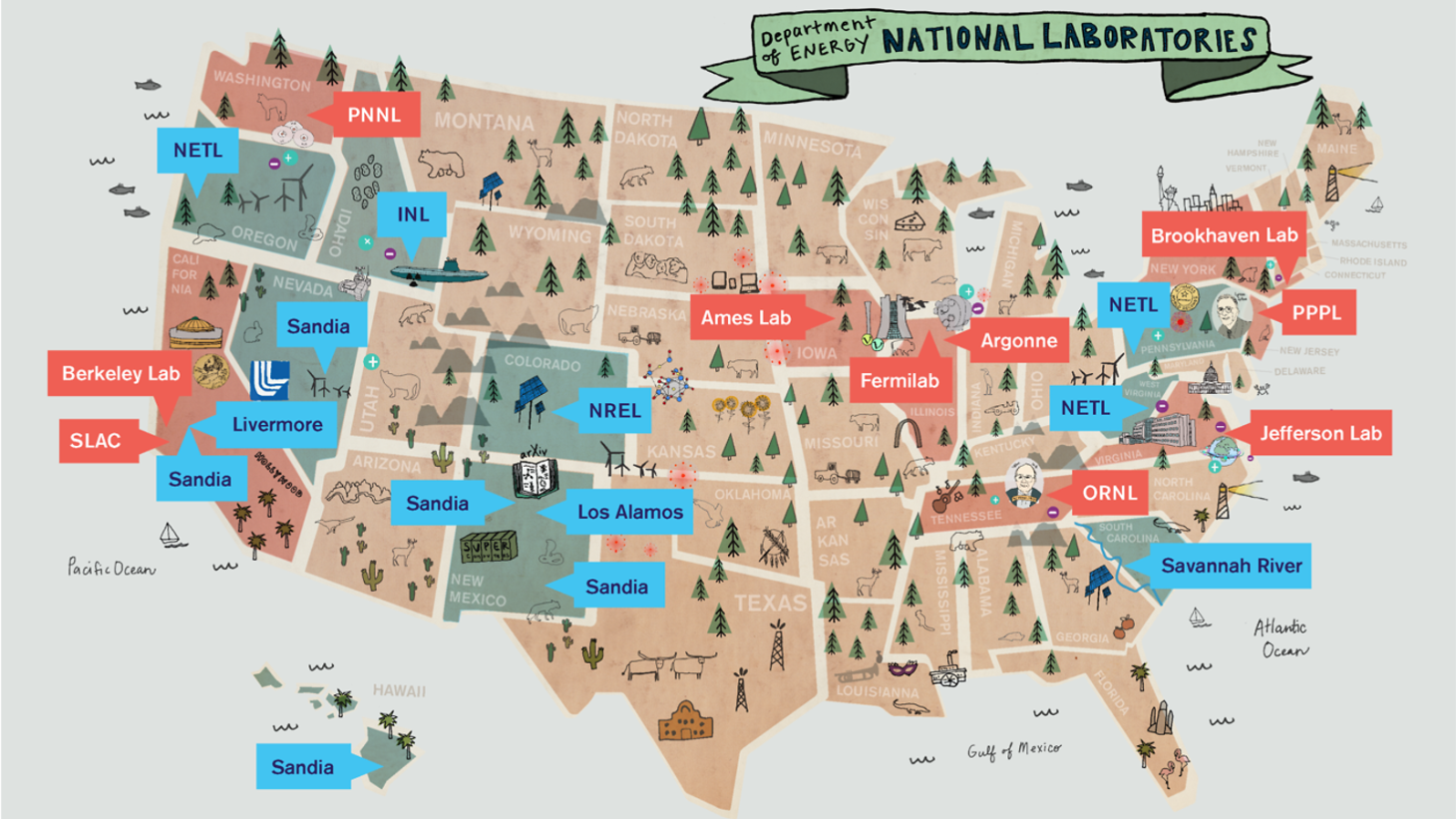
The 17 Labs of the Department of Energy are a good place to look for government internships, see Around the US in 17 Labs, Symmetry magazine.

Illustrated map of the continental United States with tabs pointing to Department of Energy Labs.

(Credit: Symmetry) A map showing locations of all 17 DOE labs. Illustration by Sandbox Studio, Chicago.

Subscribe to Study Abroad