Teaching Innovation

Teaching Innovation

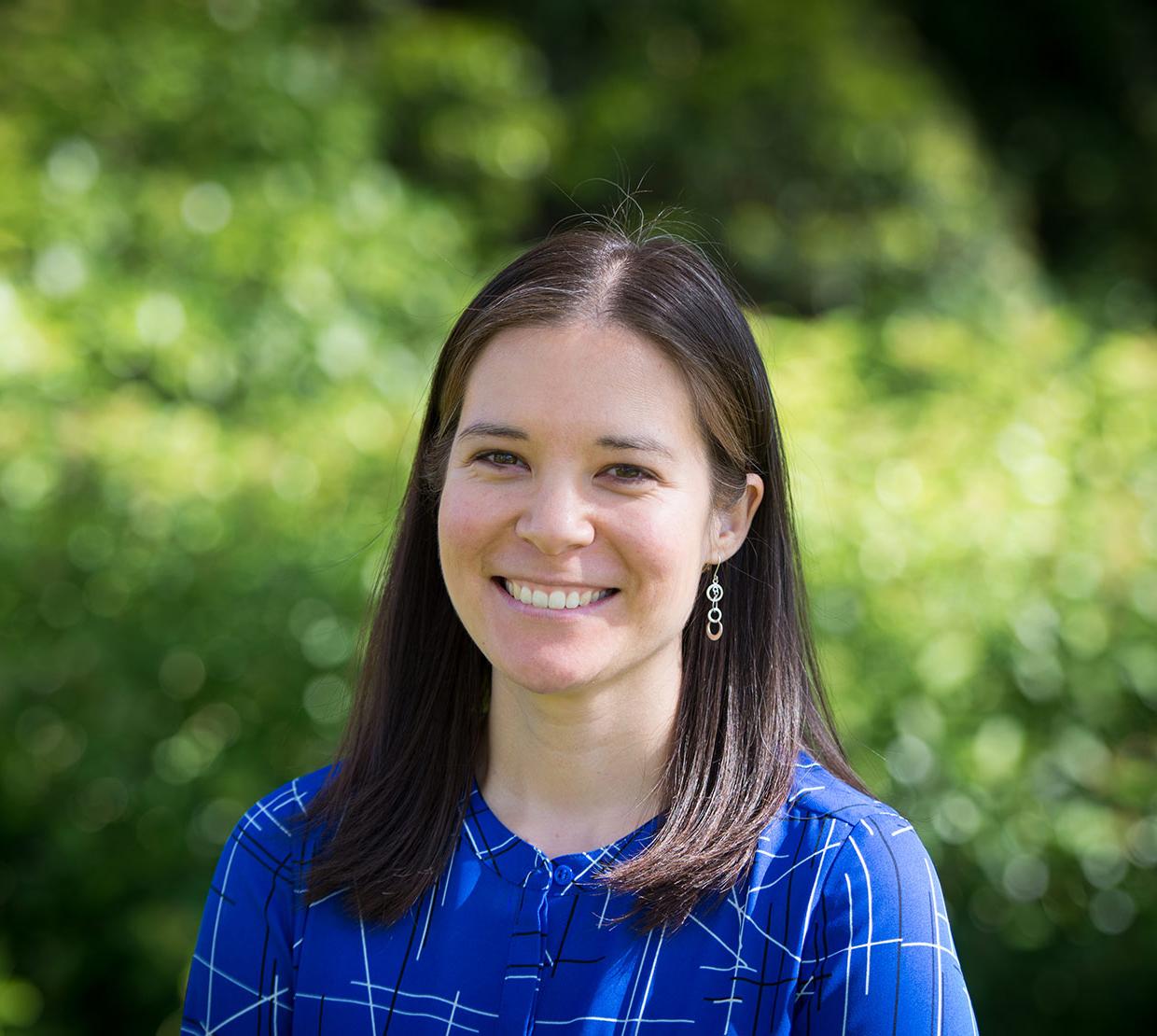
Elise Lockwood in front of shrubbery

Mathematics professor receives Google award to improve K-12 computer science education in Oregon

By Srila Nayak

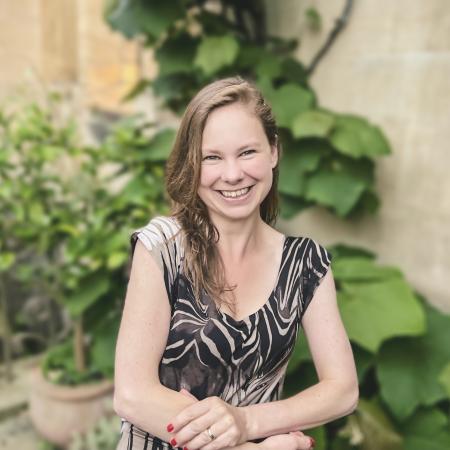
Elise Lockwood, associate professor of mathematics

Elise Lockwood, associate professor of mathematics, is part of a $141K, one-year grant from Google to enhance and increase integration between computer science (CS) education and mathematics teacher education curriculum. The project aims to better equip more teachers to teach computational concepts and practices in Oregon high schools. The grant is awarded as part of Google’s growing efforts to support excellent, cutting-edge research in academia.

As part of the project “Integrating CS Education into Teacher Education and K-12 Mathematics,” Lockwood will develop teaching modules for mathematics education students at OSU to build their computer science knowledge and skills. She will collaborate with colleagues Jennifer Parham-Mocello, assistant professor of computer science in the College of Engineering and the lead investigator on the study, and Rebekah Elliott, associate professor of mathematics education in the College of Education at OSU.

This mathematics and computer science education project aims to develop computational thinking and fluency of K-12 students both to enrich their conceptual understanding and to better prepare them for jobs in a highly technological society. The researchers say that this is especially important for Oregon “where many school districts have a growing population of youth minoritized within the educational system who are experiencing lower graduation rates than white peers and are relegated to low track courses and below grade level learning.”

Furthermore, Lockwood and Parham-Mocello point out that Oregon is one of only five states that has no policy to support K-12, computer science education. According to a report on K-12 computer science education in Oregon, only 37% of all high schools teach computer science, and universities in Oregon did not graduate a single new teacher prepared to teach computer science in 2016.

In an attempt to transform the dispiriting circumstances surrounding computer science education in Oregon schools, Lockwood and her colleagues are expanding ways to implement computer science education by exploring connections between secondary mathematics content and basic computational concepts. The researchers will “identify specific topics in existing mathematics standards (for secondary students) that fit with core CS concepts,” and then use those topics to build teachers’ knowledge and skills in computer science.

Over the 2019-2020 academic year, the Google award will offer unique opportunities for students on campus who plan to become secondary mathematics teachers. Both master’s students in the College of Education and undergraduate students in the mathematics department in the College of Science are eligible to participate. Lockwood and her colleagues will develop curricular materials to be utilized in a capstone mathematics course sequence for undergraduate pre-service teachers at OSU, and they will also create curriculum to work with a group of master’s level teacher candidates. In the process, the OSU students studying mathematics education will learn the basics of computational thinking, which they can apply in their future careers as teachers.

Extending mathematics education to computational learning

Lockwood is a highly regarded scholar in the area of mathematics education research. Her impressive research on how students learn combinatorics has steadily expanded to investigate the role played by students’ computational thinking and activity in mathematical and STEM learning. She was awarded a $800K five-year NSF CAREER award in 2017 to study how computational settings, specifically introductory Python programming, can strengthen aspects of students’ combinatorial reasoning. Her published research on using basic Python programming for undergraduate combinatorics problem solving paves the way for novel and creative methods of using computing.

While Lockwood’s CAREER grant was not designed to focus on pre-service teachers explicitly, findings from that project can inform how pre-service mathematics teacher training might involve computational thinking and activity.

“I am thrilled to work with my colleagues Jennifer and Rebekah on this project, and I think that our respective areas of expertise set us up well for a productive collaboration. I am very excited that this award will let us start some exciting work that fits well with my CAREER project,” said Lockwood.

She received the John and Annie Selden Prize for Research in Undergraduate Mathematics Education from the Mathematical Association of America. Lockwood was also awarded a 2019 Fulbright research scholarship to conduct research on how computing can help the teaching and learning of mathematics at the University of Oslo, Norway.

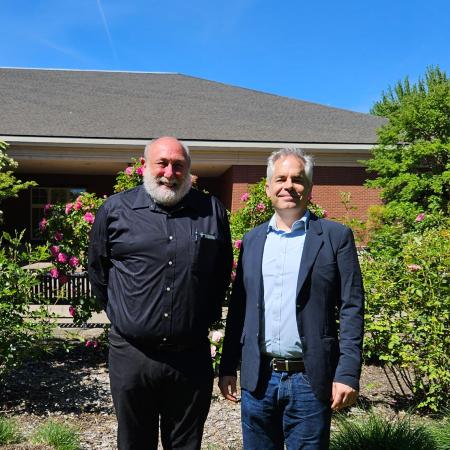
Naveen and Sarah in front of Owen Hall

Mathematics graduate student's leadership, innovative teaching, outreach and research garners awards

By David Pengelley

Alumnus Naveen Somasunderam and Ph.D. student Sarah Hagen

New alumnus Naveen Somasunderam (Ph.D. ’19) and Ph.D. student Sarah Hagen recently received top mathematics department awards. Somasunderam received the overall Graduate Student Excellence Award, and Hagen is the William F. Burger Graduate Teaching Award recipient. Somasunderam finished his Ph.D. dissertation research in number theory this spring and will be a tenure track assistant professor at the State University of New York at Plattsburgh in the fall. Hagen’s ongoing Ph.D. dissertation research is in partial differential equations. Both have also shown enormous individual leadership in adapting active learning methods to their teaching, as well as initiating mathematics outreach activities.

Leading from below to promote active learning

Somasunderam created an active learning classroom in teaching calculus, and Hagen designed a week-long boot camp for incoming graduate students as well as a Ph.D. qualifying exam preparatory course. They each created classrooms in which students are provided opportunities to engage in mathematical investigation, communication and group problem-solving, while also receiving feedback on their work from both experts and peers. These classrooms feature practices that engage students in activities, such as reading, writing, discussion, or problem solving, that promote higher-order thinking. There is now clear scientific evidence that these active learning features result in better student performance and retention than more traditional, passive forms of instruction alone.

“I have had many classes where students were so engrossed in the learning that they lost track of time, and not a single student left until I requested them to do so. It is such a rewarding experience as an instructor to see my students enthusiastically take charge of their own learning.”

Both Hagen and Somasunderam adapted a particular tripartite approach for their pedagogy: Students read, then engage and pose written questions before class, and also prepare before-class problem work that is built upon in groups and as a whole class, guided by the instructor. Finally, further higher level homework is completed after class.

“I have had many classes where students were so engrossed in the learning that they lost track of time, and not a single student left until I requested them to do so. It is such a rewarding experience as an instructor to see my students enthusiastically take charge of their own learning,” said Somasunderam.

Hagen describes the active learning process in her classroom. “Students were much more engaged when their classmates presented on the board than when I presented on the board. The few times that I wrote on the board I could feel the room tense up and the students’ eyes glaze over (and I pride myself on being an engaging instructor!). The problem is that they felt like what I had to say was gospel, and so they didn’t engage as much or question as much.

Students often came up with solutions very different than what I had in mind. When there were multiple solutions to the same problem I had students write them all up. We then looked them over, compared them, and discussed the virtues and drawbacks of each attempt. This would *never* have happened if I had simply written my own proof on the board. Teaching with active learning was way more fun than I had anticipated. The fun was being able to interact with the students on a more personal level. Students also gain experience and confidence presenting their work.”

Hagen and Somasunderam are superb examples of “leading from below”, in which graduate students, postdocs, and young faculty are often leading the way toward adoption of evidence-based active learning teaching practices for increasing student engagement and success.

Engaging in mathematics outreach

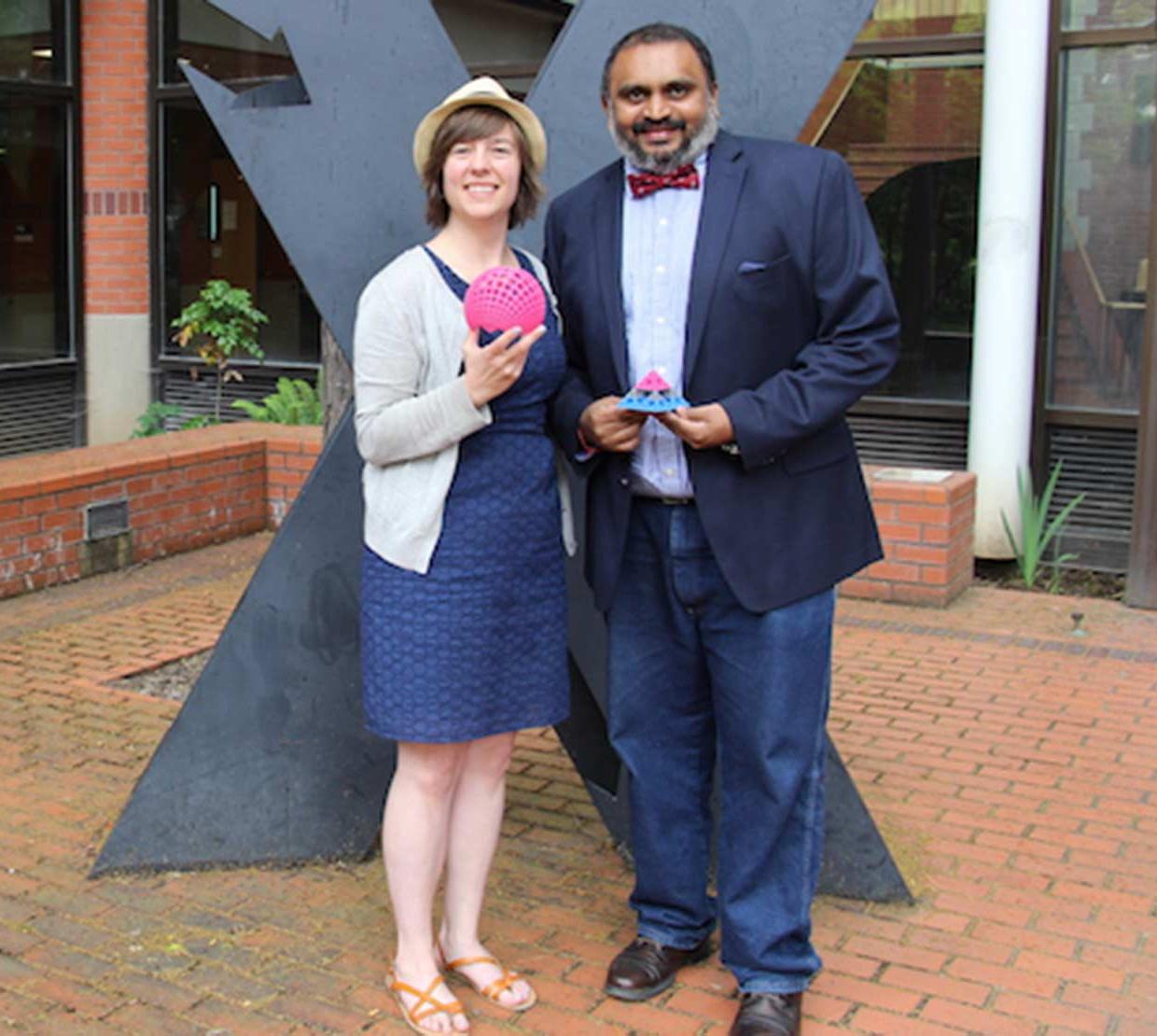
Both Somasunderam and Hagen have also led in creating outreach from the OSU Mathematics Department. Somasunderam co-created the Math Circus Project, aiming to bring out the artistic and aesthetic aspects of mathematics, by enabling children to play with 3-D printed mathematical objects. One example is an activity with stereographic projection spheres, which children use to investigate transformations of the plane and sphere, as well as to think about notions of infinity. Another theme is hands-on work with fractals. Math Circus events have included College of Science K-12 Discovery Days, Boys and Girls Club of Salem, Franklin School Science Night, and Periwinkle Science Night, Albany. The design and implementation of the Math Circus also includes OSU undergraduates.
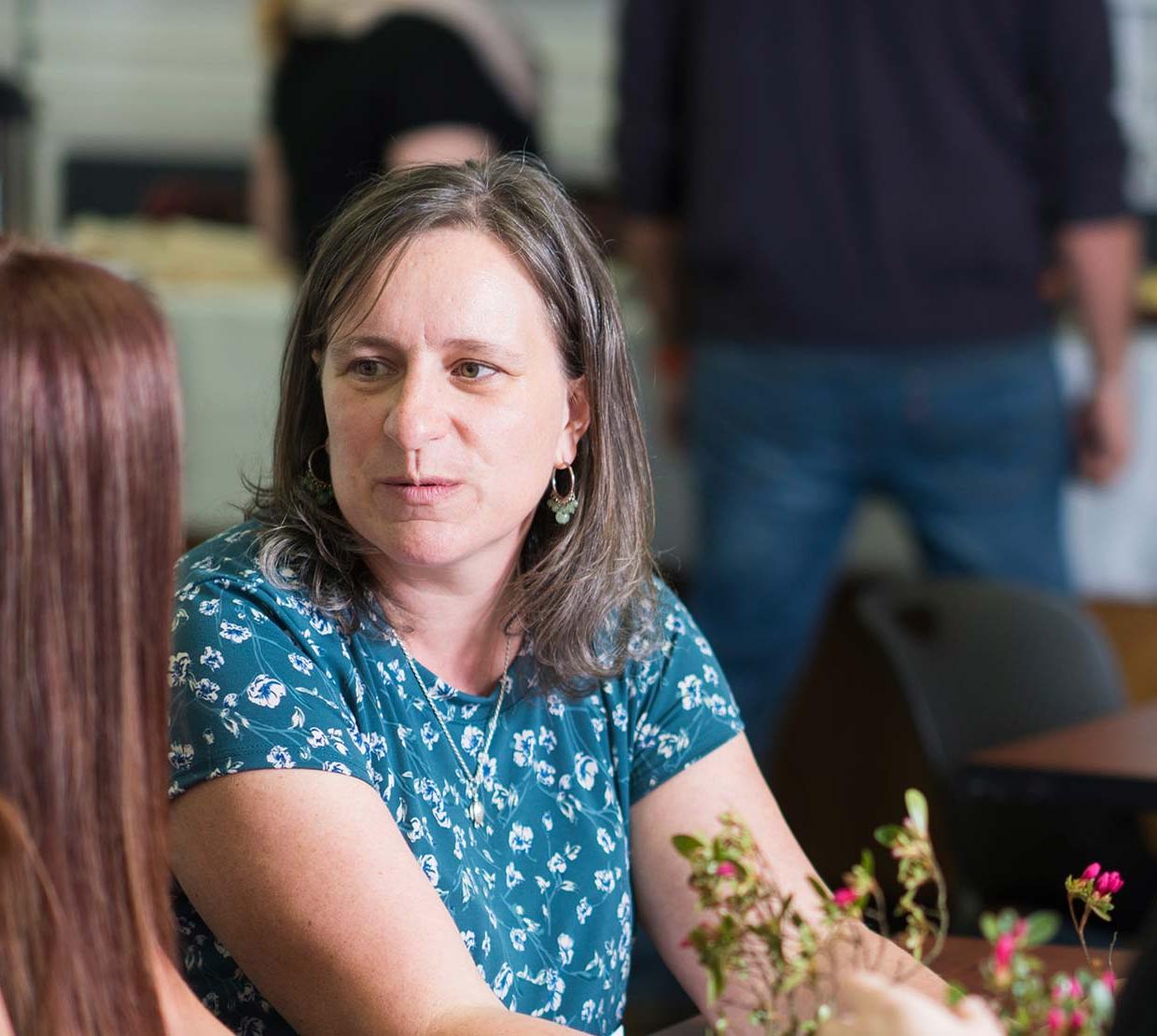
Hagen likes to jokingly refer to herself as an “evangelical mathematician.” Intent on spreading the good news about mathematics, she engages in a wide variety of community outreach. Her outreach has targeted preschoolers, retirees and everyone in between. She has participated in outreach events far beyond OSU’s campus. She’s given talks in bookstores, pubs, science festivals and the public library, where her standing room only hands-on events have included topics such as Pi Without Circles, How Big is Infinity? and Ancient Greek Astronomy.

Her talks have been featured in the Corvallis Gazette-Times. She has run math demo booths and workshops at events aimed at children and adults, including an event with logic and probability puzzles for inmates at the Coffee Creek Correctional Facility, organized by and co-designed with fellow graduate student Branwen Purdy. For College of Science K-12 Discovery Days, she developed and recruited volunteers to help run Tic-Tac-Totally Crazy (an activity where participants play variations of tic-tac-toe but with different sized boards). For Mathematical Marvels Day at the Eugene Science Center she developed and ran a demo on the mathematics of fluid dynamics called Order and Chaos in Fluid Flow.

Hagen also performs her unique brand of math-themed comedy throughout the Pacific Northwest (including at the Majestic Theatre in Corvallis), and she co-produced a math-themed comedy benefit for the Eugene Science Center. In an effort to make the department’s outreach efforts more impactful and sustainable, Hagen helped form a mathematics outreach working group and is currently developing an outreach website for the department. She is also a founding member of the Graduate Student Outreach Council in the College of Science, and a current Oregon Museum of Science and Industry Communication Fellow.

Somasunderam and Hagen were together part of a team that developed and ran a Pi Throwing Contest at Da Vinci Days, where participants approximated π using Buffon’s needle experiment (dropping and counting toothpicks instead of needles for safety). Some visitors said it was the most interesting event at the entire fair.

Hagen’s research is in the analysis of the incompressible Navier-Stokes equations. Using the tools of Fourier analysis, complex analysis, dynamical systems, and number theory, she is working to develop theorems regarding the properties and dynamics of solutions that model fluid flow. For instance, a ghost solution is a non-stationary solution whose energy and enstrophy are nevertheless constant in time. She can prove that such ghost solutions exist only outside the (weak) global attractor. She is currently writing a paper to submit for publication. Her research advisor is Radu Dascaliuc.

Somasunderam’s research is in the area of p-adic Fourier analysis and equidistribution. Classical Fourier analysis, which can be described as the study of broad classes of functions using the theory of waves, is a centuries-old research area of deep historical importance to both pure mathematics as well as physics and engineering. His work applies similar principles to the study of objects of interest in number theory, which is the study of the divisibility properties of whole numbers. His results give a way to quantify how well-distributed general sequences are with respect to a certain type of geometry arising naturally from notions of divisibility by prime numbers.

This project required Somasunderam to develop mastery in both analysis and number theory, and his work contains elements of topology and dynamical systems as well. Some of his dissertation work has been submitted for publication in a leading journal on number theory. His research advisor is Clay Petsche.

“It was such an exhilarating experience to see the math that I first saw in high school physics, like taking the Fourier series of a function, having analogues in more advanced research level mathematics. I was awestruck now as much as I was then as a young high school student,” said Somasunderam

The recent awards to Somasunderam and Hagen reflect their extraordinary combination of teaching innovation, outreach, and research.

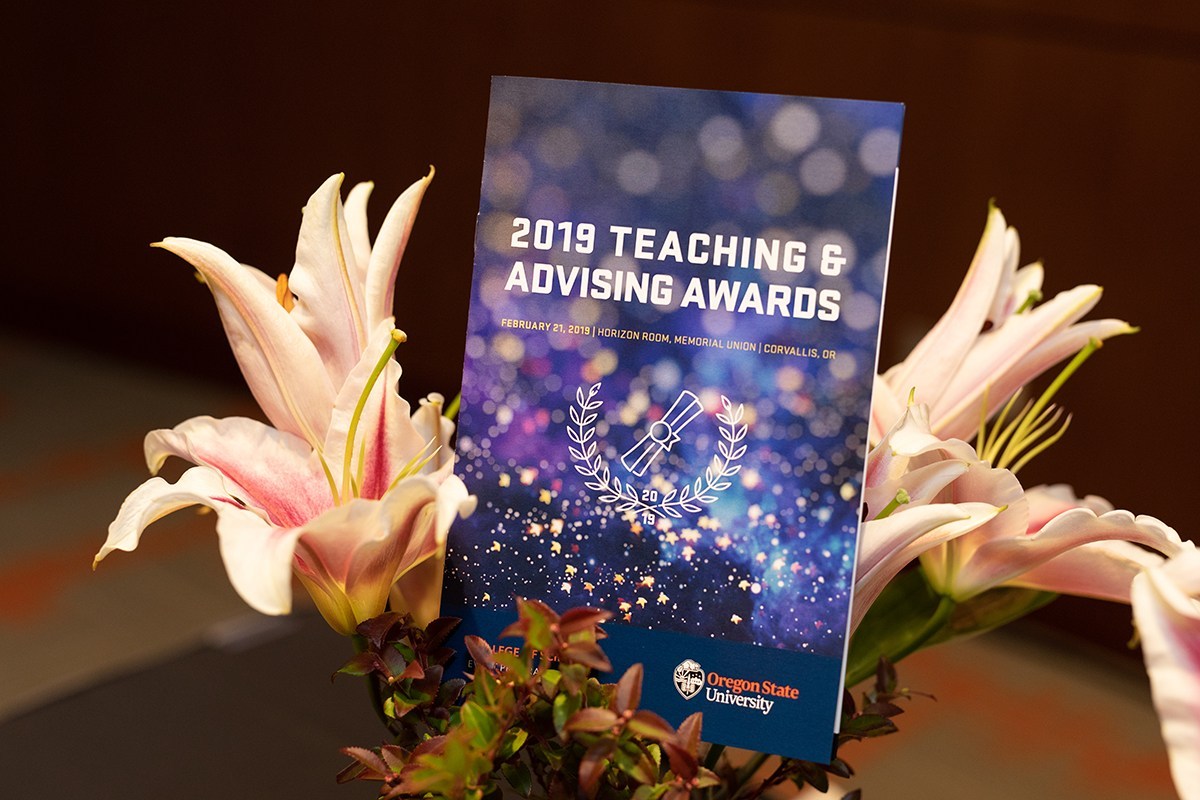
diploma icon above vibrant galaxy

Celebrating excellence: 2019 teaching and advising awards

Winter 2019 Teaching and Advising Awards

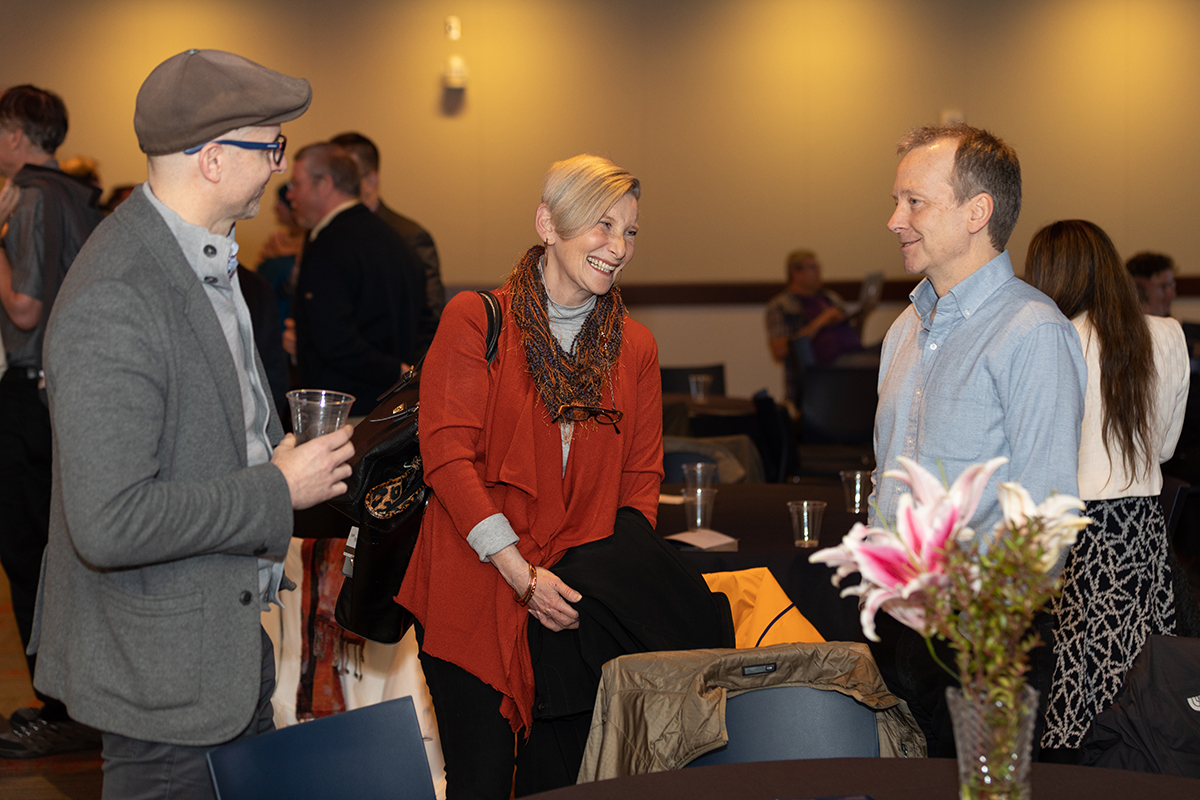
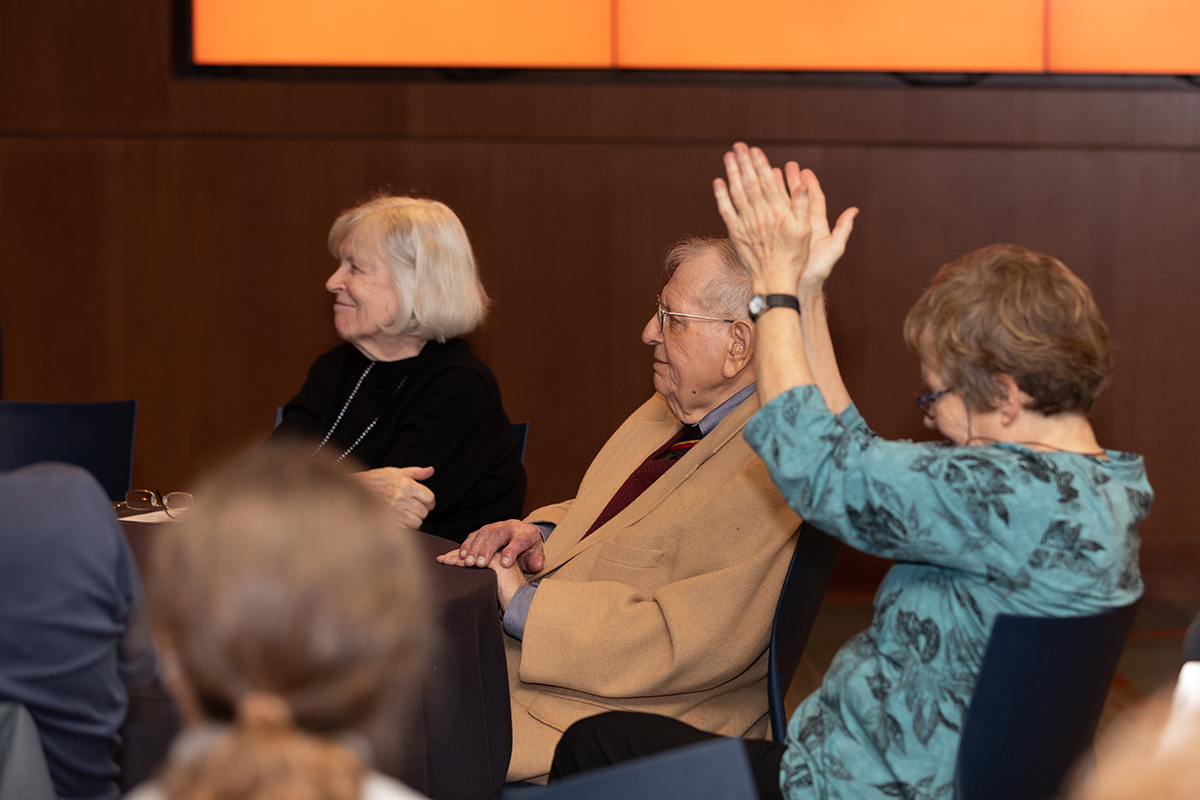
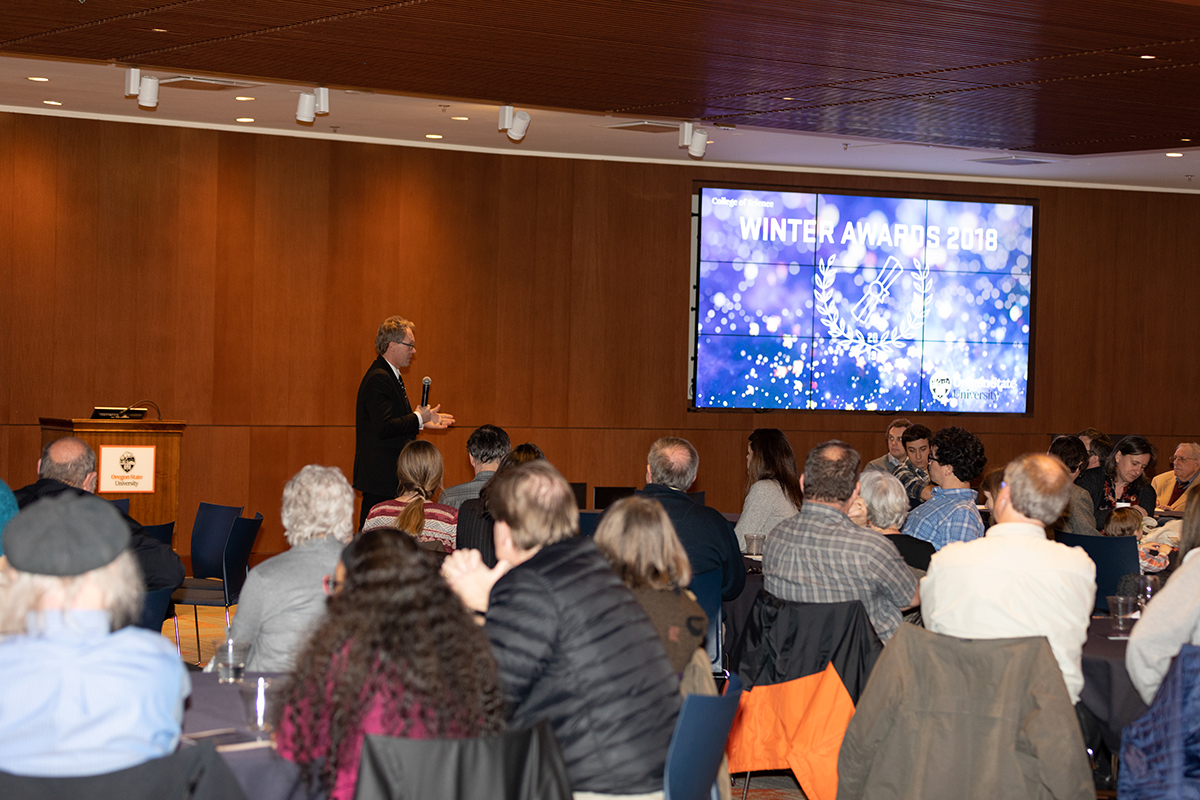
The College of Science recently celebrated its 2019 Winter Teaching and Advising Awards with faculty, advisors and students to recognize exceptional teaching and advising – key areas of distinction in the College. Effective teaching, advising and mentorship are at the heart of the College of Science’s mission to build leaders in science.

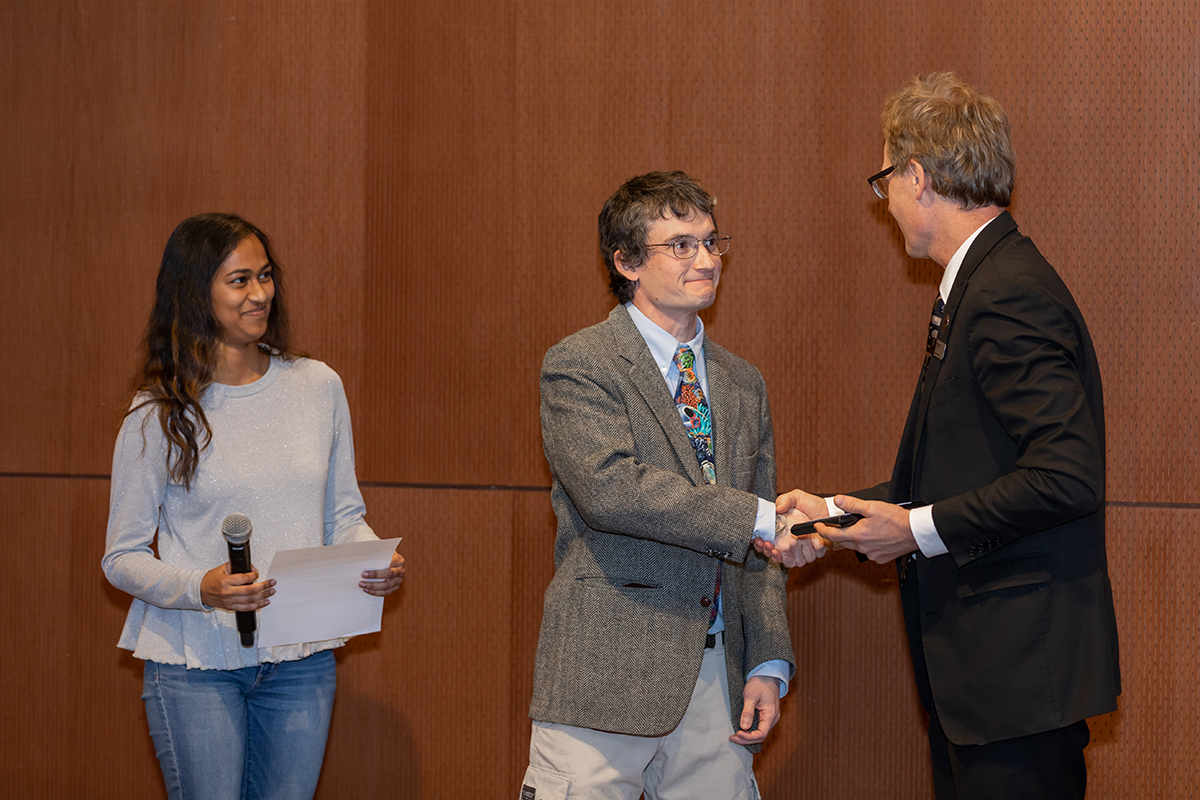
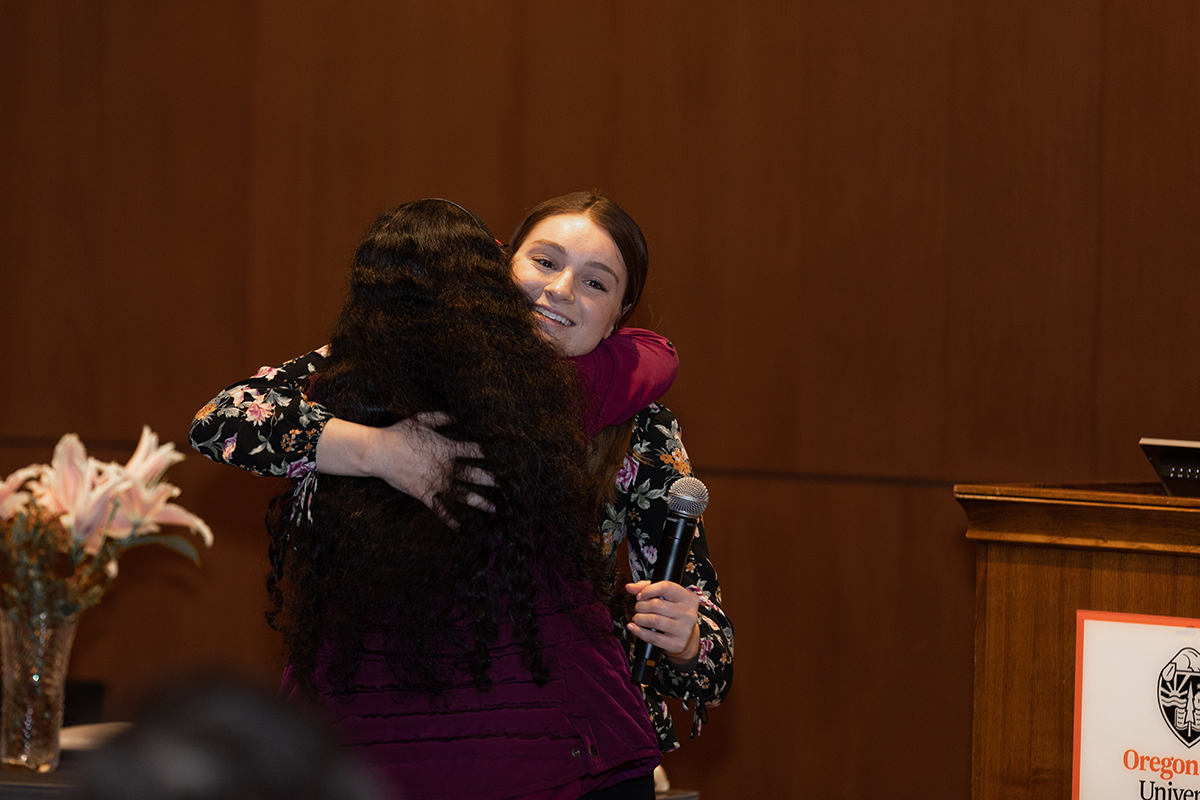
Dean Roy Haggerty delivered opening welcome remarks, Associate Dean Matt Andrews served as the lively emcee, and several science students offered earnest tributes and presented the awards.

“This awards ceremony is our opportunity to recognize teaching and advising excellence and emphasize our College’s dedication to student success,” said Dean Roy Haggerty. “I am proud to celebrate this year’s recipients whose commitment to their students models the College of Science’s highest values.”

Congratulations to all of our award winners and nominees. Their hard work to make science education more meaningful, relevant and effective advances our mission and transforms lives.

2019 Award Winners

Olaf Boedtker Award for Excellence in Academic Advising

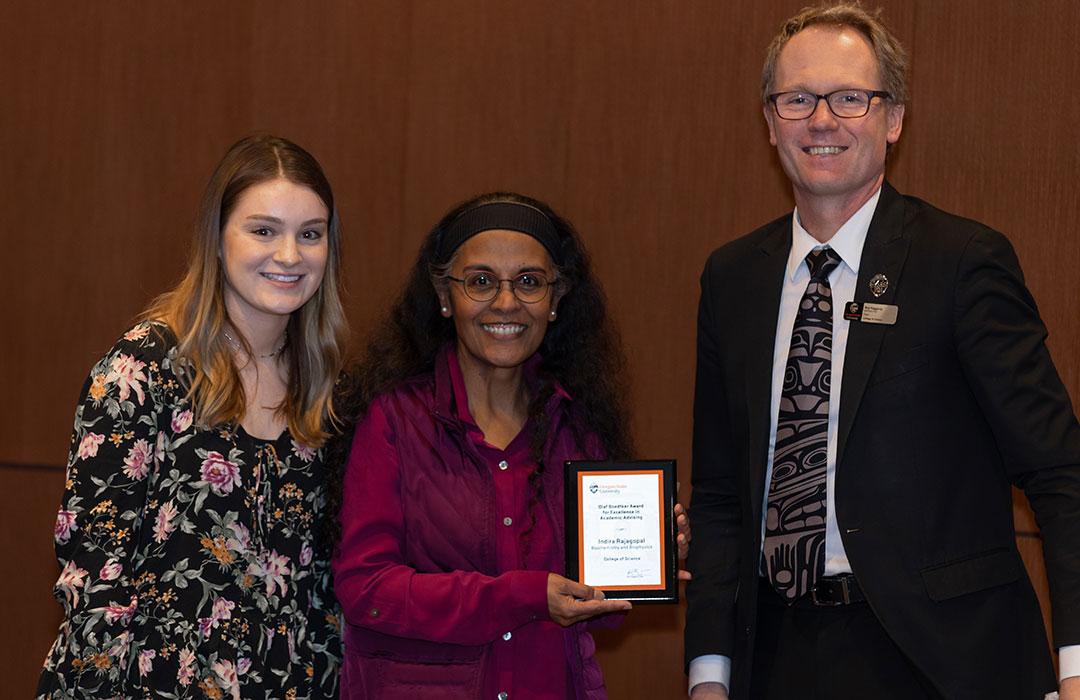
Indira Rajagopal receiving award from student and Roy Haggerty

Newly retired senior instructor Indira Rajagopal (center) ands biochemistry and molecular student Lily Sloan (left) with Dean Haggerty (right).

Indira Rajagopal, who retired as senior instructor in biology and biochemistry and biophysics in December, won the Olaf Boedtker Award for the second time in three years for her exceptional and inspirational advising of undergraduate students. The award was presented to Rajagopal by Lily Sloan, a biochemistry and molecular biology junior.

“Indira Rajagopal provided endless support and guidance to her students, and we were lucky to have such a dedicated advisor. My wonderful experience in the biochemistry and biophysics department was significantly impacted by Indira and the amount of effort she put in to help students. Indira brought so much positivity to the department, and I could not think of anyone more deserving of this advising award,” wrote one of her student nominators.

Rajagopal, newly retired as senior instructor in biology and biochemistry and biophysics, has consistently been credited throughout her 30-year tenure at Oregon State for the devotion she brings to her roles as an inspiring mentor, professor and advisor. Her work of encouraging students to pursue meaningful opportunities stems from her passion to help students reach their potential. That same dedication is exemplified by the work Rajagopal has done with her husband Kevin Ahern, recently retired biochemistry and biophysics professor, writing and publishing free electronic textbooks for online learners worldwide.

Nominees: Kevin Ahern, biochemistry and biophysics; Alex Beck, BioHealth sciences; Linda Bruslind, microbiology; Cody Duncan, integrative biology; Henri Jansen, physics; Barbara Kessel, microbiology; Shawn Massoni, BioHealth sciences; Brock McLeod, integrative biology; Jennifer Olarra, integrative biology; Kari Van Zee, biochemistry and biophysics.

Loyd F. Carter Award for Outstanding and Inspirational Teaching (Undergraduate)

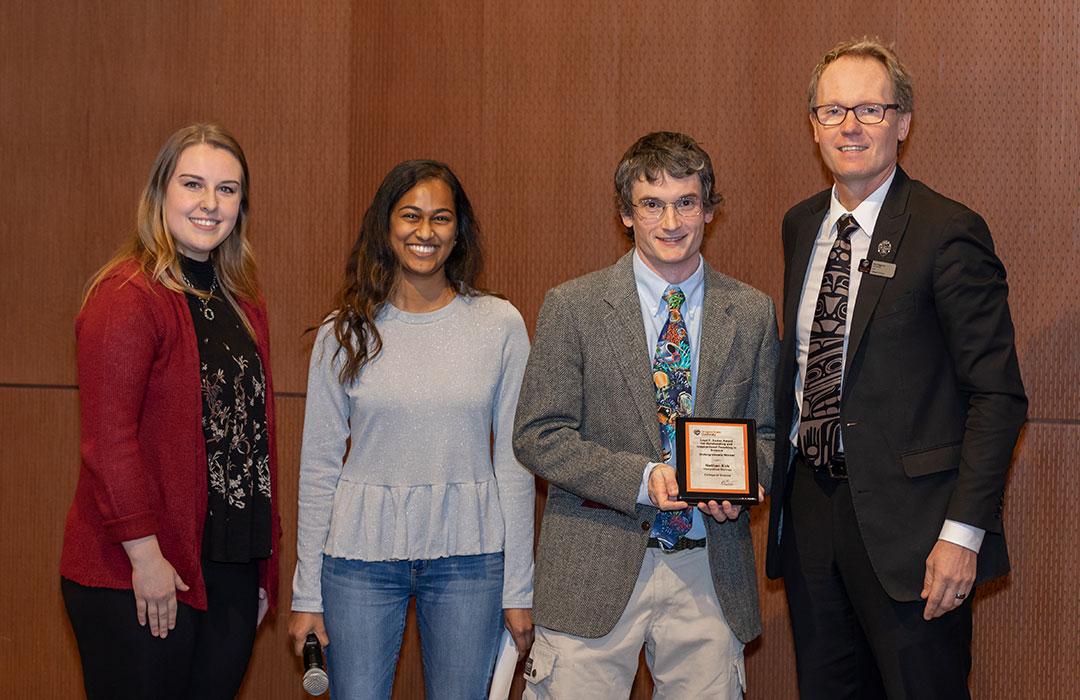
Nate Kirk receiving award from two female students and Roy Haggerty

Instructor of biology Nate Kirk (center right) with Dean Haggerty (right) and students Anastasiya Prymolenna (left) and Sonya Bedge (center left).

Instructor of biology Nate Kirk received the Loyd Carter Undergraduate Teaching Award for his effective and inspirational approach to teaching undergraduate biology students. Bioresource research student Sonya Bedge and chemistry student Anastasiya Prymolenna presented the award to Kirk.

“Nate is an incredibly thoughtful, understanding and kind professor, and I feel honored to have had him for the Principles of Biology series. His lectures were engaging, and he facilitated great discussions among peers about the course material. Nate clearly dedicated a lot of time to figuring out how to help his students learn best and gain a deeper understanding of the subject as a whole,” wrote one of his nominators.

Kirk, who teaches Honors and non-Honors Principles of Biology Series in the College, believes students learn best from each other and from practical experience, so he limits his direct lecture time in favor of directed learning. Combining lectures with hands-on experiences, he leads students to make their own discoveries and experience the thrill of science. Kirk was also honored as 2016 Honors College Professor of the Year.

Nominees: Nathan Kirk, integrative biology; Phillip McFadden, biochemistry and biophysics; Richard Nafshun, chemistry; Ryan Mehl, biochemistry and biophysics; Daniel Myles, chemistry; Chris Orum, mathematics; Devon Quick, integrative biology; Indira Rajagopal, biochemistry and biophysics; Lyn Riverstone, mathematics; Daniel Rockwell, mathematics; KC Walsh, physics; David Wing, mathematics.

Loyd F. Carter Award for Outstanding and Inspirational Teaching (Graduate)

Assistant professor of chemistry Sandra Loesgen received the Loyd Carter award for her outstanding and inspirational teaching of graduate students. She mentors and teaches graduate students to a variety of state-of-the-art techniques to identify and develop drug leads to cancer treatment.

“Dr. Loesgen’s enthusiasm for the topics she teaches are contagious. When you are in her classes, you are truly immersed in the subject. This means you are learning to become a true chemist in interpreting NMR spectra and understanding how organisms make their natural products. As she teaches these subjects, she wants you to understand rather than memorize,” wrote one of her students. “She is energetic, and her passion for the topics exudes as she delivers each lecture.”

Loesgen leads a highly motivated team of graduate students from diverse backgrounds, including pharmaceutical sciences, chemistry, biochemistry, molecular biology, and microbiology. In the Loesgen Lab, she guides student researchers as they explore target-based drug discovery with a focus on new anticancer, antimicrobial and antiviral compounds from microbial sources. She and her students discovered a soil-dwelling bacterium whose molecules destroy melanoma cells.

Nominees: Sally Hacker, integrative biology; David Hendrix, biochemistry and biophysics; Sandra Loesgen, chemistry; and Oksana Ostroverkhova, physics

Frederick H. Horne Award for Sustained Excellence in Teaching Science

Marita Barth, senior instructor of chemistry, won the Frederick H. Horne Award for her exceptional qualities as a teacher and a mentor. Barth, who focuses on distance chemistry education, has distinguished herself as an educator who bolsters the confidence and success of undergraduate students.

“Marita creates a really positive environment, and many students draw a contrast with their experiences at other institutions, telling us that they felt more comfortable, more supported and engaged with OSU Ecampus. Even at a distance, Marita has been able to convey an enthusiasm and passion for chemistry that sparks student interest – and remember that she is working with a student population that is more likely to come to us fearful of, or reluctant to, study this subject,” said Michael Lerner, chair of the Department of Chemistry.

“Marita has been able to convey an enthusiasm and passion for chemistry that sparks student interest.” – Michael Lerner

Barth leads her department’s general chemistry for non-majors courses at Ecampus, which are OSU’s largest online classes with ever-increasing enrollments – 430 students are currently enrolled in the sequence. She has continuously redeveloped and improved courses by producing videos and interactive materials that are now used by other faculty in the Department of Chemistry.

The awards ceremony also included a special presentation by participants of the Faculty-Student Mentor Program who shared their inspiring experiences. Led by Dean Haggerty, this new program aims to enhance student engagement in learning and improve retention and graduation rates. At its foundation are relationships built between faculty mentors and students. Mentors focus primarily on helping students – many of whom are first-generation college students – transition and adjust to college life. Based on the program’s success, OSU plans to expand the program across the entire university.

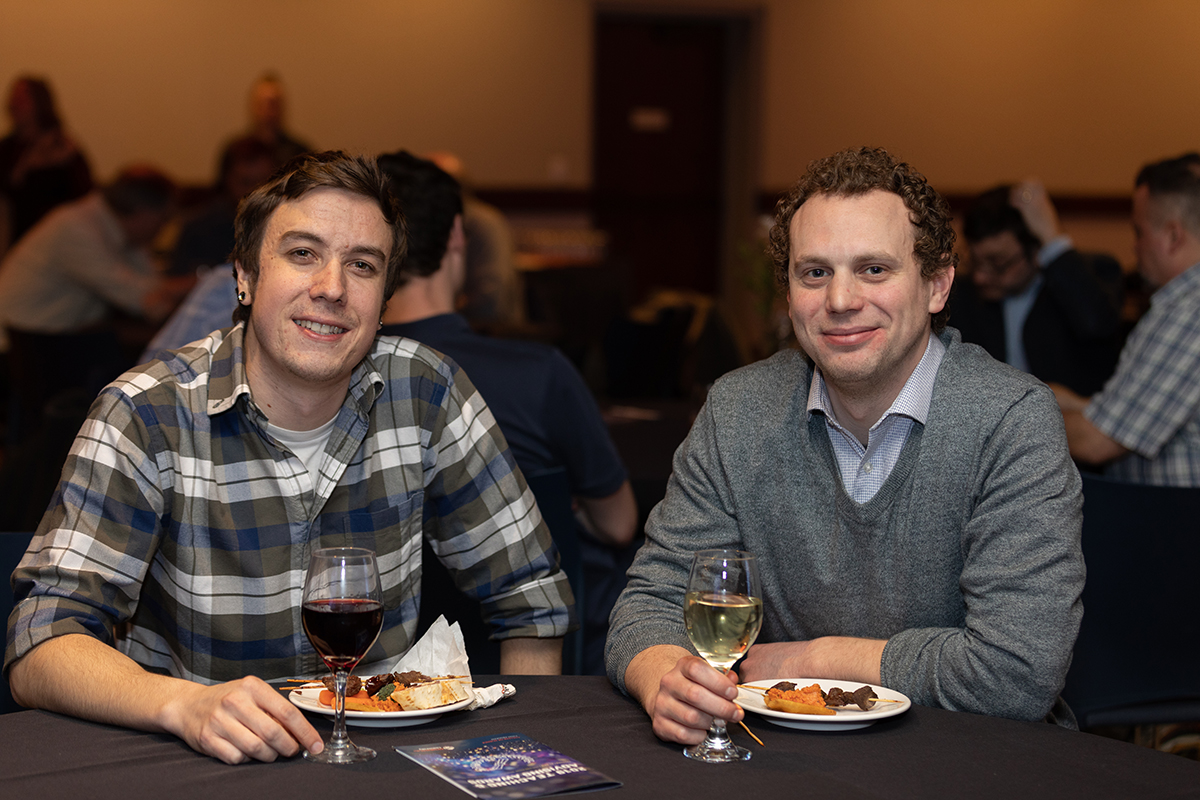
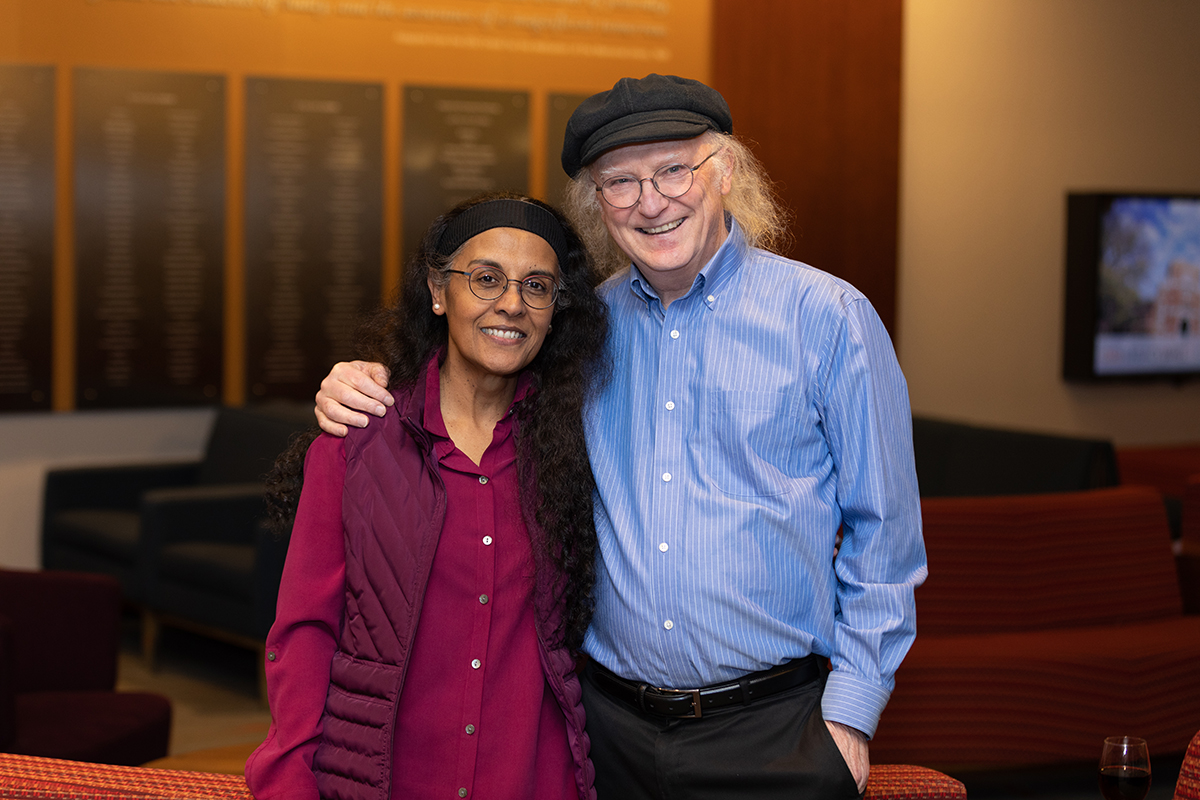
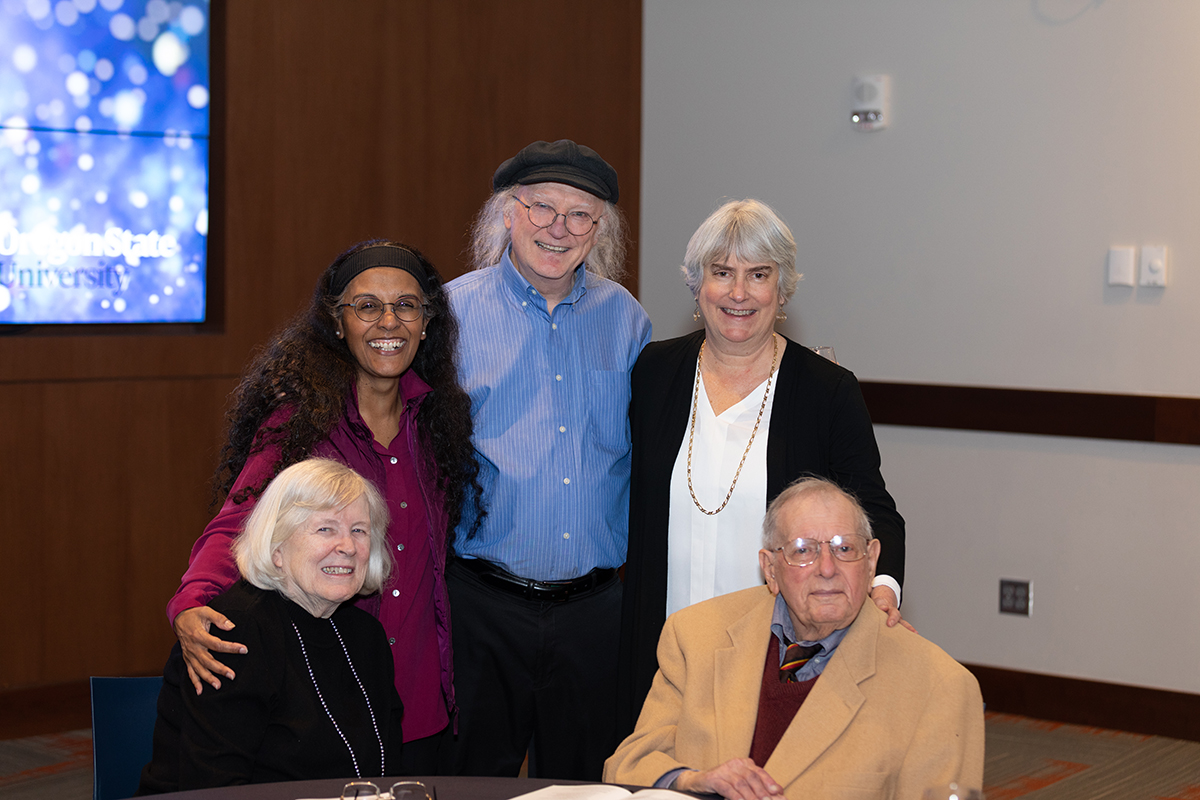
Photos from the College of Science Teaching and Advising Awards, February 21, 2019.

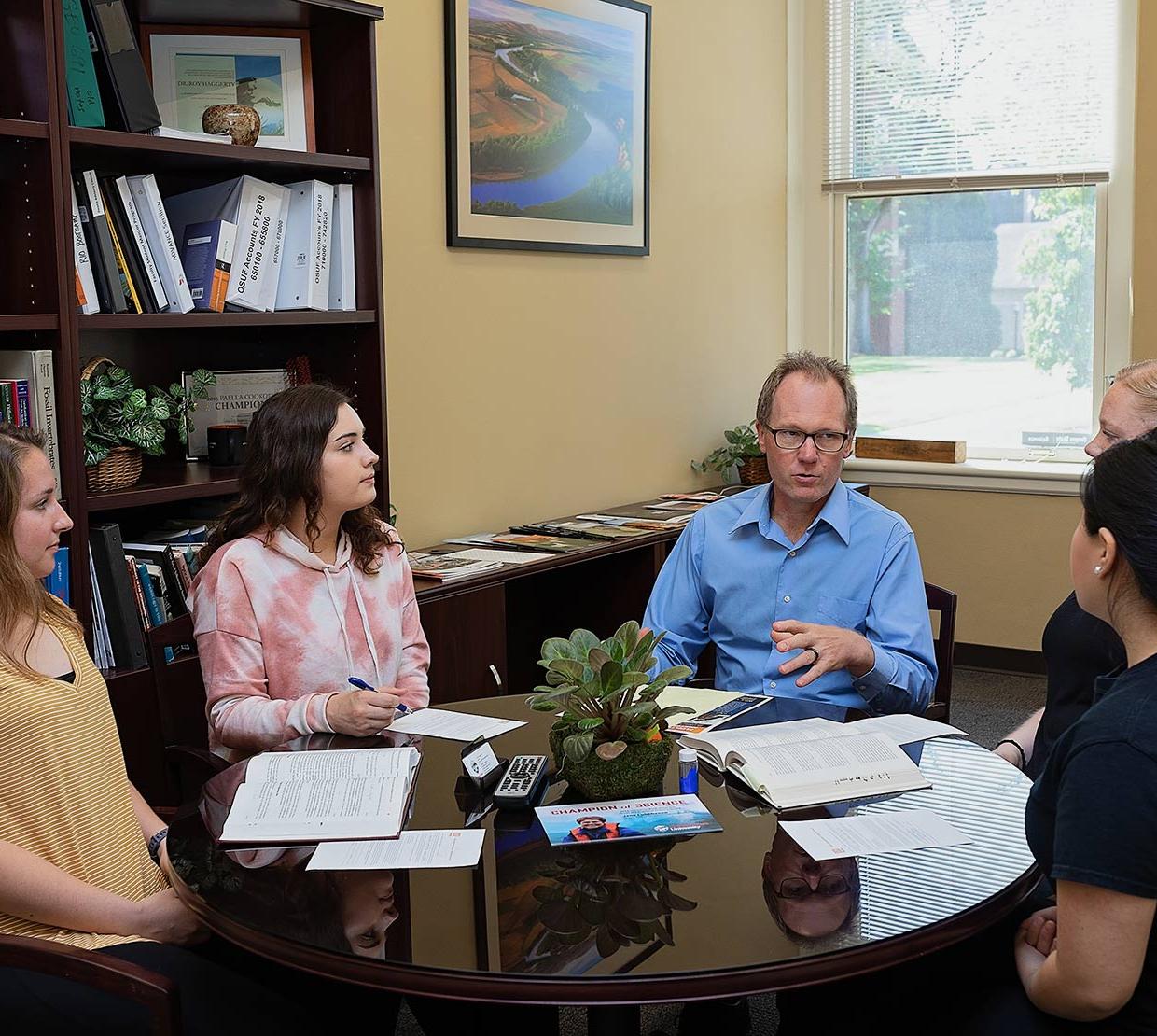
Roy Haggerty talking with female science students in his office

New faculty-student mentor program to raise retention and graduation rates

By Mary Hare

Dean Roy Haggerty and first year science students

This fall, Oregon State University launched an exciting new pilot program to develop stronger relationships between faculty and students, with the overarching goal of improving student retention and graduation rates. The College of Science played a lead role in developing the program.

Currently, the Faculty-Student Mentor program is only being tested on a sample of underrepresented minority students, first generation and Pell-eligible students who are in their first year at OSU (both traditional and transfer students. However, OSU is hopeful that these two preliminary years will see the success required to expand the program to the entire university. There is reason to be optimistic; data from other universities show faculty-student mentor programs can reduce dropout rates by as much as half.

OSU currently has a first-year retention rate of about five percent lower than its goal of 90 percent retention. This rate is even lower for Pell-eligible, first-generation and underrepresented students. While an OSU study showed many undergraduates feel isolated from faculty, nearly 96 percent of students say they have at least one professor who makes them excited to learn. Therefore, the urgent need is to facilitate access and foster substantive faculty-student relationships to enhance student engagement and increase retention and graduation rates.

In order to help the university do a better job in supporting students in their first year at OSU, the pilot program will focus on establishing a relationship between mentors and students rather than advising or conveying discipline-specific knowledge. This approach will help mentors place special focus on issues of student transition and adjustment to college life.

Students selected for OSU’s Faculty-Student Mentor program are put in groups consisting of five students, a peer mentor who is a junior or a senior, and a faculty member. Students will meet with their mentors for one hour every other week during fall, winter and spring terms throughout their first year at OSU.

The new mentoring program is supported by several senior professors and upper-level administrators. The program is led by College of Science Dean Roy Haggerty and Dan Larson, interim vice provost for student affairs. In addition to Dean Haggerty, faculty volunteers for the program include College of Science Associate Deans Henri Jansen, Doug Keszler, Matt Andrews; Math Department Head Bill Bogley; statistics professor Alix Gitelman; Microbiology Department Head Jerri Bartholomew; Provost Ed Feser, Senior Vice Provost for Faculty Affairs Susan Capalbo and other university leaders and faculty.

Strategies to improve student retention are particularly relevant in STEM fields. From universities all across the United States, studies indicate that fewer than half students who start out in these programs succeed in graduating with a degree in the field. This rate is considerably higher for students from underrepresented groups, with only a quarter of those who enrolled receiving a STEM degree.

Studies dating back to the 1990s have hypothesized that the lack of positive mentorship is often a significant factor in this disparity of graduation rates. Many first-generation and underrepresented students struggle to find their feet in a field that no one in their personal life has even encouraged, let alone shown them it’s possible. For some of these students, the greatest benefit of a mentor program is the positive role models it provides, helping students form a stronger self-identity as scholars, and realize their full potential for success in challenging fields at the university.

This research has been backed by numerous National Science Foundation (NSF) programs that support expanding representation in STEM fields through structured mentorship. In 2015, the NSF EFRI Research Experience and Mentoring Program cited a study by the Committee on Science, Engineering, and Public Policy at the National Academies, which describes how “mentorship is of even greater value for underrepresented populations in STEM.”

The Faculty-Student Mentor Program is part of OSU’s Student Success Initiative whose mission is to bolster student success through expanded student support services and changes in learning models. The program was renamed Beaver Connect in early 2020 and expanded to students across the university.

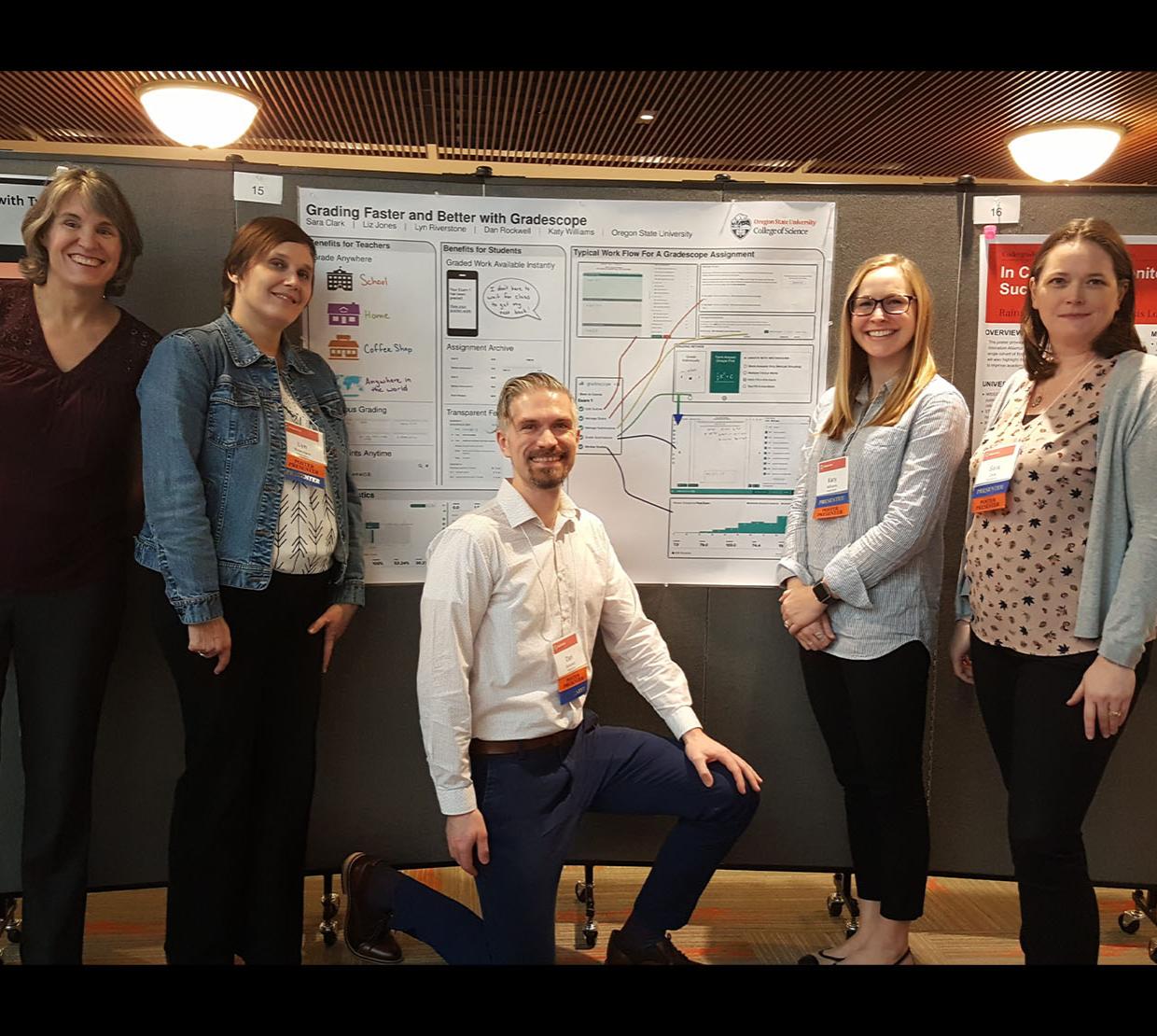
Elizabeth Jones, Lyn Riverstone, Daniel Rockwell, Katy Williams and Sara Clark in front of research poster.

Mathematics at the 2019 Undergraduate Student Success Summit

Feature photo (from left to right): Elizabeth Jones, Lyn Riverstone, Daniel Rockwell, Katy Williams and Sara Clark at the poster session outside the MU Horizon room. This article was created by the Newsletter/Media Committee with photo editing by Joy King. Please email [email protected] with any comments.

Since 2015, OSU has undertaken two major Undergraduate Student Success Initiative (USSI) efforts. First, a fundraising initiative in partnership with the OSU Foundation to raise $150 million to support student success and second, a series of academic interventions intended to bolster student success directly through expanded student support services, particularly related to advising and financial aid, or indirectly through changes in learning models and provision to instructors and administrators of better and more timely data.

Oregon State recently hosted the 2019 Undergraduate Student Success Summit focusing on five themes: Transition experiences, financial aid and scholarships, faculty-student engagement, curricular excellence and experiential learning. The Department of Mathematics made several contributions to the event. The event brought together administrators, faculty, graduate students and undergraduate students to discuss ways to enhance the student experience and outcomes at OSU. Katy Williams, Instructor of mathematics, enjoyed the sense of community that was created by the summit.

“What I really enjoyed about the event was the fact that everyone was brought together. It was like we all had a seat at the table. There aren’t many instances in which instructional faculty, administrators, and support staff all get to be in the same room and discuss strategies for student success. That was really exciting and I hope there will be more of this in the future!” -Katy Williams

Mathematics instructors Sara Clark, Lyn Riverstone and Katy Williams, presented a talk on Fostering Community in College Algebra. The instructors, along with a panel of current and former College Algebra students, discussed how the students in College Algebra make lasting friendships, build mathematical confidence and become more self-reliant in their learning. Williams felt that “bringing in student voices really gave a unique perspective on active learning, the student experience in College Algebra, and the community in our classes.”

Several members of the Mathematics Department also gave lighting talks at the summit. Wendy Aaron, Mathematics & Statistics Learning Center (MSLC) Coordinator, gave a presentation about the student support provided in the MSLC. Graduate student Naveen Somasunderam, along with Professor Vrushali Bokil, provided an overview of the directed reading program network which pairs undergraduate student and graduate student mentors to explore interesting mathematical readings. Finally, Senior Instructor Dan Rockwell, presented along with Susan Fein of Ecampus about digital photo hunts in online College Algebra.

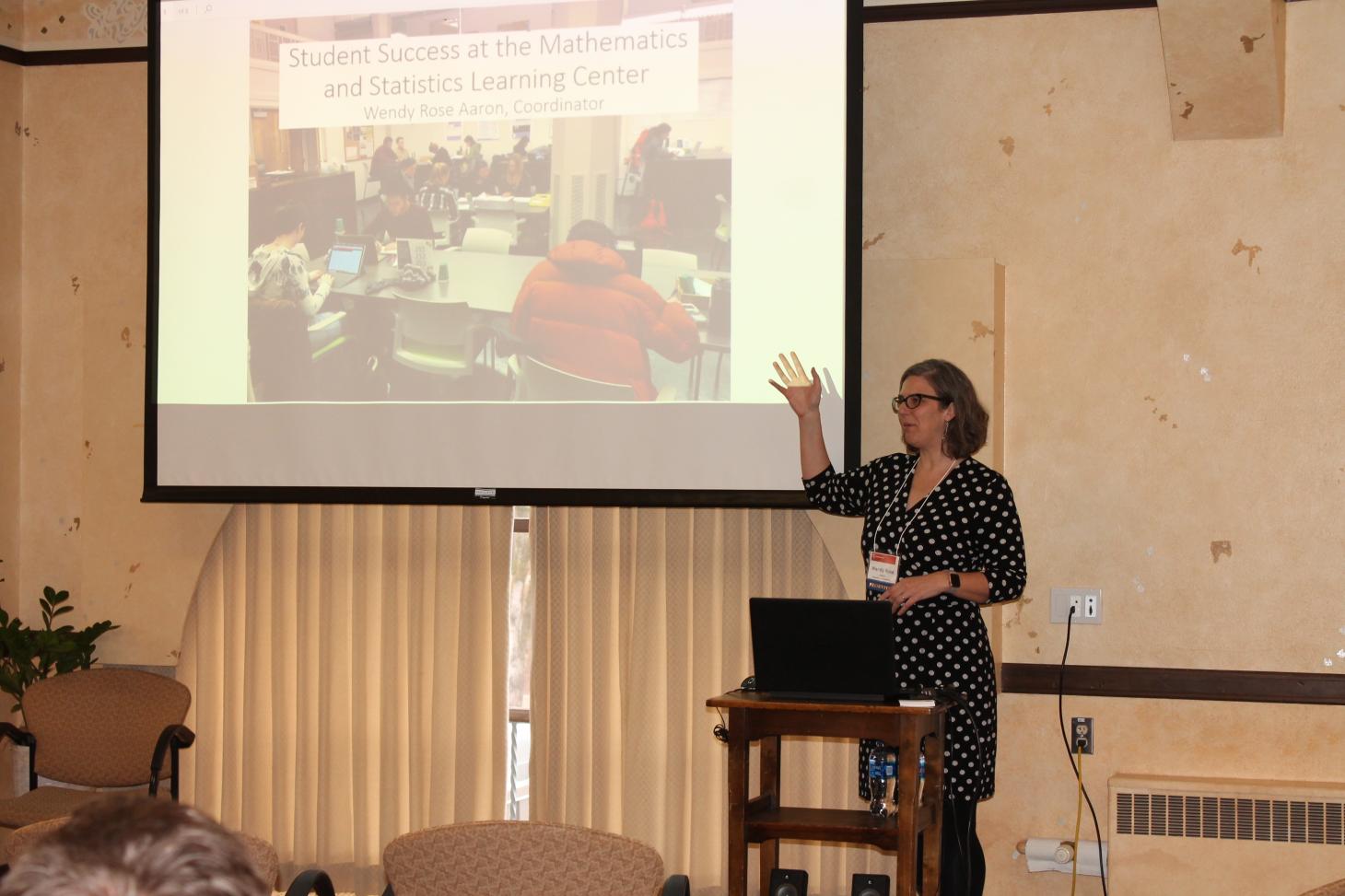
Wendy Aaron presenting in front of a projector.

Wendy Aaron talks about student support in the MSLC.

Rounding out the summit day, Sara Clark, along with Elizabeth Jones, mathematics instructor for the Educational Opportunities Program (EOP), and Cub Kahn, OSU Hybrid Initiative Coordinator, facilitated a round table discussion thinking beyond the traditional textbook order of topics when redesigning a course.

Clark, Jones, Riverstone, Rockwell, and Williams also presented a poster highlighting the benefits to students and faculty of the online grading tool Gradescope.

Mathematics Instructors Participate in a AMS Conference in Florida -- Sara Clark, Lyn Riverstone, Dan Rockwell, and Katy Williams were also part of the “Main Attraction” at the American Mathematical Association of Two-Year Colleges’, AMATYC, 44th Annual Conference in Orlando, Florida this past November. AMATYC’s mission is to “provide high quality professional development, to advocate and collaborate at all levels, and to build communities of learners for all involved in mathematics education in the first two years of college”.

Clark, Riverstone, and Williams, along with Elizabeth Jones, Math Instructor for the Educational Opportunities Program, presented a talk entitled An Active, Adaptive Approach to Teaching and Learning College Algebra. The talk focused on the recent redevelopment of College Algebra, MTH 111, and outlined the challenges and successes of incorporating active learning in the classroom and adaptive online technologies outside of the classroom.

Dan Rockwell presented a mini session at the AMATYC conference entitled Getting Out of the Classroom: Calculus Field Trips for Adults. Rockwell discussed how the activities he uses in his calculus courses that get his students out of the classroom to see math in the real world.

Clark, Jones, Riverstone, and Williams also took advantage of a concurrent conference, Accelerate, put on by the Online Learning Consortium, OLC, also taking place in Orlando at the same time. The OLC’s mission is to create community and connections around quality online and digital learning while driving innovation.

The four math instructors presented a talk with Cub Kahn, OSU Hybrid Initiative Coordinator, and Susan Fein, OSU Ecampus Instructional Designer, on A Team Approach to Redesign of a Large-Enrollment, High-Failure-Rate Course in a Blended, Active and Adaptive Format. The group discussed the process of the collaborative effort used to redesign College Algebra as a blended, active, and doubly adaptive course. Clark, Jones, Riverstone, and Jones also participated in a discovery session about Retelling the Story of College Algebra with an Active and Adaptive Approach for Student Success and Engagement. The session detailed how the order of the college algebra content was completely reimagined to introduce all function types on day one of the course, engaging students early and building big ideas from the start. Williams summed up the experience,

"Going to Florida was a great opportunity to present at two national conferences. It was gratifying to receive such positive feedback from so many colleagues across the country!” -Katy Williams

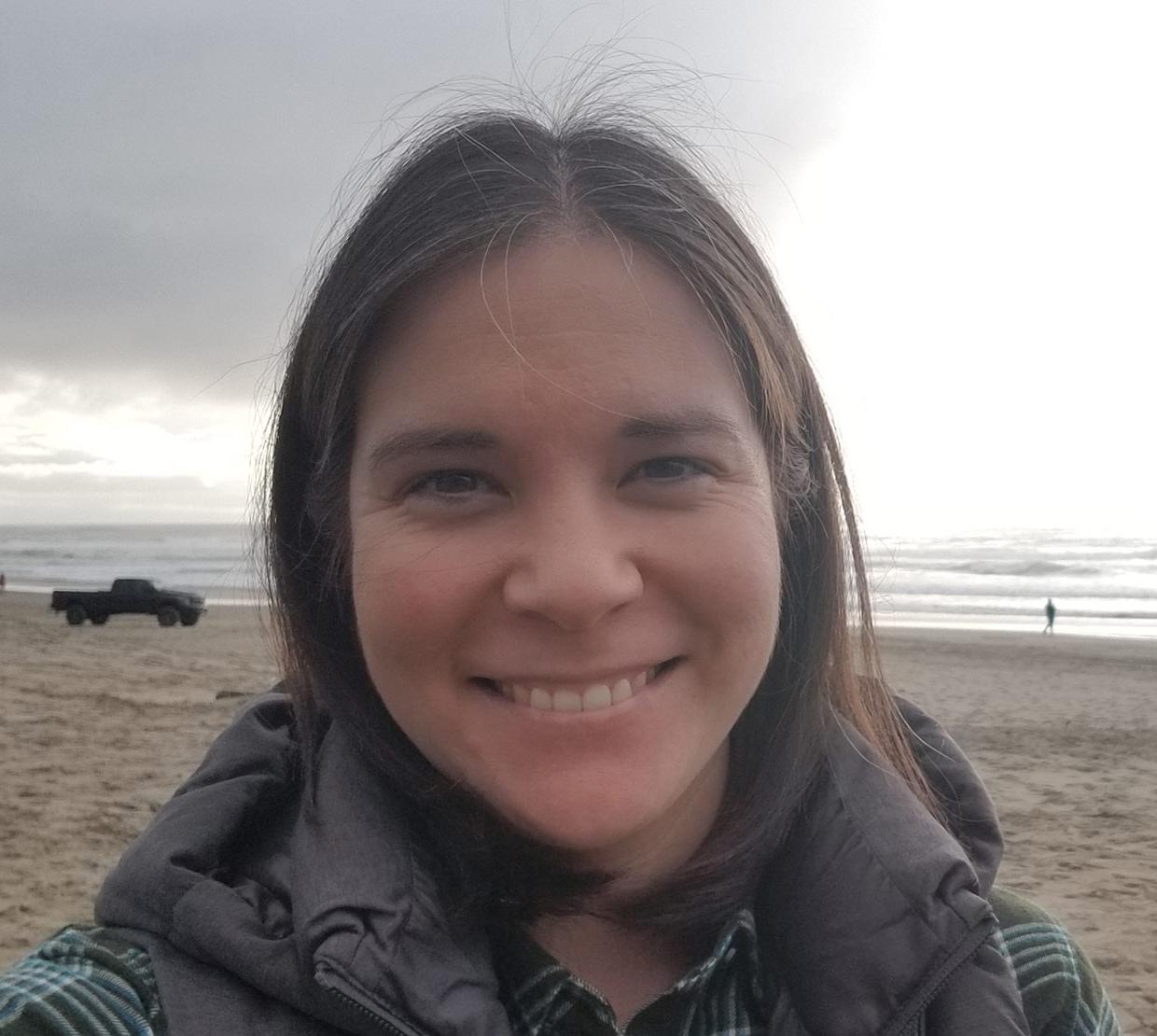
Elise Lockwood on beach

Mathematician garners global recognition for her work in undergraduate education

By Debbie Farris

Elise Lockwood, associate professor of mathematics

Congratulations to mathematician Elise Lockwood, who has received the John and Annie Selden Prize for Research in Undergraduate Mathematics Education from the Mathematical Association of America (MAA), the world’s largest community of mathematicians, students and enthusiasts.

Lockwood, who will begin the academic year as a newly promoted associate professor of mathematics, was honored as an outstanding mathematics educator earlier this month at MathFest, the annual summer mathematics conference that celebrates both teaching and research in mathematics, that was held in Denver. She received $500 and a certificate of recognition from the MAA.

Past recipients of the John and Annie Selden Prize hail from institutions such as the University of Warwick, Loughborough University, Rutgers University, Arizona State University and San Diego State University. Lockwood remarked on the “incredible honor to join the company of these past Selden Prize winners.”

At MathFest, she presented a talk on “An Initial Exploration into Undergraduate Students’ Computational Activity in a Combinatorial Setting,” as part of a session on Research in Undergraduate Mathematics Education.

The international award honors a researcher with a significant record of published research in undergraduate mathematics education and who has worked in the field for no more than 10 years. The prize was created to encourage researchers early in their careers. One award, at most, is given every other year.

“I am extremely honored to receive the Selden Prize. The Research in Undergraduate Mathematics Education [RUME] community has been tremendously formative in my professional development. I have felt encouraged and supported since the beginning of my career, and my RUME colleagues continue to challenge me to become a better researcher,” said Lockwood.

"I am also grateful for the example that Annie and John Selden have set – their commitment to mentoring and their genuine love for the field is something I wish to emulate throughout my career."

No stranger to the national spotlight, last year Lockwood received a five-year $800K National Science Foundation (NSF) CAREER Award for her ground-breaking education research project, “Developing Undergraduate Combinatorial Curriculum in Computational Settings.” CAREER Awards are NSF’s most prestigious award for early career faculty who possess the potential to serve as academic role models in research and education and to lead advances in the mission of their department or organization. She was the first to receive the prestigious award in the Mathematics Department at OSU.

Lockwood’s research focuses on the teaching and learning of combinatorics at the undergraduate level. The field of combinatorics includes enumeration (or “counting”) problems, which involve combinatorial operations such as permutations and combinations. Its applications in probability and discrete mathematics are significant for secondary and post-secondary education. Her research is especially important because evidence strongly indicates that students struggle with combinatorial mathematics, which poses challenges to their success in the classroom.

“This award wouldn't be possible without the support of my mentors, my colleagues and my students, all of whom inspire me and sharpen my thinking. I am grateful to the Mathematics Department and College of Science, who have encouraged me and have fostered a positive collaborative and collegial work environment. It is a joy for me to work at OSU,” said Lockwood.

Lockwood earned her undergraduate degree in mathematics from Wheaton College and her master’s and Ph.D. in mathematics education from Portland State University. She was a postdoctoral fellow at the University of Wisconsin, Madison prior to joining OSU.

Lori Kayes talking with a student

Science faculty receive $1 million to increase inclusivity and success of diverse students

Lori Kayes, senior instructor in integrative biology

Ongoing efforts to increase inclusion, access and excellence in science education at Oregon State University received a significant impetus with a recent five-year $1 million grant from the Howard Hughes Medical Institute (HHMI) to improve instruction in undergraduate STEM (science, technology, engineering and mathematics) classrooms.

The ambitious project is called Inclusive Excellence @ Oregon State. OSU was one of 33 colleges and universities that HHMI selected this year for its Inclusive Excellence Initiative. Oregon State is the only Oregon University selected for a HHMI grant this year. The Initiative aims to produce sweeping cultural changes in post-secondary institutions through a variety of pedagogical approaches to increase diversity and inclusion of underrepresented minority (URM) students in science programs.

At Oregon State, these students will include underrepresented ethnic minorities, first-generation students, and economically disadvantaged students majoring in science and math.

The project is a collaboration between the College of Science, OSU’s Center for Research on Lifelong STEM Learning, and Division of Undergraduate Education. Martin Storksdieck, director of the Center, is the principal investigator (PI) on the project. Co-PIs on the project include mathematics associate professor Mary Beisiegel, senior instructor in integrative biology Lori Kayes, Nana Osei-Kofi, associate professor of women, gender and sexuality studies, and associate director at the Center Julie Risien.

Other science faculty involved with the project include integrative biology senior instructor Devon Quick, who is part of the core team and will assist with program implementation. In addition to educators from sociology, engineering and education, other members of the proposal steering committee are integrative biology professor and interim department head Robert Mason, Head of the Department of Biochemistry and Biophysics P. Andrew Karplus and mathematics professor Tom Dick.

“OSU has a long history of successful HHMI grants. We are excited to have another opportunity to engage with this prestigious and highly selective program. Being selected for the Inclusive Excellence initiative is indicative of the fact that OSU is primed and ready to change the way we think and act in higher education,” said Kayes.

A path toward inclusive excellence in STEM

The grant will help OSU develop a cohort-based professional learning community for designing STEM curricula that will increase the performance of URM students in select critical science and mathematics courses.

In 2015, about 41 percent of Corvallis and Ecampus students at OSU were Pell-eligible and 27 percent were first-generation students. Fall term 2017 enrollment data show that 25 percent of science majors are first in their family to attend college, 23 percent are underrepresented minorities and 35 percent are both minorities and first-generation students.

However, longer term data at OSU reveal that the gap in graduation rate for URMs and Pell-eligible students ranges from six to 18 percent across various science disciplines and that science is not retaining URMs at the same rate as they are students from majority groups.

Taken collectively, these trends demonstrate that the time is ripe to systematically work towards developing a more inclusive science education that is responsive to the needs of students from diverse backgrounds.

The project seeks to replace traditional lecturing in critical natural sciences courses in favor of a combination of active learning strategies and culturally responsive teaching practices that improve and equalize student success. To this end, Inclusive Excellence @Oregon State will form a five-term Summer Academy with mathematics and science faculty from OSU and nearby community colleges. The faculty will participate in a 40-hour training dedicated to developing teaching practices for inclusive STEM pedagogies and individual course redesigns that will be then implemented in their classrooms.

The project will target instructors of high enrollment, multiple section courses and their community college equivalents in the natural sciences and mathematics and train them to create classrooms where all students, but particularly underrepresented and first generation students, feel welcome and can succeed.

“We hope to see a shift to more active learning approaches coupled with culturally aware faculty. In biology courses culturally responsive teaching practices will potentially include the use of diverse representations of scientists, having a diverse teaching team, using a variety of assessments as opposed to just exam-based evaluations, and incorporating social justice ideas related to biology in the classroom discussions,” explained Kayes.

She continued, “We have already done a lot of transformative work in many of our biology classrooms; this work moves us towards more specifically addressing these hard to get at inclusivity practices in our courses and promoting active learning and culturally responsive pedagogies across not only our campus, but also our neighboring community colleges.”

By the end of the five-year grant period, Inclusive Excellence@Oregon State will have created a community of 100 faculty committed to the success of URM students in STEM courses. Each faculty member teaches approximately three courses per year resulting in 300 inclusive classrooms that affects thousands of undergraduate students.

Inclusive Excellence @ Oregon State builds on the momentum of numerous efforts at OSU to develop a culture of inclusion and excellence in teaching, including OSU’s Difference, Power, Discrimination Program, the ADVANCE Seminar and Enhancing STEM Education at OSU (ESTEME@OSU), the latter two being National Science Foundation (NSF) funded initiatives.

Implementation of the program and the establishment of learning communities within and across departments and institutions will build on the foundation of ESTEME@OSU. That program was funded by NSF's Widening Implementation and Demonstration of Evidence-Based Reforms (NSF WIDER) initiative to broadly implement evidence-based instructional practices in large enrollment undergraduate STEM courses.

“The HHMI grant recognizes the amazing work that is already being done on our campus to transform our STEM classrooms. It gives us the resources to try to spread that work and take it one step further by thinking more specifically about inclusivity and cultural responsiveness within our classrooms,” said Kayes.

Related articles: Inclusive Excellence @ Oregon State awarded $1 million from HHMI

33 Schools to Support Diversity and Inclusion on Campus Through 2018 HHMI Inclusive Excellence Initiative

OSU math faculty in front of LINC

Math faculty win award for exceptional teamwork and teaching

Mathematics department receive 2018 Faculty Senate Student Learning and Teamwork Award

A year ago, a group of seven mathematics instructors set about improving student performance and learning in introductory pre-calculus courses at OSU and achieved encouraging results. Mathematics calculus courses such as college algebra have been identified as having the strongest impact in the success and retention of students in STEM. Since spring term 2017, "Team Math" as they have become known across campus, redesigned college algebra and algebraic reasoning by integrating active learning technologies and other innovative student engagement strategies.

This has resulted in creating a successful teaching and learning environment in precalculus courses that is welcoming to students, empowers faculty to challenge students in their understanding and enhances student participation, a significant achievement in the introductory mathematics classroom at OSU.

For its work in enhancing student success, Team Math has received the 2018 Faculty Senate Student Learning and Success Teamwork Award. The award recognizes departments or interdisciplinary groups at Oregon State that have demonstrated exceptional teamwork in creating and sustaining an exemplary teaching and learning environment to advance the university’s strategic goal of student success and excellence.

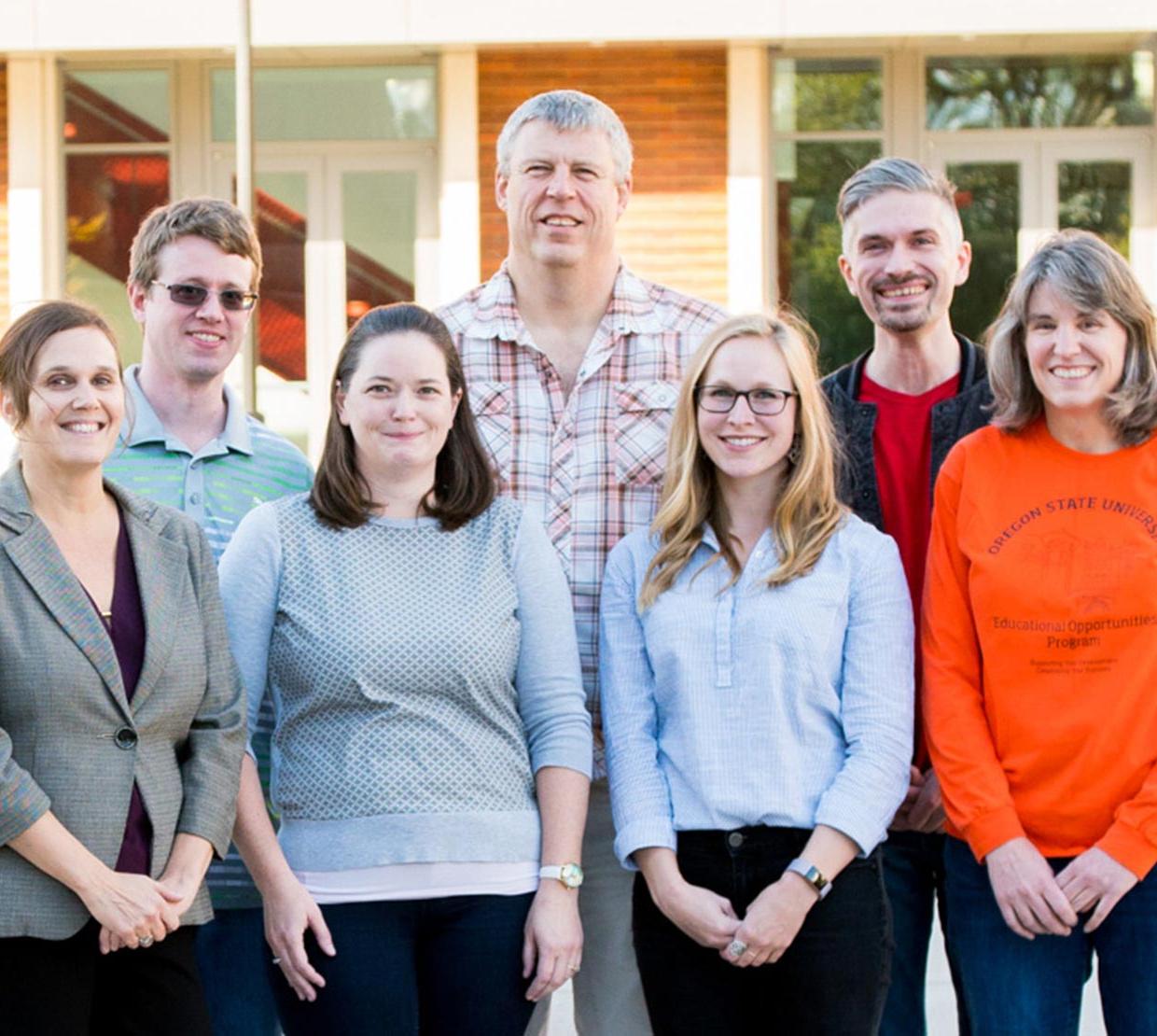
The team includes six mathematics faculty, one person from the Educational Opportunity Program and three educators from Ecampus, Academic Technologies and the Center for Teaching and Learning.

“Team Math is working on improving students success at some of the most impactful mathematics courses at OSU,” said Enrique Thomann, head of the Department of Mathematics.

Congratulations to these members of the awarding-winning team:

Sara Clark, Mathematics instructor and advisor
Scott Peterson, Senior mathematics instructor
Lyn Riverstone, Senior mathematics instructor
Daniel Rockwell, Senior mathematics instructor
Katy Williams, Mathematics instructor
David Wing, Senior mathematics instructor
Liz Jones, Mathematics instructor-Equal Opportunities Program
Susan Fein, Instructional designer, Ecampus
Lynn Greenough, Associate director, Academic Technology
Cub Kahn, Hybrid course initiative coordinator, Center for Teaching and Learning

During the first year of implementation, Team Math saw strong outcomes in the following areas:

  • Decreased DFWU rates (grades of D, F, withdrawal and unsatisfactory) in every term compared to previous terms
  • Increased retention of students, and
  • Reduction in achievement gap as a result of improved performance across different student populations, including underrepresented and first-generation college students.

“The group effort to reinvent the learning and teaching environment for this particular course is laser-focused on making every possible attempt at helping students succeed in mathematics and break the old paradigm ‘I am not good at math,’” said Thomann.

Pioneering adaptive learning technology in math courses

Failure rates in college algebra are high across the country and present significant barriers to earning STEM degrees because mathematical sciences courses in the first two years of college function as pathways for many different science and engineering majors. Thanks to the efforts of Team Math, the rate of drops in DFWU (grades of D, F, Withdrawal or Unsatisfactory) in both Algebraic Reasoning and College Algebra courses show progress.

The faculty nominated for this award are pioneers in the use of adaptive learning technology at OSU, creating an effective and innovative learning environment for students in mathematics courses. The mathematics faculty worked closely with Susan Fein (Ecampus), Lynn Greenough (Academic Technology) and Cub Kahn (Center of Teaching and Learning) to adapt the organization of ALEKS (Assessment and Learning in Knowledge Spaces) modules to enhance students’ performance.

ALEKS provides an environment of interconnected mathematical concepts in which students progress through by passing modules. The organization of these modules and the interconnectivity among them is at the heart of the effectiveness of this approach, requiring curricular expertise as well as technical support. The integration of efforts between the mathematics faculty involved and faculty from Ecampus, Academic Technology and from the Center of Teaching and Learning has contributed to the success of this initiative.

The recent award to this group of faculty to develop open educational resources for College Algebra (MTH 111) further attest to their focus in making the learning experience of our students more affordable as well as successful. It is natural to expect that similar material will be developed for other courses in the near future further improving students’ access to educational resources.

In spring 2017, Team Math began collaborating to redesign College Algebra in part supported by a grant from the Bill and Melinda Gates Foundation through the Association of Public and Land Grant Universities (APLU). With a membership of 237 public and state research universities and land-grant institutions, APLU works as a research, policy and advocacy organization devoted to increasing degree completion and academic success, advancing scientific research, and expanding engagement.

The redesign of College Algebra began in spring 2017 with five sections fully implemented by that fall. The redesign of Algebraic Reasoning also began in fall of that year. Elementary Functions (MTH 112) is undergoing a similar process and will be completed by winter 2018.

Team Math's efforts will provide a first-year experience to incoming students in mathematics using a unified teaching approach. These courses will also introduce students to the culture of active learning that is growing to include calculus courses and others in the College of Science, supporting OSU's student success goals.

Team Math’s impact on the learning culture on campus and beyond continues to grow. The team of math faculty has participated in national and regional meetings to share their experience. At OSU, they have shared their experiences in forums and advisory meetings. They have made presentations at the 2017 ORMATYC conference (Oregon Mathematical Association of Two Year Colleges) and at a University of Louisville workshop on active learning. The group also presented to science faculty at the College of Science Winter Awards ceremony and to chemistry faculty. The group is already planning presentations for other academic units at OSU as well as the 2018 ORMATYC conference.

Related articles

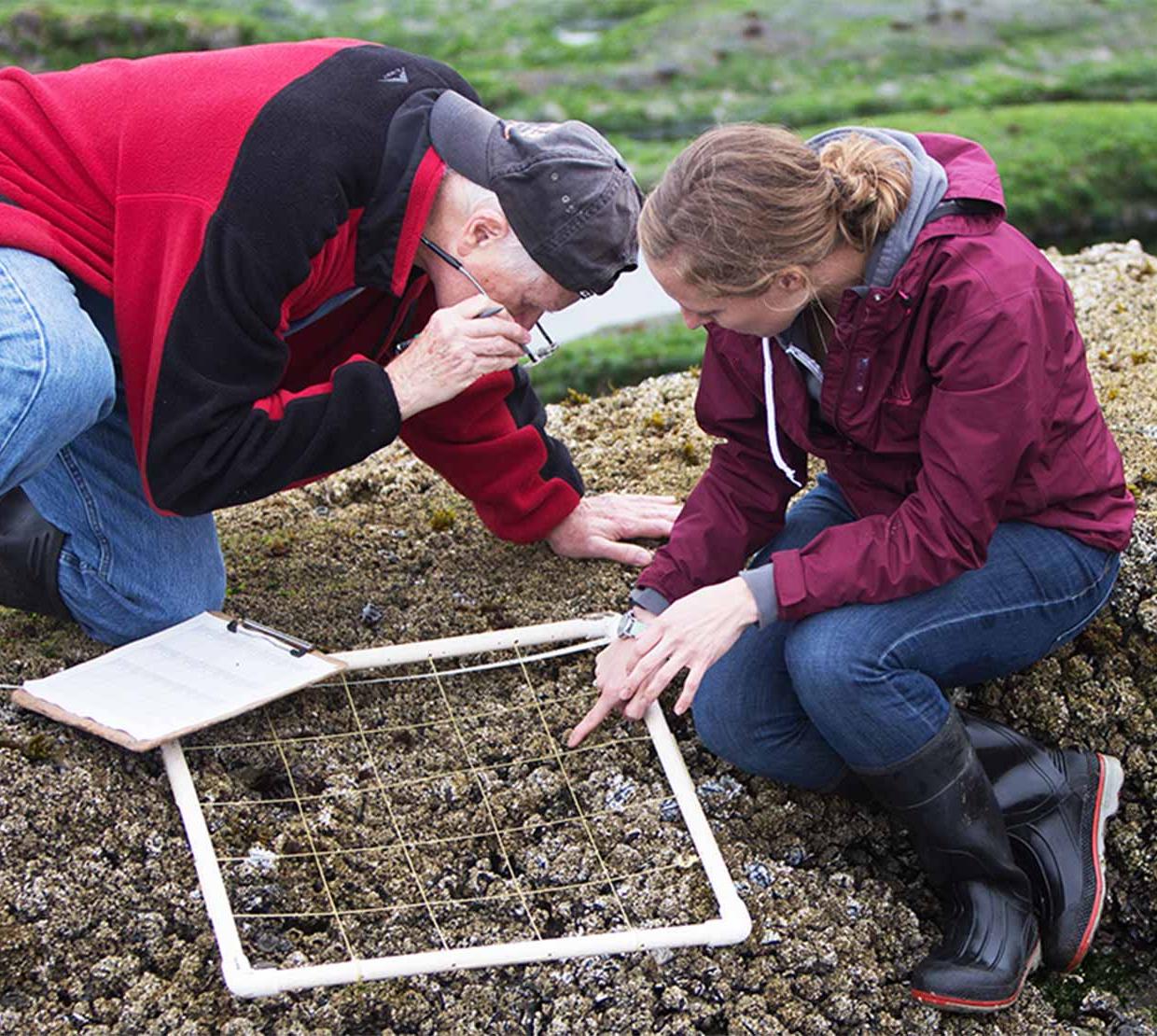
student and mentor studying section of soil

Online Environmental Sciences program ranked No.2 in country

By Srila Nayak

On campus environmental science bachelor program

“The History of Life on earth has been a history of interaction between living things and their surroundings,” writes Rachel Carson in her environmental classic Silent Spring (1962). An education in Earth’s natural and physical environments and their interrelationships is at the foundation of the top-ranked interdisciplinary Environmental Sciences undergraduate program at Oregon State.

Global warming, species extinction, air and water pollution, natural resource depletion, and renewable energy demands are rapidly changing the world we live in. These developments require the expertise and knowledge of environmental scientists who can assess, tackle and mitigate environmental challenges as well as help preserve a healthy natural environment. According to the Bureau of Labor Statistics, employment of environmental scientists is projected to increase 11 percent from 2016 to 2026.

Housed in the College of Earth, Ocean and Atmospheric Sciences, Oregon State’s online and on campus environmental sciences bachelor program is setting high standards for excellence. U.S. News & World Report features OSU in its top 40 programs for Best Global Universities for Environment/Ecology, awarding it a rank of 36 amongst similar programs worldwide.

The online program in environmental sciences was ranked No. 2 in the nation by Online Colleges in its ranking for Best Online Colleges for Environmental Science in 2018. For its rankings, Online Colleges “collected data from the National Center for Education Statistics’ Integrated Postsecondary Education Data System (IPEDS) and utilized a custom methodology to ascertain the ten best schools for environmental science in the United States.”

Students can earn an environmental sciences degree both on campus and through online courses, which are taught by Oregon State faculty, many of whom are in the College of Science. The online bachelor of science degree in environmental sciences is offered by OSU’s award-winning Ecampus. With a focus on eco-oriented programs as well as a broad swath of fields from anthropology to computer science, OSU Ecampus has racked up top place rankings in almost every prestigious survey of online degree programs. Since 2014, U.S. News & World Report has ranked OSU Ecampus in its top 10 online bachelor’s programs.

Breaking down boundaries: An interdisciplinary approach

One of the great strengths of environmental sciences at OSU is undoubtedly its interdisciplinary character. The program emphasizes the biological, physical, earth and natural sciences as well as the integration of social sciences that cover a wide range of subject areas from ethics to environmental law, policy and management.

Director of the Environmental Sciences Program Laurence Becker explains that the program offers a broad base in the sciences with a great deal of academic flexibility for students who love the environment and desire a broad exposure to both science and environmental law and policy.

An attractive feature of the program is that students can choose from one of nine options that range from studies in alternative energy and environmental science education to earth systems and environmental water resources. The most popular options are applied ecology and conservation, resources and sustainability.

In addition, the major offers two certificates: one in the popular field of geographic information science (GIS) and the other in scientific, technical and professional communication. All of the specializations are available online through Ecampus except alternative energy and environmental science education.

More often than not students discover their vocation as they experience different facets of environmental science training in this nontraditional program.

“This program allows them to remain open to different job opportunities and different areas of environmental science they are exposed to in their undergraduate career. The broad degree allows students to shift along the way if needed and many discover interests they wouldn’t have dreamed of in the beginning,” said Becker.

The science in environmental sciences

Science is a foundation for the degree because environmental studies majors need the scientific aptitude to apply complex concepts in biology, chemistry, mathematics and physics in order to understand challenging environmental issues and seek solutions. Quantitative coursework in differential, integral calculus and statistical methods prepare students to design research models and employ analytical tools to study and assess the environmental impact of development projects and businesses.

The bachelor of science degree in Environmental Sciences requires all students to complete a full year of basic science courses in biology and chemistry, as well as courses in calculus, statistics and physics.

The environmental sciences curriculum comprises many core courses that are taught in the College of Science. It offers students different specializations in the program as well as a rigorous foundation in theoretical and experimental upper-level science courses, including:

  • Ecology (BI 370), which is central to the degree program
  • Marine ecology
  • Ecological methods
  • Animal behavior
  • Human ecology
  • Conservation of marine mammals
  • Modern chemical analysis, among others.

For example, a specialization in aquatic biology comprises coursework in a diverse and exciting mix of courses in marine and invertebrate biology offered by the College of Science, oceanography in the College of Earth, Ocean and Environmental Sciences and courses in biological resources at the College of Forestry.

The strong presence of science in the basic, core and specialized components of the Environmental Sciences program enhances both its rigor and cross-disciplinary power.

Develop expertise that makes a difference to all

An experiential learning requirement offers students the opportunity to complete an environmental science related internship, research project, field course or a study abroad experience.

Becker points out that online students are encouraged to pursue internships; on-campus students often undertake research projects or internships.

The experiences often turn out to have a lasting impact on student careers, explains Becker. Students discover opportunities to pursue significant internships in the areas of hydrology, wildlife management, conservation science, biochemistry and geoscience across local and federal government agencies, research centers, environmental consulting firms and not-for-profit organizations. It is not unusual for quite a few of them to translate into longer-term opportunities and job offers.

The broad versus the narrow

Becker often meets parents of prospective students who are nervous about job prospects within a broad field of study.

“The program’s training in science and social science cultivates a broad knowledge of natural sciences with ethics and policy. We often attract students from more specialized majors such as engineering who don’t feel comfortable in a narrower choice of subjects and are motivated by a deep love for the environment.”

The most attractive feature of the degree is the wide variety of careers it throws open for graduates. Environmental scientists can work in local government, private companies, law firms, not-for-profit groups or government agencies such as the Environmental Protection Agency, the National Park Service, or the United States Geological Survey. Students also get into competitive law school programs and other graduate programs in the sciences and policy.

Due to the unique constellations of quantitative, analytical and research skills in addition to writing and communication abilities that they acquire from the interdisciplinary curriculum, environmental science students find themselves well suited to a diverse range of jobs across environmental science, policy, education and consulting firms.

“It is incumbent on us as advisors and teachers to help students find something that they are passionate about,” said Becker.

Each year Becker invites seniors and recent alumni to speak to first-year students in his Environmental Sciences Orientation class. During a recent visit, a talented environmental sciences alumnus who was also a ROTC (Reserve Officers Trainings Corps) graduate at OSU, shared insights gleaned from his professional journey.

He had easily found employment, working at positions related to the field of environmental sciences that were nonetheless very different from one another. A fourth job change landed him an enviable position in the Oregon National Guard where he leads the environmental management of their facilities.

The alumnus had a message about the enduring advantages of an environmental sciences degree: “The degree because of its breadth allowed me to apply for jobs that I hadn’t worked in.”

“Having this broad background allowed for a possibility of change when the opportunity arose,” added Becker.

Given the rising demand for experts in the field, OSU environmental scientists will be having an impact on the world around us for many decades to come.

hand writing on chalkboard

Transforming college algebra

By Srila Nayak

College of Science mathematics faculty are replacing the traditional classroom model to improve student success in introductory algebra courses through technology, new active learning approaches and measurement of student performance and understanding. These have improved retention, performance and student engagement in 100- and 200-level mathematics classes at OSU.

The greatest need: Teaching innovations in college algebra

Failure rates in College Algebra courses are high across the country and present significant barriers to earning STEM degrees because mathematical sciences courses in the first two years of college function as pathways for many different science and engineering majors. According to a report, "Common Vision" from the Mathematical Association of America (MAA), 50 percent of students earn a grade lower than C every year in the United States. This sort of poor performance in gateway or general introduction courses such as college algebra not only has a hugely detrimental effect on students' performance in their first two years of college, but also has lasting negative repercussions beyond college, since failure to obtain a degree in science or engineering prevents graduates from getting higher paying jobs.

Finding the status quo unacceptable, universities and colleges are pushing forward with large-scale implementation of modern instructional and delivery methods. Modernized pedagogy in mathematics departments currently involves using innovative instructional technology that enhances learning in ways not supported by the traditional classroom. And for good reason. The same MAA report finds that "failure rates under traditional lecture are 55 percent higher than the rates observed under more active approaches to learning."

Through the use of adaptive courseware—a personalized learning tool that students can use to review, practice and develop the requisite mathematical skills for a particular course—mathematics instructors have implemented bold new solutions that will help OSU students succeed in math.

OSU is one of just eight universities awarded funding from a Gates Foundation grant through the Association of Public and Land-Grant Universities (APLU). This grant supports the implementation of adaptive courseware in high enrollment general education courses, including College Algebra/Math 111.

Mathematics instructors Sara Clark, Scott Peterson, Lyn Riverstone, Dan Rockwell, Katy Williams, David Wing and Elizabeth Jones of the Equal Opportunities Program--known as Team Math--spent more than 300 hours across several months working together to re-design College Algebra. To ensure the use of best practices that lead to student success, the team worked closely with OSU’s Center for Teaching and Learning, Ecampus, Academic Technologies and the Academic Success Center, and engaged numerous instructors in biology, physics and chemistry who are models of innovative practice. The team piloted the redesign in five sections of Math 111 in spring term 2017.

Comparative results from Fall 2016 to Fall 2017 are encouraging, revealing clear drops in DFWU rates (grades of D, F, Withdrawal or Unsatisfactory) in both Math 103 (Algebraic Reasoning) and Math 111 (College Algebra).

  • MTH 111 (Corvallis): 34.9% to 27.5% (7.4% drop)
  • MTH 111 (online): 67.3% to 43.9% (23.4% drop)
  • MTH 103 (Corvallis): 32.9% to 19.3% (13.6% drop)

The videos below feature members of Team Math describing the process and experience of the Math 111 redesign.

College Algebra Redesign with Adaptive Courseware: A Blended, Active, and Adaptive Course

College Algebra Redesign with Adaptive Courseware: The Course Redesign Experience

There was a healthy precedent for introducing innovations to the teaching of college algebra. Instructor Sara Clark, with the help of a Digital Learning Award from the Bill and Melinda Gates Foundation-supported Online Learning Consortium, has already implemented a similar online adaptive program in her developmental math courses and obtained highly successful results.

Online learning platform

Adaptive courseware in Math 111 involved using Learning Catalytics, a web-based student response tool, and Assessment and Learning in Knowledge Spaces (ALEKS), an adaptive courseware platform. These tools allow instructors to adapt to student needs both inside and outside of class.

Students can register for Learning Catalytics right from their smartphones, iPad, tablets or laptops. Learning Catalytics acts as a type of clicker that tabulates responses to problems posed in class. As with a traditional clicker system, Learning Catalytics allows for multiple choice, short or long answer types of questions, but also includes graph sketching, ranking, and mathematical expressions.

Learning Catalytics helps the instructor monitor student responses to questions and determine where they are struggling with the help of real-time analytics. Instructors also use the software to promote interaction by grouping students who have different answers. The result is a highly energized class excited by mathematical challenges.

“We were inspired to adopt this tool after visiting Physics Instructor KC Walsh’s class,” said Riverstone. “He teaches in a big lecture hall and the class just explodes. Students turn around, face each other and start discussing the question. There is a lot of problem-solving, discussion, critiquing and mutual guidance.”

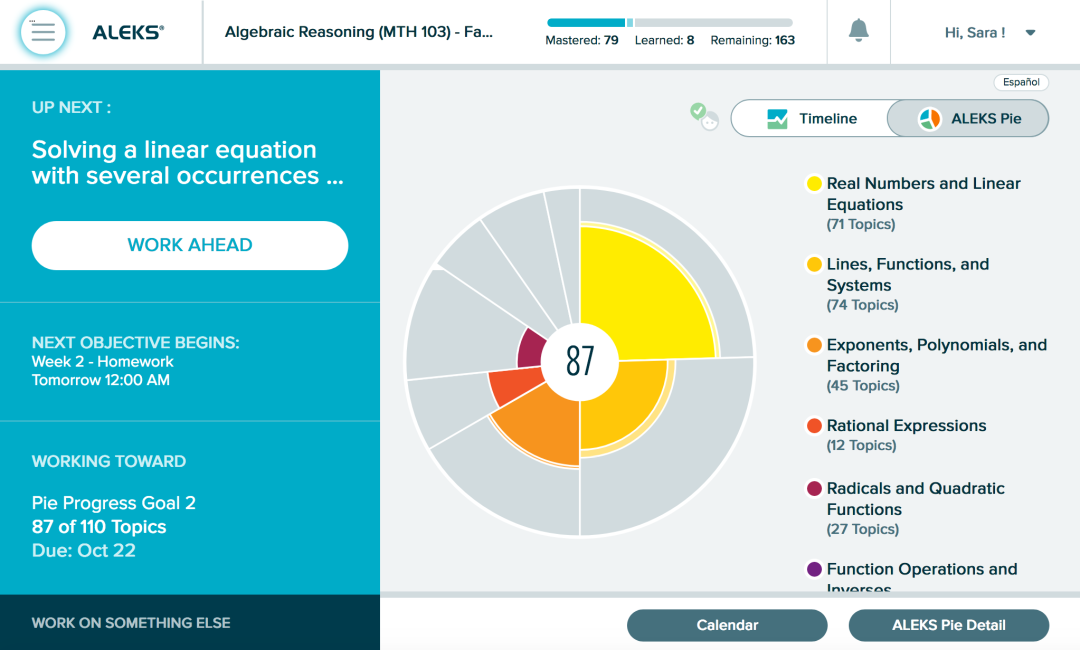
ALEKS is the adaptive courseware that students use outside of class to check on their prerequisite knowledge and get up to speed on the topics they need to be successful in class. ALEKS provides individualized pathways for students to learn foundational content through an initial knowledge check and regular assessments throughout the term to learn what each student knows, and then supplies explanations and practice exercises only on content the student is ready to learn. Students who already know a topic will not need to relearn it in ALEKS, whereas students who are struggling will first work through any prerequisites needed to be successful on the more difficult topic.

Math 103 ALEKS

Students can view their progress in this pie chart. Colored areas represent mastery and gray areas indicate concepts that need work.

"Through the use of these new adaptive tools, we’re trying to more effectively meet each student where they are, to facilitate that connection between a new concept and the individual understanding the student comes in with,” Riverstone explained.

By supporting progressive, incremental learning and timely knowledge on strengths and weaknesses, ALEKS becomes a valuable component of overall course experience. Students can come to class prepared to work in teams for supported, intensive problem solving.

“Numerous studies have shown that students don’t learn by passively listening to lectures. Students learn by constructing the knowledge themselves through active learning exercises," Riverstone stated.

Additional strategies, such as a modeling project designed by mathematics doctoral student Emerald Stacy, inspired students to work on interesting real–world data sets to understand the uses of specific algebraic functions and their practical relevance.

Riverstone and team are developing new syllabi structured around adaptive courseware for fall courses in Algebraic Reasoning and Elementary Functions.

In class evaluations, students responded positively to the class and its innovative pedagogical tools and structures. They reported more confidence in their ability to understand and apply algebraic concepts as well as an increased enjoyment of mathematics.

“I gained insight into what I might want to do with my life. I have been considering going into education and I might focus on math,” wrote one student. Another mentioned, “This class was engaging, interactive and educational—and packed into a ‘math support system.’ There never was a dull moment.”

“We heard a lot of things from students that we wouldn’t have heard before in the algebra class,” said Riverstone.

Subscribe to Teaching Innovation