Mathematics

Mathematics

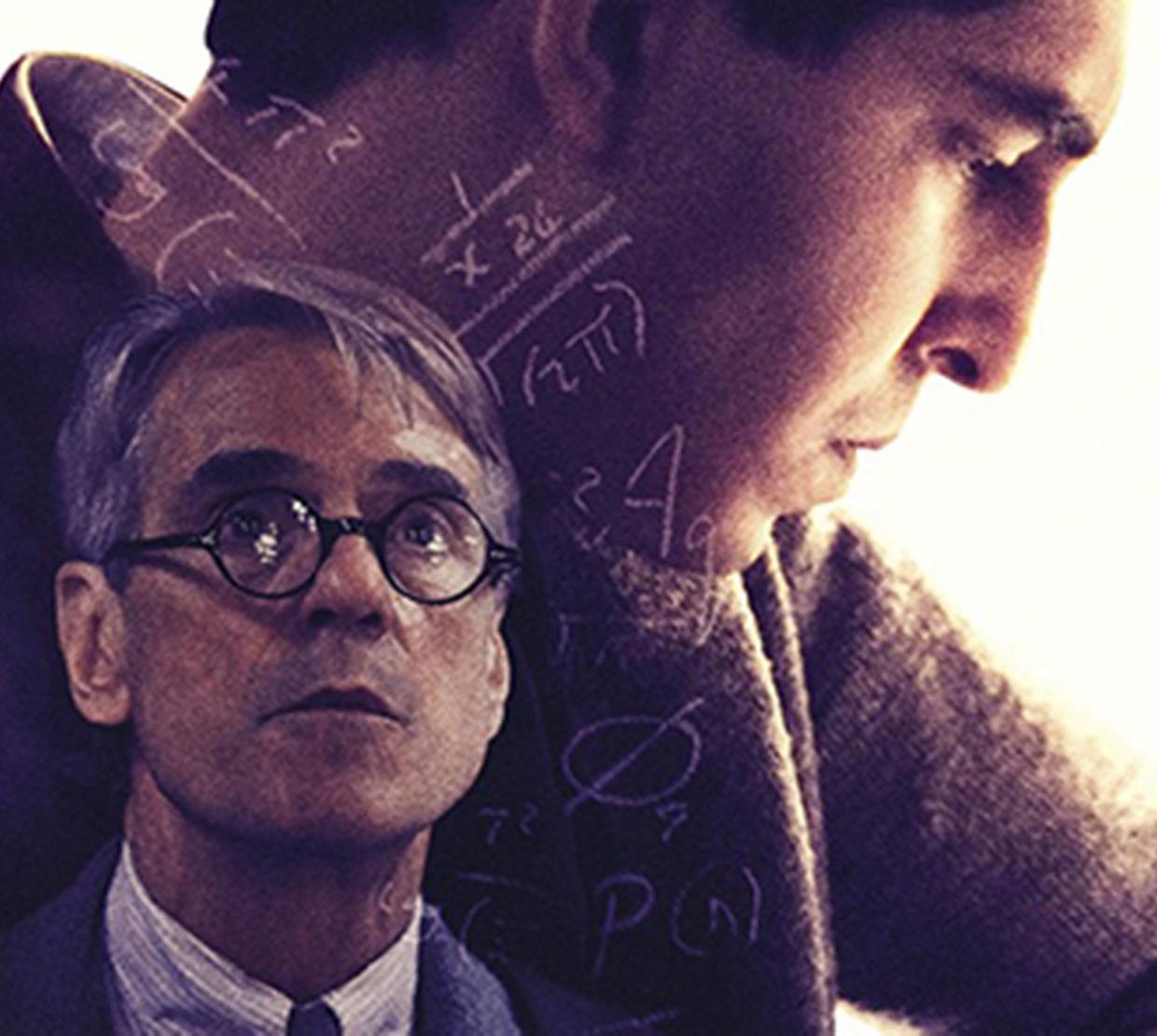
The man who knew infinity movie poster

Free movie, dinner and discussion: The man who knew infinity

The man who knew infinity screening

The College of Science will treat mathematics, physics and statistics students and faculty to an evening of movie, dinner and a Skype discussion with OSU alumnus (BS & MS '60) and world famous mathematician, Dr. George Andrews on Thursday, May 26. The group will watch "The Man Who Knew Infinity" the recently released biographical drama film on the life of Indian mathematical genius, Srinivasa Ramanujan at Darkside Cinema at 3:30 pm.

The film portrays the relationship between Ramanujan and University of Cambridge number theorist G.H. Hardy in the early 1900s and Ramanujan's experiences with English racism during his visit to Trinity College.

After the movie, the College of Science will host a 45-minute Skype discussion with professor Andrews, who is the Evan Pugh Professor of Mathematics at Pennsylvania State University and a member of the National Academy of Sciences. Among his many towering mathematical achievements, Andrews is perhaps best known for his work on Ramanujan's "Lost Notebook" as it is called in the mathematical community.

A few months before he passed away, Ramanujan had spoken about his new work on theta functions which physicists use in their study of the heat equation. However, he didn't leave behind any published work on the subject and nothing more was known about his contributions to this branch of mathematics until Andrews' amazing find.

Andrews discovered Ramanujan's "Lost Notebook" in a library of Trinity College, Cambridge in 1975. Excitedly leafing through the 100-odd loose pages, Andrews found they contained 600 equations in all—revolutionary mathematical findings on mock theta functions—of which only a fifth had been independently discovered in the years after Ramanujan's death in 1920. In the decades following his discovery, Andrew has co-authored several books that provide proofs of most of the theorems listed in "the Lost Notebook."

Delicious pizza will be served during the discussion. The movie and discussion will give students a renewed appreciation of the human dimensions of mathematics and a fascinating peek at the history and legacy of twentieth-century mathematics.

Mathematics, physics and statistics students and faculty can click here to RSVP today

Source: http://www.pnas.org/content/102/13/4663.full

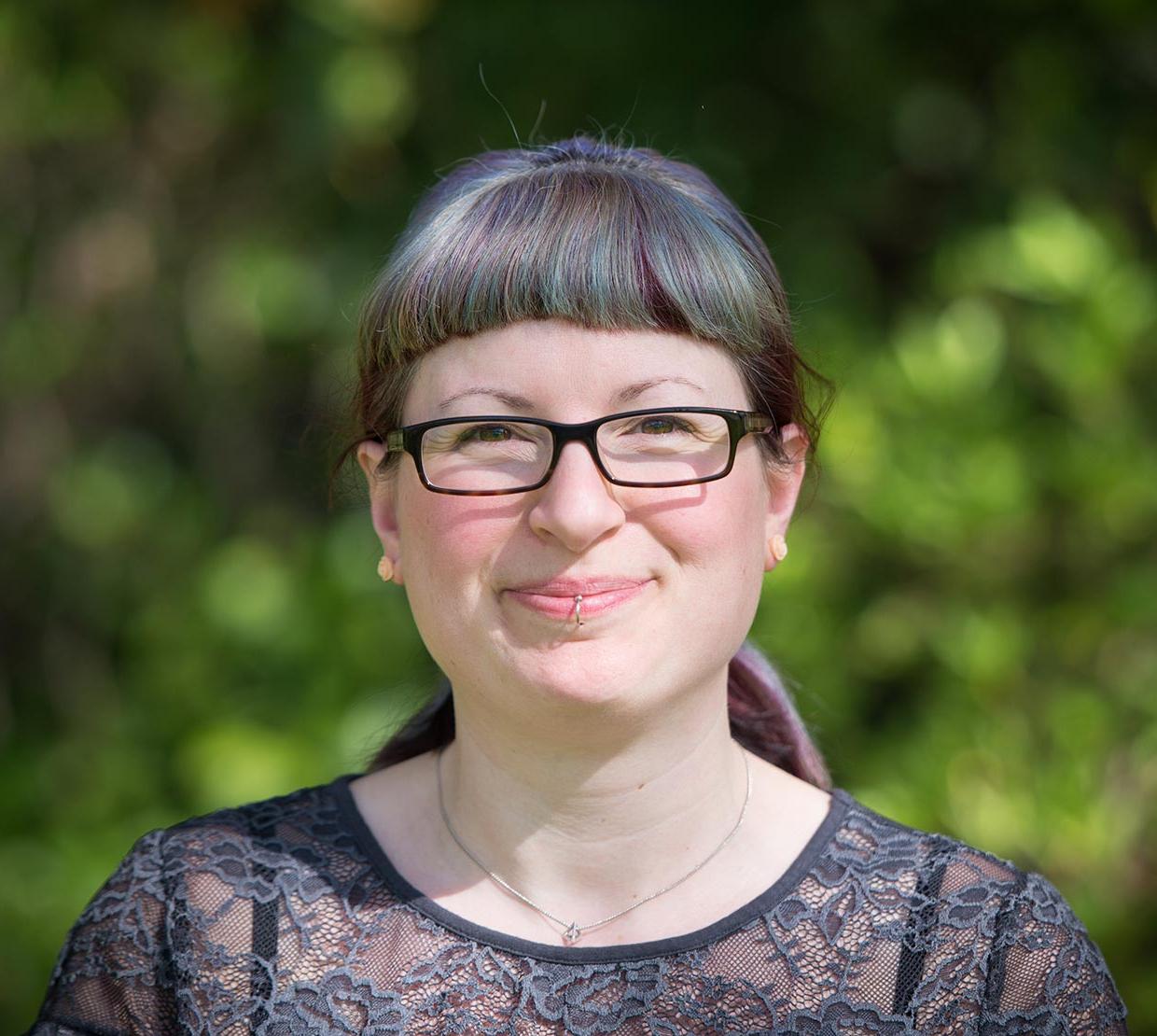
Holly Swisher standing in front of shrubbery

Massive online database lays foundation for mathematics of the 21st century

Holly Swisher, associate professor of Mathematics

An international team of mathematicians that includes Holly Swisher, associate professor of Mathematics, has released a massive mathematical database that catalogs objects of central importance in number theory and maps out the intricate connections between them.

The “L-functions and Modular Forms Database,” or LMFDB, serves as an atlas of mathematical functions and other objects, and also reveals deep relationships in the abstract universe of mathematics.

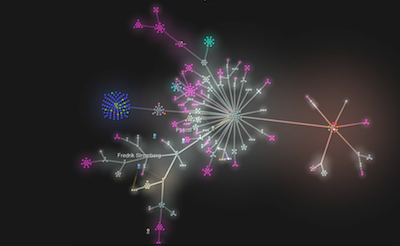
3D model of web system

Collaborations in 21st century-style: This time-lapse video illustrates the collaborations and contributions between the 70 mathematicians around the world as they access and modify files over a 5-year time period. There is a flurry of activity when there is a workshop. Photo credit: LMFDB.org

By coordinating efforts, researchers have made these relationships visible by developing new algorithms and performing calculations on an extensive network of computers. Free and open source, the database is accessible online for anyone to use to learn and discover uncharted mathematical worlds.

The team includes over 70 mathematicians from 12 countries and more than a dozen research areas. They represent a range of institutions including the American Institute of Mathematics; Arizona State University; University of California, San Diego; MIT; Oregon State University; University of Vermont; University of Vienna, Austria; University of Warwick, UK; and others.

Swisher has been a member of the project since its first official workshop in Paris during the fall of 2010. Work on the database generally happens during weeklong workshops where participants cycle between individual work, small group teamwork and large group discussions. The group has no leader—all decisions are made by consensus at workshop meetings.

The quantity and depth of data is staggering. The LMFDB tabulates data which has been produced over many decades, and which is now available in one place in a unified format. Hundreds of CPU years of computing time were involved in compiling the database along with thousands of hours of human effort.

“Many of us have made extensive computations, and we wanted to make this data available to other researchers and to link these projects together to aid mathematical progress,” said project member John Jones of Arizona State University. “By joining forces, we now have a site for one stop shopping of big data.”

Many of these calculations are so intricate that only a handful of experts can do them, and some computations are so big that it makes sense to only do them once. For example, a recent computation by Andrew Sutherland at MIT used 72,000 cores of Google's Compute Engine to complete in hours a tabulation that would have taken more than a century on a single computer.

The application of large-scale cloud computing to conduct research in pure mathematics is just one of the ways in which the project is pushing the frontier of mathematics forward. Large-scale computer experiments now take the place of computations by hand or with a calculator, which is rapidly speeding up the process of testing and discovery.

"We are mapping the mathematics of the 21st century,” says LMFDB project member Brian Conrey, director of the American Institute of Mathematics.“ The LMFDB is both an educational resource and a research tool which will become indispensable for future exploration."

LMFDB project member John Voight, an associate professor of mathematics at Dartmouth, notes: "Our project is akin to the first periodic table of elements. We have found enough of the building blocks that we can see the overall structure and begin to glimpse the underlying relationships.”

Similar to the periodic table, fundamental objects in mathematics fall into categories with names like L-function, elliptic curve, and modular form. Elliptic curves, which arise naturally in many parts of mathematics and are described by simple cubic equations, form the basis of cryptographic protocols used by most major Internet companies, including Google, Facebook and Amazon.

Modular forms are more mysterious objects—complex functions with an almost unbelievable degree of symmetry. Elliptic curves and modular forms are connected via their L-functions. The remarkable relationship between elliptic curves and modular forms is just one example of connections made fully explicit in the LMFDB, where one can travel from one world to another with the click of a mouse.

L-functions are like DNA, and mathematical objects are related when they have the same DNA. Continuing the analogy, sequencing the human genome becomes more valuable when you have sequenced a diverse group of people throughout the population. LMFDB is at the point of having sequenced many genomes.

These broad categories of fundamental objects in mathematics naturally divide into smaller subcategories, each with its own personality. Every object has connections to objects in other categories, which project members refer to as its “friends.”

One of the major goals of the project is to determine the “friend” network and to understand how the quirky behavior of a particular object can influence its “friends.” The database provides a coherent picture of this web of mathematical relationships.

“The LMFDB is really the only place where these interconnections are given in such clear, explicit, and navigable terms,” OSU’s Swisher said. “Before our project it was difficult to find more than a handful of examples, and now we have millions.”

The database has been funded by the National Science Foundation; the United Kingdom’s Engineering and Physical Sciences Research Council; the American Institute of Mathematics; the EU 2020 Horizon Open DreamKit Project; and the Institute for Computational and Experimental Research in Mathematics.

The official of the LMFDB was released on May 10 at public lectures occurring at the American Institute of Mathematics, Dartmouth College and University of Bristol. Read more online at AIMath.org.

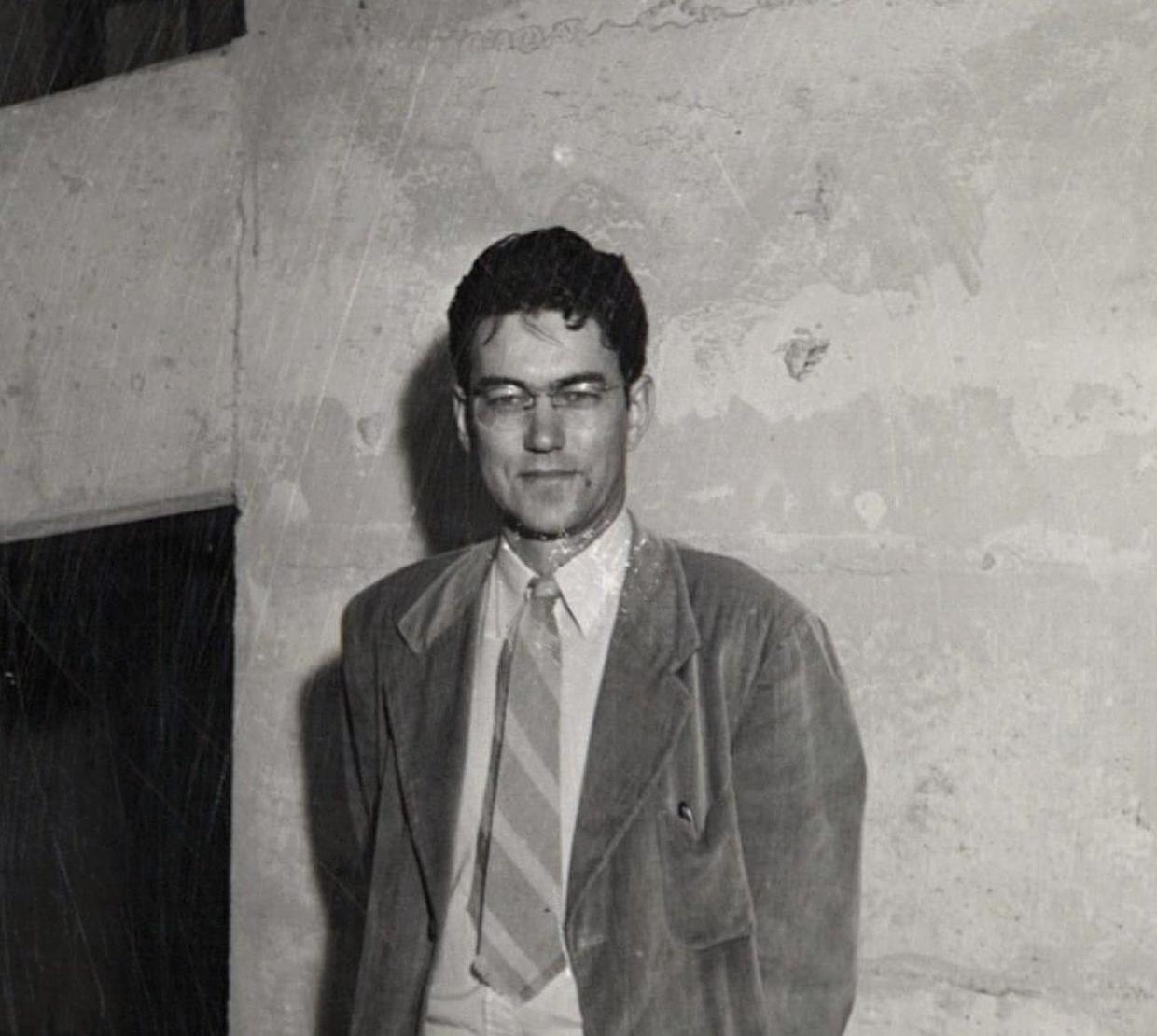
Vintage black and white picture of Arvid T. Lonseth in front of concrete wall

Lonseth Lectures: A deep commitment to mathematical education

Photo credit: Courtesy of Special Collections and Archives Research Center, Oregon State University Libraries.

The Lonseth Lecture Series was established in 1985 to honor Arvid T. Lonseth, Professor Emeritus and former chair of OSU's Mathematics Department. A superb and devoted scholar and teacher of mathematics, Dr. Lonseth joined OSU’s Mathematics Department in 1948 and served as department chair from 1954-68. The lecture series is a testimony to his deep commitment to the mathematical education of students, especially undergraduates.

One of his former students from the late 1950s, Judy Allen, devoted a chapter in her 2012 memoir to him, saying the "non-gender-biased dear man" inspired and mentored her and ultimately changed her life. Married at 18 and mother of three children by 22, she was majoring in Home Ec but longed to study math and computer science. Dr. Lonseth saw that she pursued her dreams.

This happened over tea at the Azalea House, a coop house for Home Ec majors, when students invited their favorite professor to tea. Lonseth was the only man at the tea party.

Setting his teacup on a side table, he bent down to look in Judy's face. “You’re very good at math. That should be your major.” Read more of her reflection of Dr. Lonseth.

Dr. Lonseth earned his B.A. in mathematics at Stanford University and his Ph.D. at the University of California, Berkeley, in 1939. His research was focused on integral equations, the calculus of variations, and computational methods.

The Department of Mathematics holds its Annual Lonseth Lecture Series spring term. Prior to the lecture, the department celebrates the achievements of undergraduates, graduates, and faculty with its annual Mathematics awards ceremony.


Read more stories about: mathematics


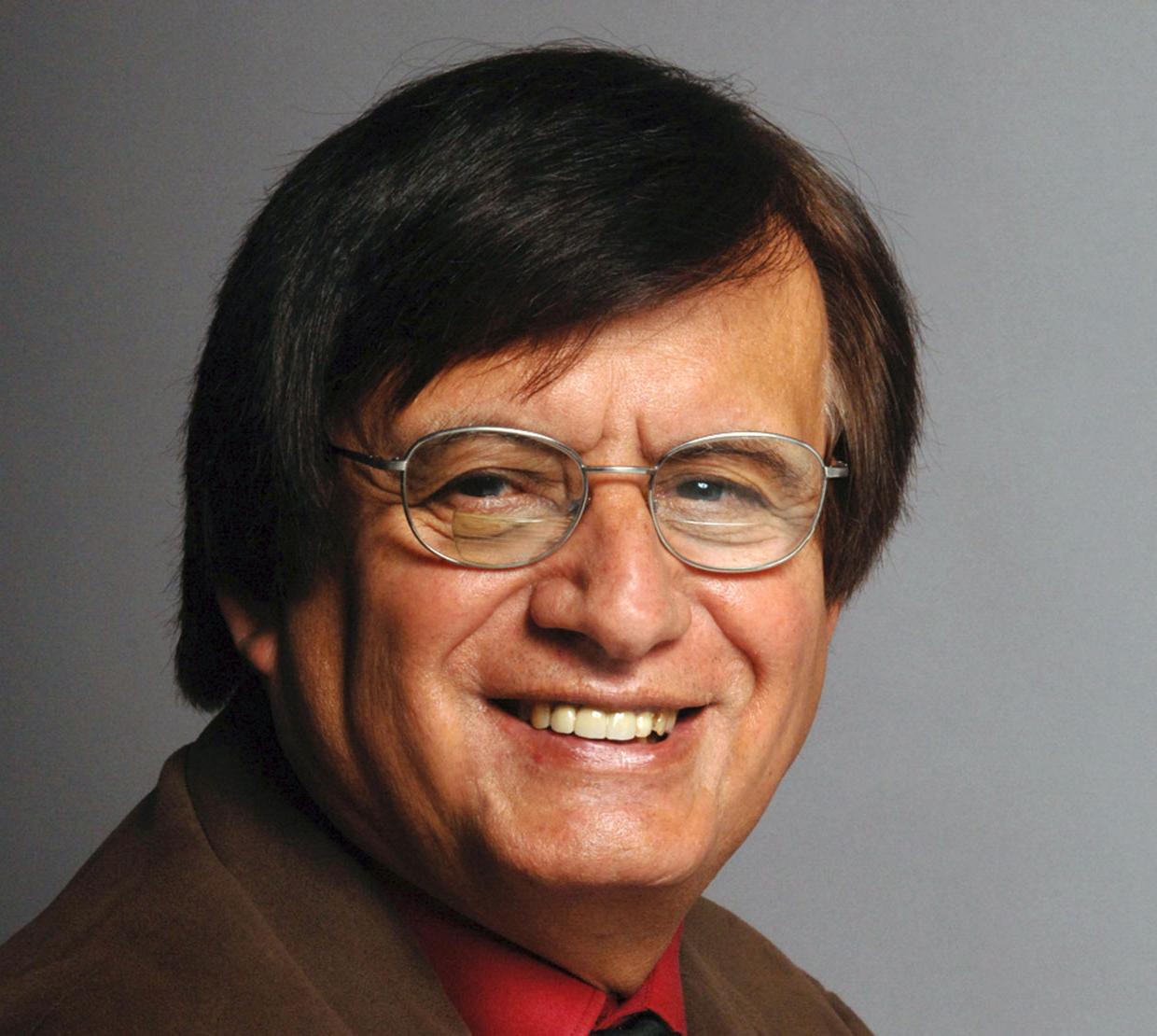
Richard Tapia in front of grey backdrop

Renowned mathematician uses math to enhance his personal life

Richard Tapia, professor in mathematics at Rice University

The College of Science welcomes renowned mathematician Richard Tapia who will present a public science lecture entitled, "Using Mathematics to Enhance My Personal Life," for faculty and students. The event will be held May 11 at 3:00 pm in Snell International Forum at 2150 SW Jefferson Way on campus. REGISTER here. Dr. Tapia is a University Professor in Rice University’s Computational and Applied Mathematics Department, the university’s highest academic title awarded to only seven faculty in its history.

For many years, Dr. Tapia was involved in BMX bicycle racing as a supportive father for his son. He will kick off his talk using several lively videos to identify and illustrate what he calls the "Curse of Lane 8" or "The Fair Lane Assignment Problem in BMX Bicycle Racing." Next, he will use his mathematical training to formulate the issue as a mathematical problem and then solve the problem using a computer while describing the solution technique.

In the second part of this talk, Dr. Tapia will show and describe how he made a riveting video with the help of a dual art and math undergraduate at Rice University that ended up accompanying him as he showed his 1970 Chevelle Malibu SS at car shows across the country. Both the car and video are named, “Heavy Metal.” Check out an interview of Dr. Tapia at the Detroit Autorama 2008.

1970 Chevelle in front of grey backdrop

Dr. Tapia’s 1970 Chevelle SS, “Heavy Metal”

The video depicts the late 1960’s and early 1970’s, an era marked by muscle cars, heavy metal music and social rebellion. The psychedelic images in the video were constructed entirely using mathematics. Numerical simulations of fluid in and around the car were developed using numerical methods to solve the Navier-Stokes partial differential equations that govern fluid flow.

By being creative with the mathematical parameters and solution techniques, Tapia and the student created some highly striking and interesting images and patterns. Using video, they were able to demonstrate that mathematics can take us places where physics can’t.

Dr. Tapia is the 2011 awardee of the National Medal of Science, the highest honor bestowed by the U.S. government on scientists and engineers. He has received the National Science Board’s Vannevar Bush Award, has been elected to the National Academy of Engineering--the first Hispanic to receive these honors, and has served on the National Science Board from 1996-2002.

In 1990, the National Research Council named Tapia one of the 20 most influential leaders in minority mathematics education in the country. Later that year, he received the Hispanic Engineer National Achievement Award for Education from Hispanic Engineer.

Internationally recognized for his research in the computational and mathematical sciences, Dr. Tapia is also Director of Rice University’s Center for Excellence and Equity in Education. He has also been featured in a video promoting the Society for the Advancement of Chicanos and Native Americans in Science (SACNAS).

"Professor Tapia and late professor Blackwell are two folks whom I admire, first for their excellence in mathematics and statistics, and second for their leadership in enhancing diversity--two of our College's core values," said Sastry G. Pantula, dean of the College of Science.

"The Blackwell-Tapia conferences, named after these two leaders, have a great impact on building diverse leaders in science. The OSU community is in for a treat. We can all learn a lot from Dr. Tapia's experiences."

The renowned mathematician holds honorary doctorates from Carnegie Mellon University, Colorado School of Mines, University of Nevada, and Claremont Graduate University. He also has two professional conferences named in his honor: the Richard Tapia Celebration of Diversity in Computing Conference and the Blackwell-Tapia Mathematics Conference.

Dr. Tapia presents the Mathematics Department’s 31st annual Lonseth Lecture May 10 at 4:00 pm in LaSells Stewart Center, Construction & Engineering Hall, following the annual Mathematics Awards ceremony at 3:30 pm. This scientific talk, “The Remarkable Journey of Isoperimetric Problem: From Euler to Steiner to Weierstrass,” will offer an overview of the history of the impactful isoperimetric problem. A reception will follow the events.

wooden cube on a table with math homework

Mathematician and former drag racing champ talks diversity

Richard Tapia to present “Building a Culture of Diversity in Higher Education: Obstacles and Successes.” lecture

The College of Science welcomes renowned mathematician and champion of underrepresented minorities in the sciences Richard Tapia to present a lecture on diversity for STEM leaders and faculty across campus entitled, “Building a Culture of Diversity in Higher Education: Obstacles and Successes.” He will deliver this invitation-only lunch event in Centro Cultural Cesar Chavez May 11 at noon.

Dr. Tapia is a University Professor in Rice University’s Computational and Applied Mathematics Department, the university’s highest academic title awarded to only seven faculty in its history.

Richard Tapia in front of grey backdrop

Dr. Richard Tapia, Mathematics Professor at Rice Univeristy

Internationally recognized for his research in the computational and mathematical sciences, Dr. Tapia is also a national leader in the preparation of women and underrepresented minority doctoral degree recipients in science, engineering, and mathematics. His leadership has greatly contributed to Rice University’s national recognition and success in the area of diversity in STEM.

The mathematician is also Director of Rice University’s Center for Excellence and Equity in Education. He has also been featured in a video promoting the Society for the Advancement of Chicanos and Native Americans in Science (SACNAS).

Extreme growth in the nation’s Hispanic population, primarily Mexican American, is forcing educational challenges at a crisis level for the country. Dr. Tapia’s will discuss the importance of finding ways to incorporate this growing population into mainstream of scientific and technical endeavors.

Facing challenges throughout his own journey—from being born in Los Angeles to parents who immigrated from Mexico to being a first generation college graduate to his trip to the White House where he received the 2011 National Medal of Science from President Obama, Dr. Tapia will discuss how these experiences shaped him as a leader in underrepresentation issues at the campus, state, and national levels.

"Professor Tapia and late professor Blackwell are two folks whom I admire, first for their excellence in mathematics and statistics, and second for their leadership in enhancing diversity--two of our College's core values," said Sastry G. Pantula, dean of the College of Science.

"The Blackwell-Tapia conferences, named after these two leaders, have a great impact on building diverse leaders in science. The OSU community is in for a treat. We can all learn a lot from Dr. Tapia's experiences."

Dr. Tapia will address the successes and failures of the nation’s universities in the representation of Hispanics at the undergraduate, graduate, and faculty levels in science, engineering, and mathematics. He will explore the role mathematicians play in contributing to the misrepresentation of Hispanics and diversity recruitment and retention challenges.

Dr. Tapia is the 2011 awardee of the National Medal of Science, the highest honor bestowed by the U.S. government on scientists and engineers. He has received the National Science Board’s Vannevar Bush Award, has been elected to the National Academy of Engineering--the first Hispanic to receive these honors, and has served on the National Science Board from 1996-2002.

In 1990, the National Research Council named Tapia one of the 20 most influential leaders in minority mathematics education in the country. Later that year, he received the Hispanic Engineer National Achievement Award for Education from Hispanic Engineer.

The renowned mathematician holds honorary doctorates from Carnegie Mellon University, Colorado School of Mines, University of Nevada, and Claremont Graduate University. He also has two professional conferences named in his honor: the Richard Tapia Celebration of Diversity in Computing Conference and the Blackwell-Tapia Mathematics Conference.

2016 Lonseth Lecture

Dr. Tapia presents the Mathematics Department’s 31st annual Lonseth Lecture May 10 at 4:00 pm in LaSells Stewart Center, Construction & Engineering Hall, following the annual Mathematics Awards ceremony at 3:30 pm. This scientific talk, “The Remarkable Journey of Isoperimetric Problem: From Euler to Steiner to Weierstrass,” will offer an overview of the history of the impactful isoperimetric problem. A reception will follow the events.


Read more stories about: events, diversity in science, mathematics


3D model of ocean systems

Next generation of scientists to manage ocean systems

Big Data to analyze effects of human activities and climate change on oceans

A transdisciplinary team in our College was awarded $3 million to implement the National Science Foundation (NSF) Research Traineeship at Oregon State. The program encourages the development of bold and transformative models for graduate education in STEM fields.

The proposal, “Risk and uncertainty quantification in marine science and policy,” prepares a new generation of natural resource scientists and managers to study, protect, and manage ocean systems.

NSF chose OSU to develop the program, which focuses on the use of “big data” to analyze and understand the effects of human activities and climate change on the ocean system around the world. It also requires students to look at the impact of potential management decisions on the stakeholders – the fishing industry, for example – as well as the environment.

Requiring students to work across disciplines is what they’ll encounter in the working world, said Sastry Pantula, dean of the College of Science, which is actively involved in the new program.

“Solving major complex issues related to climate change, marine studies and risk assessment requires people to have a diversity of expertise to work together,” Pantula said.

“No single person has expertise in all sciences, mathematics and statistics. Bringing an interdisciplinary cohort together will enhance depth in core areas, breadth of communication across various fields, and strength in statistical and computational skills. This program takes advantage of the unique collaborative spirit of OSU.”

Mathematics professor Juan Restrepo and statistics professor Alix Gitelman are leading the NRT program as co-principal investigators in a collaborative effort with researchers across OSU; mathematics professors Enrique Thomann and Ed Waymire are core members of the team.

Aimed at advancing graduate education training in STEM, the program emphasizes the use of big data and mathematical and statistical models to address climate and policy problems in marine systems.

The program will provide for more than 30 fellowships for OSU master’s and doctoral students, with room for an additional 30 students if they have alternative funding. The students and participating faculty will decide on the projects. Read more.

Math and science

NSF awards $1.39M for math and science teaching fellows

Math and Science teaching fellows receive NSF awards

A Noyce Teaching Fellows project recently received a 6-year grant from the National Science Foundation to provide support for 16 teaching fellows to complete a Master's degree program in secondary mathematics or science education at Oregon State University. The project will also provide teaching fellows with professional development and support during their first four years of teaching in high needs schools.

The Ambitious Math and Science Teaching Fellows project provides research-based teacher preparation courses and clinical experiences, professional development and support for teacher retention. The project seeks to promote teacher learning instructional practices that support every student, across racial, ethnic, gender, and linguistic boundaries.

Mathematics professor Thomas Dick in the College of Science is the and principal investigator (PI) and mathematics education associate professor Rebekah Elliott and science education assistant professor SueAnn Bottom both in the College of Education are co-PIs. OSU’s Graduate School is also providing the teaching fellows with significant tuition support.

In 2014, Education Week reported that Oregon ranked 40th among all states for academic achievement, measured largely by student reading and math scores on a national exam given to a sampling of students in all states. Oregon scores on the National Assessment of Educational Progress have stagnated over the past decade while most other states have recorded a lot of progress; and Oregon's low-income students have been left far behind.

An earlier NSF Noyce-funded project---Dick and Elliott were the PIs on that project--supported four teaching fellows who completed their initial licensure in mathematics and several master teaching fellows in mathematics. The new project has a greater emphasis on developing new teachers and includes both math and science education.

“These fellows will have a tremendous long-term impact on future generations of teachers and students,” said Sastry G. Pantula, Dean of the College of Science at OSU. “We are extremely grateful to our state congressional representatives for supporting science and NSF. It is having and will have a tremendous impact on Oregonians.”

The project will be implemented in partnership with the Mid-Valley Math and Science Network, and school districts supporting OSU teacher candidates, and those districts hiring the Noyce Teaching Fellows after completing their licensure programs.

“Research in the College in collaboration with the Department of Mathematics is growing knowledge about teaching practices that will act as a model for improving and enriching the experience students have in math classes,” said Larry Flick, Dean of OSU’s College of Education.

Fellows will be introduced to the foundations of this ambitious teaching model (high leverage teaching practices, equitable instruction, and discipline-specific practices) during the master’s program and use these foundations in the classroom. Investigators hypothesize that the ambitious teaching model will be especially effective in STEM classrooms in high-needs schools.

The Ambitious Math and Science Teaching Fellows project will be evaluated by assessing fellows’ progress in terms of mathematical quality of instruction and formative teaching observation. Results and resources developed through this work will be disseminated through the Mid-Valley Math Science Teaching Network, an established online network of Oregon teachers and administrators, and at meetings of the Teachers of Teachers of Mathematics.

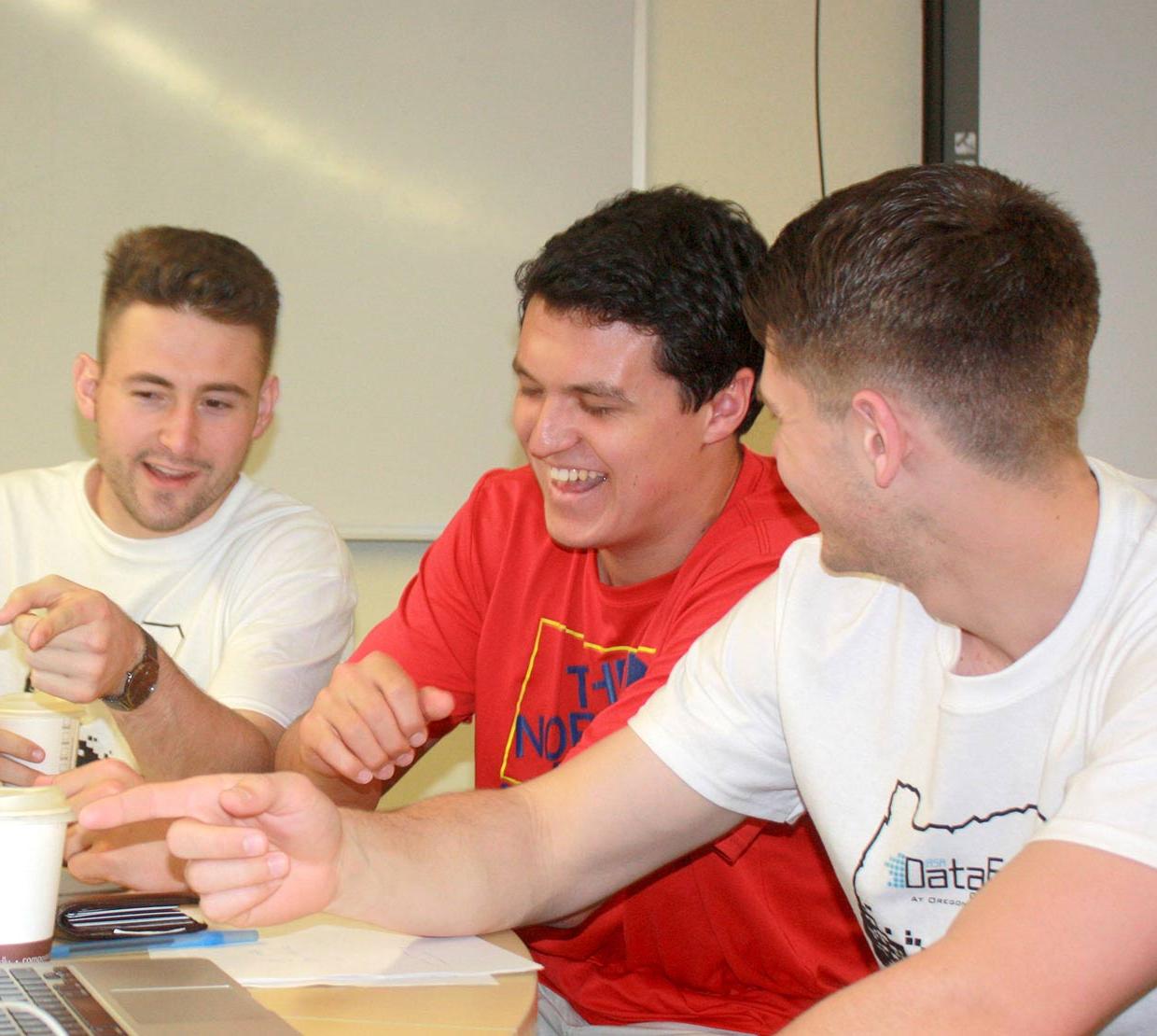
Male students interacting with data fest booth

DataFest Oregon delivers mind-numbing fun

The American Statistical Association’s Datafest

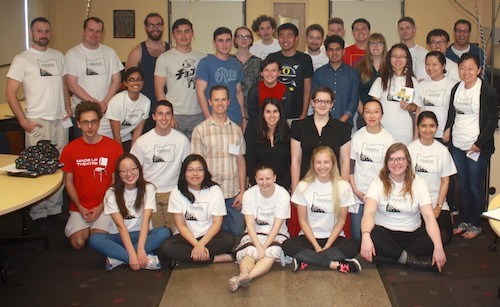
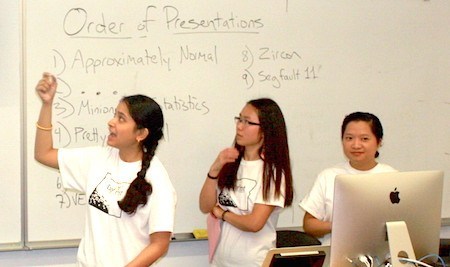
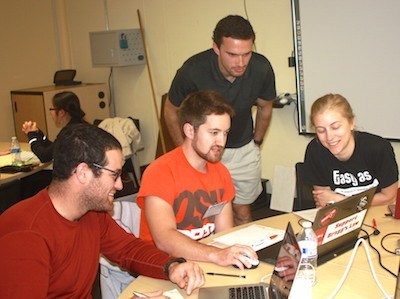
The American Statistical Association’s Datafest, a nationally coordinated data analysis competition that brings together the data science community, was held at Oregon State University April 15-17, 2016. Nine teams comprising 37 students and faculty from OSU, University of Oregon and Reed College matched up in data competitions and learned more about data science and statistics than you might think is humanly possible in one weekend.

The competitions kicked off at 7:30 pm Friday, April 15 in Weniger Hall and continued through Sunday, April 17 at 4 pm. Students came prepared with laptops locked and loaded with data analysis software and tools.

DataFest Oregon is a celebration of data in which teams of undergraduates work around the clock to find and share meaning in a large, rich, and complex data set. It’s a good way to meet other students interested in data.

Undergraduate and graduate students did the work, working under pressure as part of a team and examined their own critical thinking processes, with assistance from a cadre of roving consultants, including graduate students, faculty, and industry professionals.

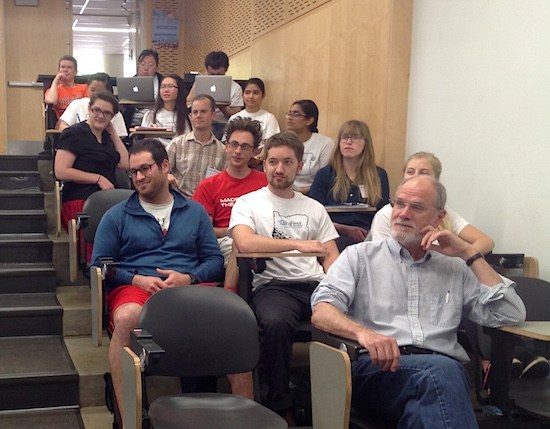
After two days of intense data wrangling, analysis, and presentation design, each team developed a mere two presentation slides in just a few minutes in hopes of impressing the panel of judges.

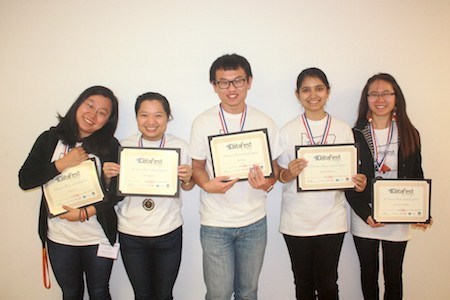
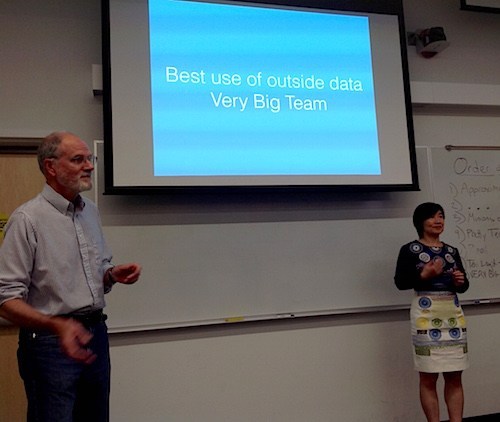
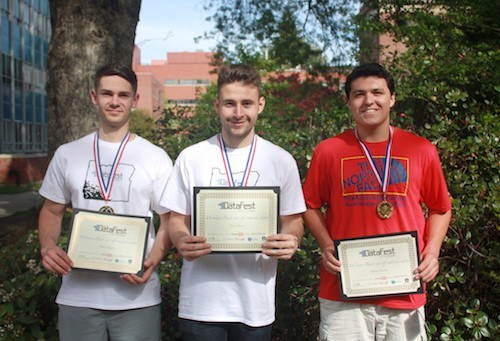
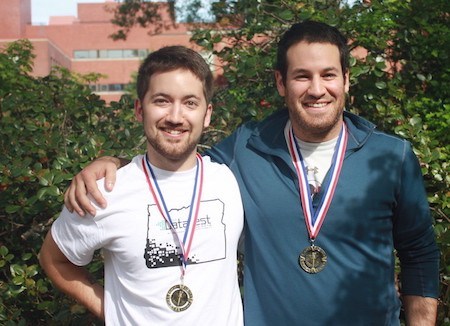
Did we mention the prizes? Prizes, fame and glory (and cool T-shirts) went to the following students who were awarded Best Insight, Best Use of External Data, and Best Visualization. Winners received medals, a book bundle, and a one-year membership to the American Statistical Association.

Best Visualization

Minions of StatisticsXiaoxi GuOregon State UniversityStatistics
Minions of StatisticsMei MengOregon State UniversityStatistics
Minions of StatisticsArpita MukherjeeOregon State UniversityStatistics
Minions of StatisticsMai NguyenOregon State UniversityStatistics
Minions of StatisticsYiran (Rain) WangOregon State UniversityStatistics

Best use of external data

Very Big TeamBret LorimoreOregon State UniversityComputer Science
Very Big TeamChris VlessisOregon State UniversityComputer Science
Very Big TeamGeorge HarderOregon State UniversityComputer Science

Best insight

Pretty TerrestrialAndrew BreretonOregon State UniversityBiochemistry and Biophysics
Pretty TerrestrialMichelle WileyOregon State UniversityBiochemistry and Biophysics
Pretty TerrestrialSteven FriedmanOregon State UniversityBiochemistry and Biophysics
Pretty TerrestrialCamden LopezOregon State UniversityStatistics

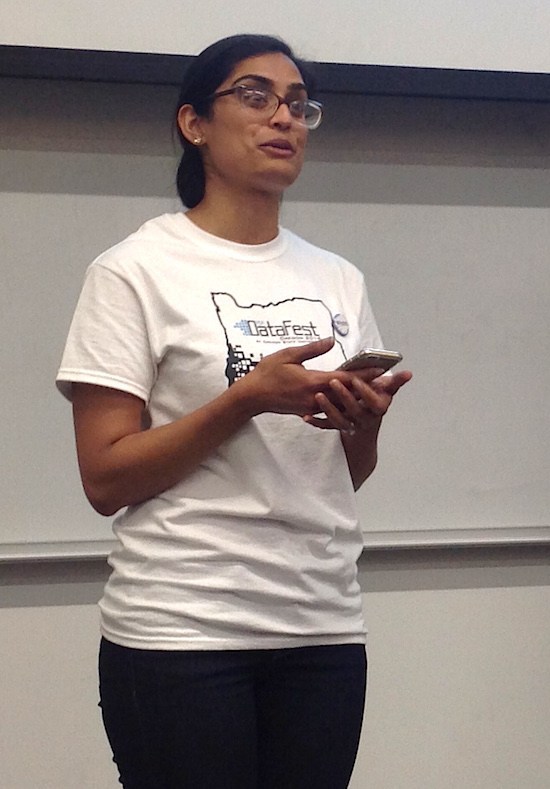
Charlotte Wickham, Assistant Professor in the Department of Statistics at OSU, was instrumental in bringing ASA DataFest to campus for the first time, championing the student competitions, and leading planning and organizing efforts.

DataFest Oregon was sponsored by the College of Science, Department of Statistics, the American Statistical Association, Google and DataCamp and Oregon State University.

Read more about ASA DataFests.

Photos from DataFest Oregon 2016:

3D model of red blood cells

Biohealth science's connection to quantitative sciences

By Srila Nayak

BioHealth

Redefining quantitative and biohealth sciences

Faculty and researchers in the College of Science are interpreting and advancing biohealth sciences in innovative new ways by applying the natural sciences, such as mathematics, statistics and chemistry. In recent times, researches in biology and medicine have been guided by biomolecular analysis technologies, mathematics and computations, and scientists are using these tools to address a spectrum of biological questions about diseases, from how they spread to risk factors.

In the last few years, our College has experienced an impressive spurt of transdisciplinary research in the quantitative and biohealth sciences. Ongoing studies and research advances range from analyzing genetic data on epidemics and inventing disease-detecting biosensors to developing statistical methods to better understand neuron connectivity and the transmission of signals in the brain. Through collaborative research across our campus, our faculty are paving the way for innovative biohealth science research which broadens the training of students across scientific disciplines.

Biological systems and mathematical models

Connections between biology and the mathematical sciences are fueling innovation and expansion in those disciplines. Statistician Sharmodeep Bhattacharyya explains how interpreting data from various experimental sources can generate new insights and solutions in the areas of neuroscience and genomics.

“Statistical methods, with their inherent objective of analyzing the uncertainty of a system help identify key interesting factors in the deluge of interesting data," said Bhattacharyya. "Such jobs can range from identifying a key set of genes affecting a disease for a specific group of people (like in precision medicine) or identifying the interaction between key regions of the brain for people who have a set of genes that causes a neurological disease."

Bhattacharyya has developed new statistical methods to analyze Electro-Cortico Graph (ECoG) array data from human and rat brains to identify connections involving speech and hearing.

Mathematician Vrushali Bokil’s research demonstrates how mathematical modeling, analysis and numerical simulations can illuminate insights in complex biological systems and how the health sciences, in turn, can spark new mathematical ideas. She collaborates with a mix of biologists and mathematicians across the country as well as in the UK, France and Germany on a project funded by NIMBioS (the National Institute of Mathematical and Biological Synthesis).

The project will allow Bokil and her colleagues to generate novel mathematical and statistical methods involving multiple hosts and multiple pathogens and that operate across a range of spatiotemporal scales, and to analyze the effects of climate change and human activities on the emergence of new plant viruses. Bokil points to the increasing use of mathematics to model complicated biological systems.

“It is exciting to be at the interface of biology and math,” said Bokil. “I write down a system of equations that models the physical or biological system. While the mathematical modeling and numerical simulations are fascinating in and of themselves, the added value of feeding back into biological applications is very rewarding.”

Benjamin Dalziel, an assistant professor in Integrative Biology, is part of a growing breed of biologists who are turning the biological sciences into a more quantitative field. Dalziel is a population biologist who uses mathematical tools to answer questions about the spread of infectious diseases, such as influenza and measles in populations and cities.

Dalziel, who also has an appointment in the mathematics department, maps hotspots of pathogen activity and diversification, and develops mathematical models to explain the patterns he finds. A current project explores whether there are systematic differences among cities with respect to their epidemic risk.

“I find the connections between mathematical modeling and biology very interesting. After developing a model, we ask, 'Is this happening in nature and how do we test it?' And if nature is doing something different, 'What did we get wrong with the model?' Sometimes there is a lot you have to do with the model besides [reviewing the] data to understand its behavior and to get it to interface with the real world," said Dalziel, who is developing a new mathematics course specifically for the life sciences.

Innovative disease imaging

A major application of analytical chemistry and its quantitative aspects to biology involves the creation of tools that directly aid in the diagnosis of cancer, heart disease, strokes and other serious ailments.

Chemistry assistant professor Sean M. Burrows runs a busy lab comprising undergraduates and doctoral students and their research is focused on innovating technologies to visualize biomarkers of disease. They pioneer novel, colorful fluorescent biosensor designs—analytical devices that relate biological molecules to a fluorescent signal—for visualizing and quantifying microRNAs, which are small non-coding RNA molecules that have a role in a plethora of gene regulatory events.

MicroRNAs hold great potential to yield information about the beginning stages of a disease and cell/tissue activity. Burrows and his team are trying to develop highly efficient fluorescent technologies for basic research and clinical use.

“Basically the idea is to design an imaging technology that will give us more information on the molecular interactions within the cell,” explains Borrows. “[For example], can we create an instrument that greatly advances the information content in terms of the numbers of colors we can look at in a cell? With the current technology, you could see one or two colors from the cell. But if we can look at 10 or more different colors, that will tell us much more about a biological mechanism," adds Burrows.

In an exciting breakthrough, the Burrows group designed a more efficient fluorescent biosensor for better signal interpretation from microRNA biosensors. The innovation has attracted significant attention in the field and was favorably reviewed in an article on the field of emerging microRNA biosensors in Analytical Chemistry.

However, existing imaging technology to learn about the underlying details of cellular mechanisms, such as the super resolution microscopy, is expensive. Burrows is keen to develop a cheaper alternative that can be used in a regular microscope.

“We can then open the door for more researchers to get more information from the cells they are interested in studying. This, in turn, will enable more transformative breakthroughs to understand disease progression and ultimately find cures.”
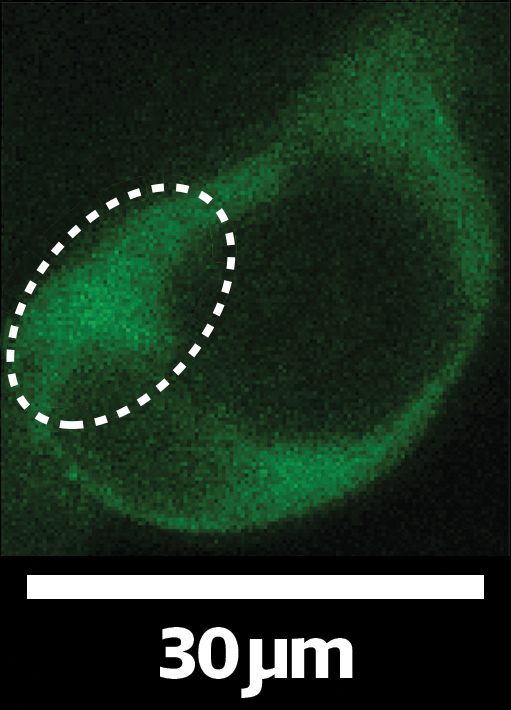
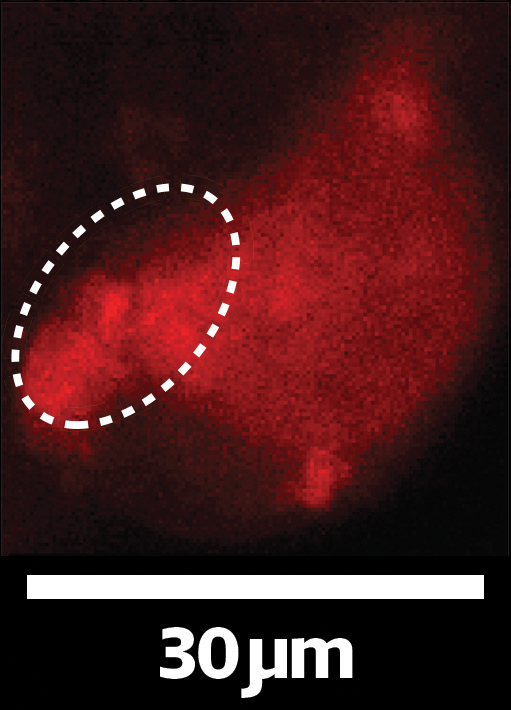
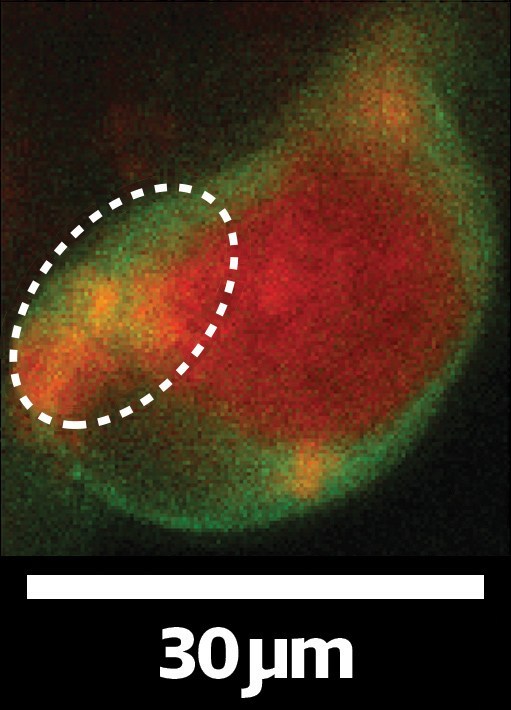
This figure shows that the biosensors can enter a cell’s cytoplasm and nucleus to find where microRNA expression occurs within the cell. Green shows the cytoplasm and the dark green spot is the nucleus. Red indicates the biosensor. The circle and the red nucleus indicate where the biosensor has entered the cytoplasm and nucleus, respectively.

Students chatting and studying around table in Austin Hall

Math Club hosts Pi Day Social

OSU Math Club hosts annual Pi Day Social

Join the OSU Math Club's annual Pi Day celebration "pie" or "pi" your favorite science professor! Willing volunteers--professors, instructors, grad students, administrators, and others--may agree to be pied in the face to raise money for the Edible Corvallis Initiative.

Everyone is invited to the event, which will be held in the Math Learning Center Friday, March 11 at 6 pm. It's a great time to take a break before final exams and wind down after Winter term. FREE pie and refreshments + math-related games + socializing and mingling = fun.

The OSU Math Club has been fundraising for the past month and will donate all proceeds to the Edible Corvallis Initiative, which seeks to make local, fresh and healthy food available to everyone.


Read more stories about: events, students, mathematics


Subscribe to Mathematics